
 Chinese
 Russian
 Arabic
If you are still watching Southeast Asian roll prices, you may be missing out on the biggest used car export dividend this year.
Africa I Nigeria.
A set of numbers will give you the key points first:
Nigeria imports about 700,000 cars every year, and used cars account for more than 95%
Starting from July 1, 2026, import tariffs on passenger cars will be reduced from 70% to 40%
In 2025, China will export 222,000 vehicles to Africa, a year-on-year increase of 67%
China's used car market share in Africa has increased from 1.2% in 2020 to 3.8% in 2024-but the ceiling is still far away
Today, we don't paint cakes, but only use real data and dry policy information to explain the Nigeria market thoroughly.
1. Why Nigeria?
Three words: big, lacking, and change.
Greater-Nigeria is Africa's most populous country (about 220 million) and Africa's largest economy. In 2025, its GDP will be about 285 billion US dollars, with a growth rate of 4.2%. In Africa, it is the country that cannot avoid any business.
Lack-The national car ownership in Nigeria is only about 5 million, and the per capita car ownership is less than 10 cars per 100 people (compared with about 23 cars per 100 people in China). Moreover, the vast majority of these 5 million vehicles are old used cars imported from the United States, Europe, and Japan. They are old and in poor condition, and there is huge demand for replacement.
Change-this is the most critical point.
2. Policy changes in 2026: tariffs will be cut by nearly half
On April 13, 2026, the Presidential Palace of Nigeria officially announced a reduction in import tariffs,which will take effect on July 1. Core changes:
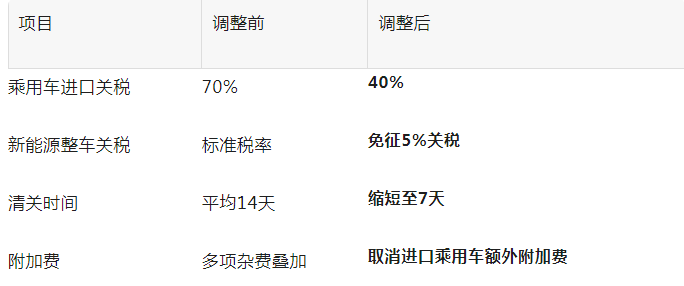
What is this concept? For a family car with a CIF price of 100,000 yuan in China, the tariff alone has been reduced from 70,000 to 40,000, and the CIF cost has been directly reduced by nearly 30%. Consumer groups that were originally blocked out by high tariffs were suddenly activated.
At the same time, the New Deal has given a clear tilt signal to new energy vehicles-pure electric vehicles will be further exempted from value-added tax. Although Nigeria's charging infrastructure is currently weak, the policy direction is very clear: whoever lays the channel first will take the lead.
3. But in parallel with the opportunity: none of the four major export regulations in 2026 cannot be stepped on
Policy liberalization does not mean that you can make money with your eyes closed. In 2026, Nigeria will simultaneously tighten the compliance standards for imported vehicles, with four rigid requirements:
1. Vehicle age limit: ≤12 years for passenger cars, ≤10 years for commercial vehicles
In 2025, passenger cars will also be allowed to have a car age of 15 years, and in 2026, it will be cut to 12 years. Commercial vehicles are strictly limited to 10 years. Entry is directly prohibited beyond the number of years, and there is no accommodation.
2. Emission standards: Euro 4 starts, and the country 3 is completely eliminated
All imported vehicles must meet Euro 4 and above emission standards. The good news is that domestic national IV and national V vehicles have basically met the standards. The bad news is that the main force exporting to Africa before--low-cost vehicles from national III and below--have all been eliminated. The road to low-cost and low-quality cars is a dead end.
3. New vehicle recovery fund
On the basis of tariffs and value-added taxes, a new vehicle recycling fund (borne by the exporter) has increased slightly, and the comprehensive export cost of each vehicle has increased slightly. Players with small profits and quick turnover need to re-account.
4. Compulsory pre-export certification (SONCAP + VTA)
This is the biggest change: all vehicles exported to Nigeria must complete the testing and certification of the designated agency before being shipped and obtain a compliance certificate before being shipped. Those who fail to pass the goods will be returned directly, and all the freight and testing fees will be wasted.
Summarize the rules of the game in 2026 in one sentence: the threshold has increased, but the market for surviving players is also larger.
4. What car is the best to sell in Nigeria?
According to actual market transaction data and dealer feedback, there are several types of hard currencies in the used car market in Nigeria:
Toyota Corolla
: The king of cars, ranking first in market share, mature maintenance network, and cheap parts. 5-8 The year-old boutique Corolla has never had to worry about selling it in Nigeria.
Toyota Sea Lion/Coster
: The main force of passenger transport, Nigeria relies heavily on this type of medium-sized buses for intercity public transportation.
Pickup trucks (Toyota Hilux, Ford Ranger, etc.)
: The road conditions are extremely adaptable, and there are just needs for government and enterprise procurement and agricultural transportation.
Compact cars (Honda Fit, Nissan Sunshine, etc.)
: 1.3-1.8L small displacement, fuel-efficient and durable, with a price of US$3,200 - 6,400, accurately matching local consumption power.
China brand SUVs (Haval, BYD, etc.)
: The cost-effective advantage is obvious. As the popularity of China brands in Africa increases, their share is climbing rapidly.
The core logic of selection: left rudder, Euro 4 or above, 5-8 years old, good condition, and guaranteed supply of parts.
5. The African story of China's second-hand cars going to sea has just begun
Pull a global perspective to look at the data:
In 2025, China exported 8.32 million vehicles, a year-on-year increase of 30%; from January to May 2026, it exported 4.24 million vehicles, a year-on-year growth rate further climbing to 49%
From January to May 2025, China exported 222,000 vehicles to Africa, a year-on-year increase of 67%-the increase far exceeded the overall export growth rate
It is expected that China's second-hand car exports will exceed 450,000 units in 2026, a year-on-year increase of 35%
At present, the annual transaction volume of used cars in Africa exceeds US$18 billion, with an average annual growth rate of 8%-10%
China's used car market share in Africa is only 3.8%
(2024 data), while Japanese and European brands account for more than 60%
The gap is space. With a market share of 3.8%, facing a market with an average annual growth rate of 10%, this increase is enough to last for many years.
6. Back to reality: To be Nigeria, these three risks must be calculated clearly
Without avoiding the problem, the long-standing difficulties in the Nigeria market still exist:
Foreign exchange risk: TheNaira exchange rate fluctuates sharply, and local importers 'payment ability and credit are uneven. It is recommended to give priority to cooperating with buyers with stable US dollar/RMB settlement capabilities, or to hedge risks through channels such as CITIC Insurance.
Logistics and customs clearance:Although the customs clearance time at the policy level has been reduced from 14 days to 7 days, the actual implementation efficiency of major ports such as Lagos still lags behind, and corruption problems have not been eradicated. You need to find a reliable local customs clearance agent and don't overturn the car in the last mile.
After-sales and accessories:Nigeria consumers are very sensitive to the fact that they can afford to buy or repair them. The core reason why Toyota dominates the market is that parts are cheap and can be repaired everywhere. Going abroad is not just about selling cars, but the follow-up parts supply and service network is about long-term competitiveness.
written in the end
On July 1, 2026, Nigeria's new tariff policy was officially implemented.
For China used car exporters, this is a window period with multiple factors superimposed: a sharp drop in tariffs, the spillover of China's automobile production capacity from overseas, the release of demand for African consumption upgrades, and the reshuffle of policy compliance thresholds to eliminate low-priced competitors.
The window will not stay open. When global players such as Toyota and Volkswagen accelerate their deployment and when more domestic counterparts flock in, the first-mover advantage will quickly narrow.
Source: Digital automobile export-Huohuo
[Disclaimer] The content of this website (including pictures and texts) originates from the Internet, and the copyright belongs to the original author. Respect the rights and interests of originality, and select content is only used for information sharing. If copyright disputes are involved, please contact us to handle them in a timely manner

 Online Evaluation
 I am Buyer
 Export Services
 subsites


 023-62852688
  No. 1-1, No. 2899, Longzhou Avenue, Banan District, Chongqing City
 Headquarters


