
 Chinese
 Russian
 Arabic
In the newly announced fiscal year 2026 budget of Trinidad and Tobago, the government will relax the allowed age of imported used cars and withdraw duty-free treatment for "high-priced luxury electric vehicles."
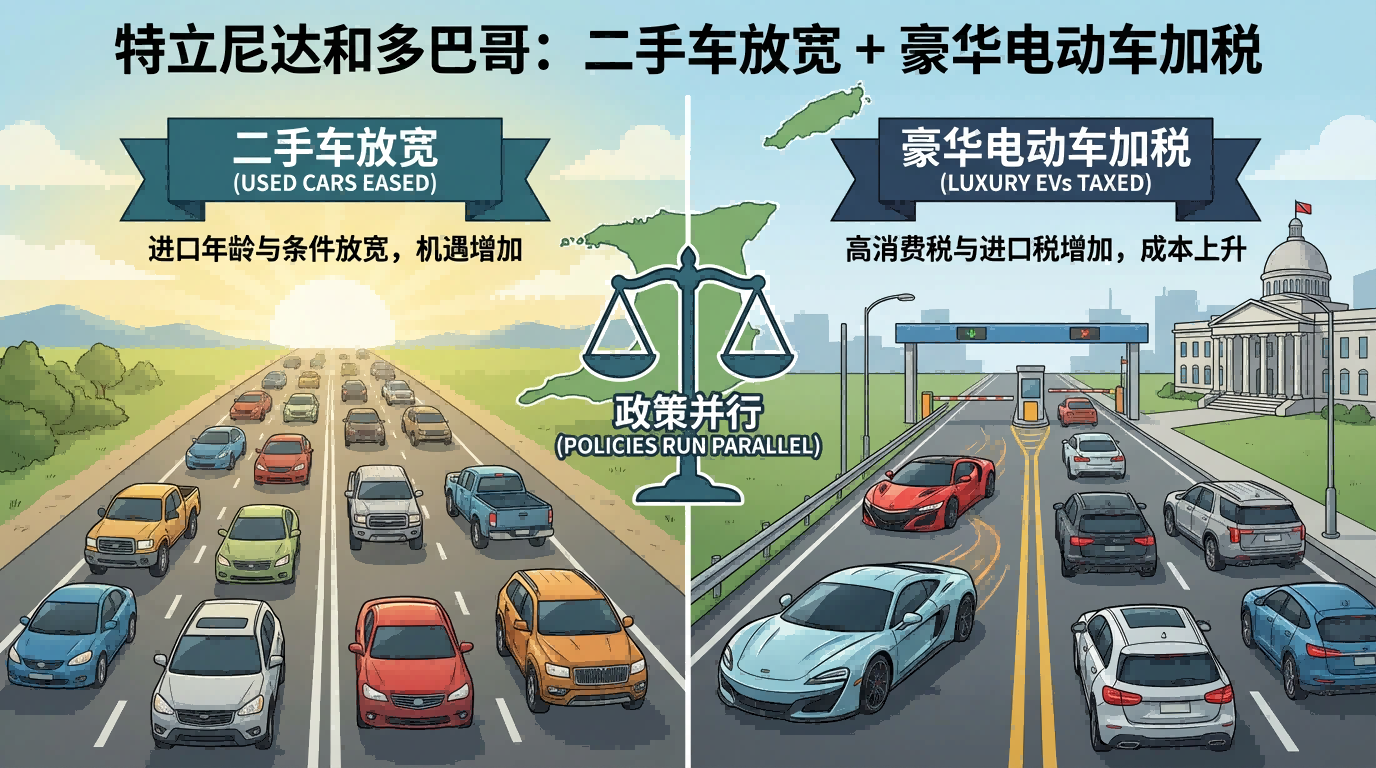
In the newly announced 2026 fiscal year budget of Trinidad and Tobago, there are two main lines for simultaneous advancement of policies related to automobile import and export: on the one hand, in order to "make car ownership more affordable," the government will relax the allowed age for imported second-hand vehicles; on the other hand, in order to cope with foreign exchange pressure and tax losses, the government will withdraw the duty-free treatment for "high-priced luxury electric vehicles" and simultaneously increase a number of customs and port administrative fees. A number of measures are scheduled to take effect on January 1, 2026.
The budget proposes to revise the "Foreign Used Car Import Policy": the allowable age of imported vehicles for private cars (including SUVs, sedans, and station wagons) will be relaxed from "within 3 years of delivery" to "within 6 years of delivery"; the allowable age of light commercial vehicles (pickup trucks, vans) will be relaxed from "within 7 years of delivery" to "within 10 years of delivery". The budget positions it as a direct tool to lower barriers to car purchases and improve affordability. For exporters whose main supply is used cars and quasi-new cars, this is equivalent to significantly expanding the pool of operable vehicles, especially benefiting the more mature pickup trucks and light commercial vehicle categories.
At the same time, electric vehicle incentive policies began to be "stratified". The budget points out that preferential policies for electric vehicles have led to the entry of some high-end models "without paying tariffs, motor vehicle taxes, and value-added tax", putting pressure on foreign exchange reserves. In order to "retain incentives for medium and low-cost electric vehicles while curbing abuse," thegovernment will impose a 10% tariff and a 12.5% value-added tax on electric vehicles with a CIF price higher than 400,000 (the local currency is based on the budget statement), and implement a graded motor vehicle tax based on motor size; it is expected to bring in approximately 40 million yuan in new fiscal revenue, which will be implemented from January 1, 2026. The budget also announced that it will cancel the tariff, value-added tax and motor vehicle tax exemptions previously enjoyed under the "Returning Nationals" project to plug the space for tax losses and tax evasion, which will also take effect from January 1, 2026.
In terms of customs clearance costs, the budget clearly increases a number of fees that are highly related to vehicle trade: container handling fees will be increased from 525 to 1,050, customs declaration transaction fees will be increased from 40 to 80, environmentally friendly tire tax will be increased from 20 to 40, and relevant illegal penalties will be increased. The government also emphasized that it will promote the digitalization and modernization of customs and tax management systems, and expand the staffing of audit, taxation and informatization positions to improve compliance and information recovery capabilities. For enterprises, this means that "customs clearance is more digital and supervision is more detailed", and the cost of single ticket and compliance need to be re-calculated in the price model.
In terms of public transportation and electrification, the budget mentions that the state-owned public transportation system will introduce 30 electric buses by mid-2026 and expand routes through PPP. This expression sends a signal of "electric procurement in the public sector." Although the quantity is not large, it has direction significance for vehicle manufacturers and solution providers wishing to enter the Caribbean bus/urban distribution market.
brief comment
The core impact of this budget on car exporters is "wider second-hand imports + narrower duty-free exemptions for luxury electric vehicles." If you are making used cars/pickup trucks/light commercial vehicles at mainstream prices, there will be more room from 2026; but if you bet on ultra-high-priced electric vehicles, you will need to recalculate the CIF price and demand elasticity after tax reimbursement. A more realistic approach is to concentrate the product line in the compliance window of "private cars within 6 years and pickup trucks/vans within 10 years", and at the same time include the increase in tire tax, document fees, and port processing fees into the DDP quotation to avoid passive losses after landing.
Source:https://republicictt.com/publications/national-budget
Source: Guangdong Good Car
[Disclaimer] The content of this website (including pictures and texts) originates from the Internet, and the copyright belongs to the original author. Respect the rights and interests of originality, and select content is only used for information sharing. If copyright disputes are involved, please contact us to handle the deletion in a timely manner.

 Online Evaluation
 I am Buyer
 Export Services
 subsites


 023-62852688
  No. 1-1, No. 2899, Longzhou Avenue, Banan District, Chongqing City
 Headquarters


