
 Chinese
 Russian
 Arabic
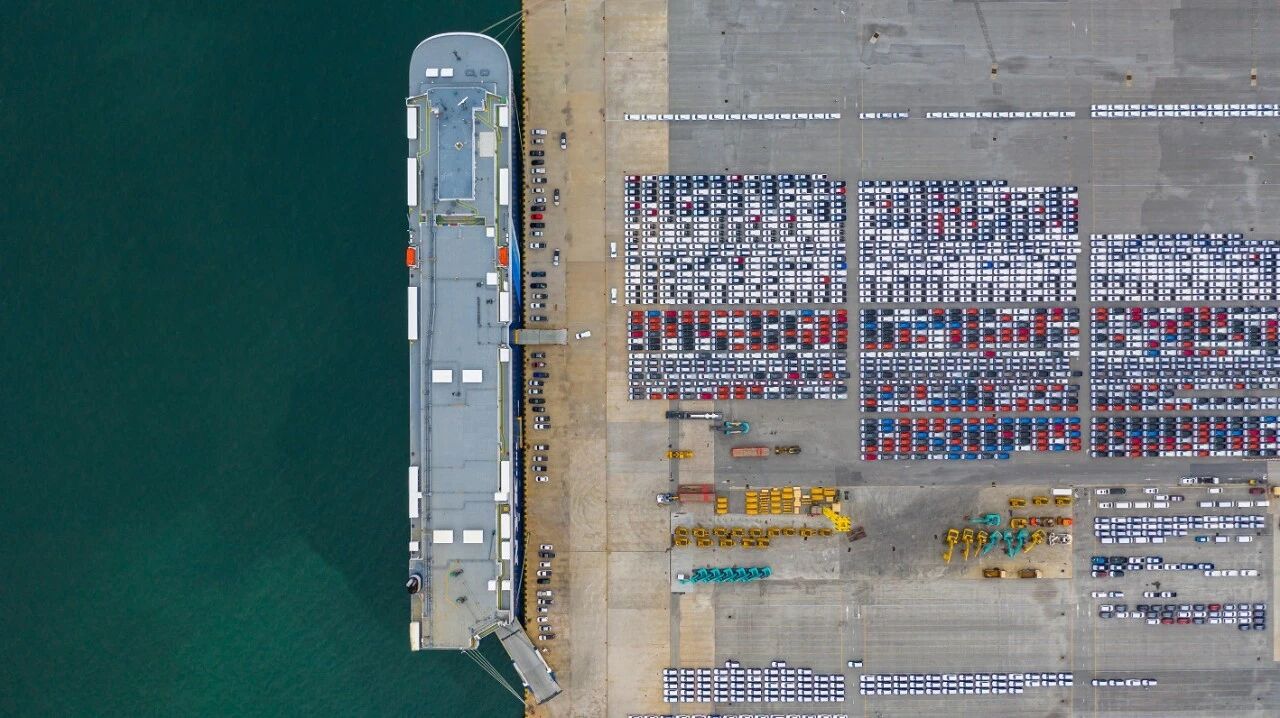
Recently, China Association of Automobile Manufacturers released automobile export data for 2025: annual automobile exports exceeded 7 million units, reaching 7.098 million units, a year-on-year increase of 21.1%, ranking the global automobile export champion.
This milestone breakthrough is not only a witness to the growth of the scale of China's automobile industry, but also marks the transition of China's automobiles from product "going out to sea" to ecological "going out to sea." After an in-depth analysis of the multiple meanings behind this breakthrough, it is not difficult to find that China's automobile industry is using exports as its fulcrum to restructure the global competitive landscape and embark on a new cycle of high-quality development.
First, the breaking of scale growth is of great significance. Previously, Japan set a single-country annual automobile export record that has been dusty in the history of the global automobile industry for more than 10 years, while China broke the historical record with absolute advantage and has been the world's largest automobile exporter for three consecutive years. Behind this data is the systematic improvement in the competitiveness of the entire chain of China's automobile industry. From the perspective of the industrial chain, China has built a complete new energy vehicle industry chain covering chip, battery, and vehicle manufacturing, and leads the world in cost control and capacity guarantee capabilities; from the perspective of product supply, it covers economic, mid-to-high-end, and luxury-level full-spectrum models, meeting the market needs of different countries and regions. The deep value of scale breakthroughs lies in the formation of a positive cycle from scale effects to cost optimization to technology iteration, laying the foundation for the sustainable competitiveness of China automobiles in the global market.
Second, the proportion of exports has increased significantly, reshaping the growth logic of industry development. In 2025, Chery Automobile will lead the industry with an export volume of 1.344 million vehicles and an export proportion of 47.9%. Chery will export one for every two vehicles sold overseas; Great Wall Motor exported 506,000 vehicles last year, becoming the core engine of sales growth; BYD and SAIC Motor, which are leading sales, both have overseas sales exceeding one million vehicles, of which BYD exported 1.049 million vehicles and SAIC Motor exported 1.071 million vehicles, a significant increase in their proportion. This change has changed the single pattern of China car companies relying too much on the domestic market and effectively hedged the pressure of intensified competition in the domestic market.
When the domestic auto market enters the stock game stage, the high growth of overseas markets provides car companies with a stable source of revenue, and also allows companies to have sufficient funds to invest in technology research and development, forming a benign development model of domestic research and development, overseas verification, and global promotion.
Third, the steady growth of export quality and the deepening of localization layout mark a qualitative leap in the "sea" of China's automobiles from quantity accumulation to quality. Different from the export model that could only rely on "low prices and volume" in the early years, China's automobile exports are now using new energy vehicles as carriers to achieve a comprehensive ecological "going out to sea" of technology, brand and industrial chain. Data shows that in 2025, China's exports of new energy vehicles will be 2.615 million, a year-on-year increase of doubling, becoming the core driving force for export growth.
In terms of localization layout, BYD's Cambodia factory was laid, and the Hungarian factory is about to be put into operation; SAIC GM Wuling Indonesia factory has realized the off-line of the 3 millionth new energy vehicle in the world, forming a localized production network covering ASEAN, Europe and South America.
Industrial chain coordination "going out to sea" has also become a new trend. The Indonesian power battery ecosystem project participated in by Ningde Times has achieved the localization of the entire chain from nickel ore development to battery manufacturing, driving the upgrading of local industries. At the level of technology output, China's smart driving technology has taken root overseas. Smart driving companies such as Radish Quick Run and Xiaoma Zhixing have deployed Robotaxi fleets in multiple overseas markets, bringing China's smart travel solutions to the world. The full-value chain offshore model in which the entire vehicle collaborates with parts, technology and services not only enhances the brand premium of China cars, but also enhances the ability to take root in overseas markets.
Judging from future development expectations, there is still huge room for growth in the global market. The 2026 automobile industry strategy report released by several securities firms shows that China's automobile market will enter a period of slow growth of "stabilizing total volume and optimizing structure." In sharp contrast, overseas market demand will surge in 2026. Relevant institutions predict that external demand sales of new energy vehicles this year are expected to reach 3.52 million units, a year-on-year increase of 43.9%.
From the perspective of market layout, the share of China's automobiles in markets such as Europe, Southeast Asia, and the Middle East continues to increase. With the deepening of industrial chain cooperation under the framework of the Regional Comprehensive Economic Partnership Agreement and the continuous production of overseas factories of China automobile companies, China's automobile exports are expected to achieve a continuous breakthrough from million-vehicle growth to high-quality growth.
It is no accident that China's automobile exports have reached a new milestone, but it is an inevitable result of industrial transformation and upgrading and global layout. This breakthrough not only demonstrates the hard power of China's intelligent manufacturing, but also reshapes the competitive landscape of the global automobile industry. Of course, we must also see that competition in the global automobile market has never stopped, and challenges such as trade barriers, differences in technical standards, and localization adaptation still need to be addressed.
In the future, China's automobile industry needs to continue to focus on technological innovation, deepen localized operations, and improve the layout of the global industrial chain, so that exports will not only become an engine of scale growth, but also a carrier of brand upgrading.
Source: China Automobile News
[Disclaimer] The content of this website (including pictures and texts) originates from the Internet, and the copyright belongs to the original author. Respect the rights and interests of originality, and select content is only used for information sharing. If copyright disputes are involved, please contact us to handle the deletion in a timely manner.

 Online Evaluation
 I am Buyer
 Export Services
 subsites


 023-62852688
  No. 1-1, No. 2899, Longzhou Avenue, Banan District, Chongqing City
 Headquarters


