
 Chinese
 Russian
 Arabic
The escalating situation in the Middle East and the disruption of the operation of key shipping nodes are forcing Central Asia to restructure its import chain...
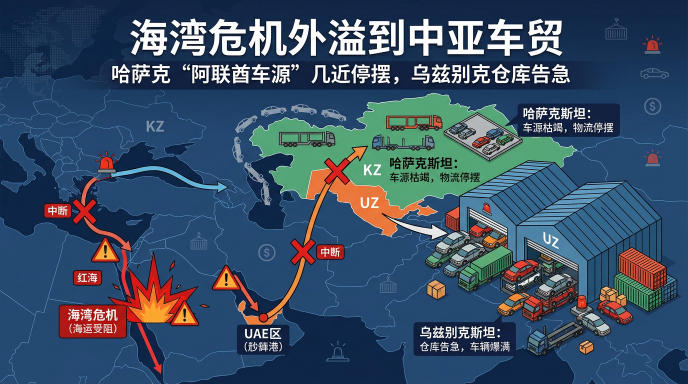
[Almaty/Tashkent Comprehensive] According to the latest research by INFOLine and IBC Global and other institutions, the escalation of the situation in the Middle East and the disruption of the operation of key shipping nodes are forcing Central Asia to restructure its import chain. The analysis pointed out that due to the limited operation of hubs such as Bandar Abbas Port in Iran and Jebel Ali Port in the United Arab Emirates, cargo flows in Central Asia are facing chain reactions such as rising freight rates and declining transshipment efficiency. Importers are forced to shift from "Just-in-time" to building deeper buffer inventories, which also directly drives up the demand for warehousing facilities.
The agency believes that the most prominent systemic impact is Uzbekistan. Stanislav Ahmedjanov, managing partner at IBC Global, said that about 18.9% of freight between Central Asia and Iran falls on Uzbekistan. For Tashkent, the "South Corridor" leading to Iranian ports is one of the nine priority international transportation corridors. Once partial blockage or instability occurs, the import end will be immediately under pressure. In contrast, Turkmenistan faces the risk of "changing channel attributes": the country borders Iran, experts say it is highly dependent on Iran's direction for food and daily necessities supplies, and the western region of Balkan velayat is considered to be particularly vulnerable. More importantly, as its transshipment function through Iran was damaged, IBC Global judged that Turkmenistan may have changed from a "transit corridor" to a logistics "dead end." Some cargo flows to Kazakhstan and Uzbekistan had to be diverted or stopped.
Although Kazakhstan is not directly involved in the conflict, it has suffered perceptible economic losses. IBC Global's analysis stated that Kazakh importers 'business of introducing vehicles from the United Arab Emirates had "almost stopped": ferry routes were interrupted, and vehicles were stranded in large numbers at Port Rashid and Al Hamriya in the United Arab Emirates, unable to complete transshipment through Bandar Abbas as originally planned. At the same time, land transfers to Aktau and Almaty via Turkmenistan have also been suspended; while Jebel Ali Port, the region's largest re-export center, is still in a "restricted operation" state.
In this context, INFOLine judges that Central Asian companies are adjusting their logistics strategies as a whole: when supply is frequently interrupted and sea freight rates soar, it is difficult for companies to continue to rely on the low-inventory turnover model and can only turn to hoarding "deeper" buffer stocks. The direct result is that regional demand for modern warehousing, especially A-level warehouses, will accelerate, rents may rise, and the construction of logistics parks and warehousing complexes may usher in a wave of investment.
Storage supply side data also proves that "capacity is not loose." Statistics from consulting firm NF Group show that as of the first quarter of 2025, the combined high-quality storage area of Kazakhstan, Uzbekistan, Kyrgyzstan and Tajikistan is approximately 2.3 million square meters, of which Kazakhstan is approximately 1.75 million square meters and Uzbekistan is approximately 503,000 square meters. The rest of the countries are even smaller.
[Brief Comment] What needs to be re-evaluated most in this round of shocks is the availability and cost fluctuations of the "Middle East-Central Asia" chain. Kazakhstan's import of cars from the United Arab Emirates is blocked, which will gradually reduce the supply of used cars in the local area and push up the prices of some models. However, it also means that the delivery cycle will be lengthened and the cost of warehousing and capital occupation will increase, forcing Central Asia to restructure the import chain.
Source: Guangdong Good Car
[Disclaimer] The content of this website (including pictures and texts) originates from the Internet, and the copyright belongs to the original author. Respect the rights and interests of originality, and select content is only used for information sharing. If copyright disputes are involved, please contact us to handle the deletion in a timely manner.

 Online Evaluation
 I am Buyer
 Export Services
 subsites


 023-62852688
  No. 1-1, No. 2899, Longzhou Avenue, Banan District, Chongqing City
 Headquarters


