
 Chinese
 Russian
 Arabic
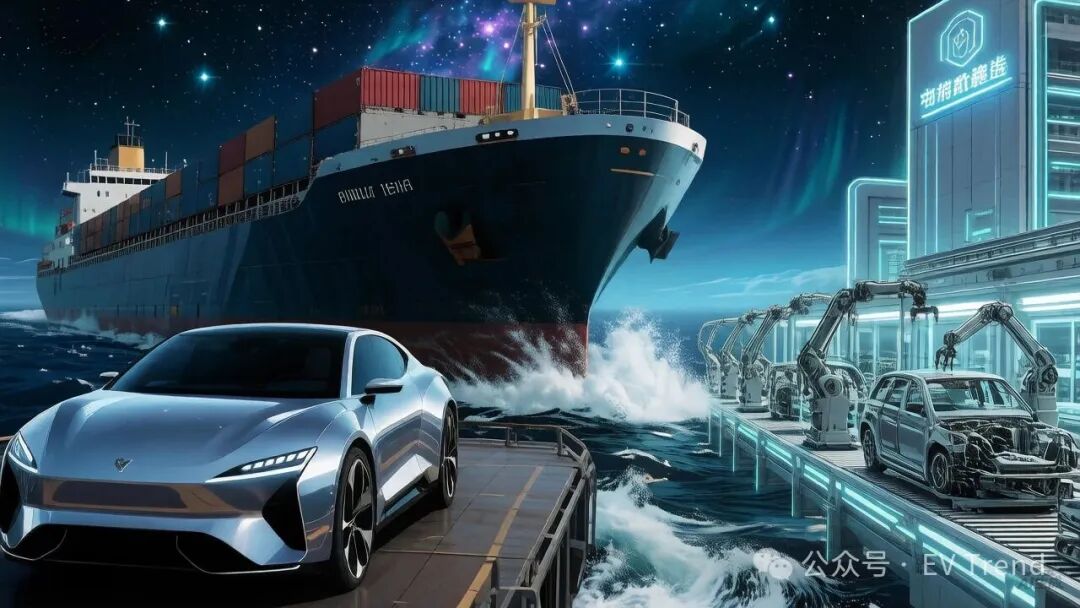
In the era of globalization, the shipping of manufacturing industries is generally guided by trade exports. After confirming market opportunities, local manufacturing and industrial chains are promoted to go abroad.
This is a comprehensive decision made by weighing policy, cost, efficiency, and competition: global layout can achieve cross-regional cost arbitrage, improve decision-making efficiency, circumvent trade barriers, and enhance local competitiveness.
Most joint venture car companies entering China also follow this route.
Even if there is a current trend of transition from globalization to regional integration, localized layout is still the best way to reduce local resistance and penetrate into overseas markets.
At present, China's leading car companies have basically reached the stage where the industrial chain goes out to sea and localized production.
1. While automobile exports hit new highs, 3 million overseas production capacity has been deployed
In December 2025, China exported 990,000 vehicles, a year-on-year increase of 73.2%; in 2025, a total of 8.32 million vehicles were exported, a year-on-year increase of 30.0%. See the following figure.
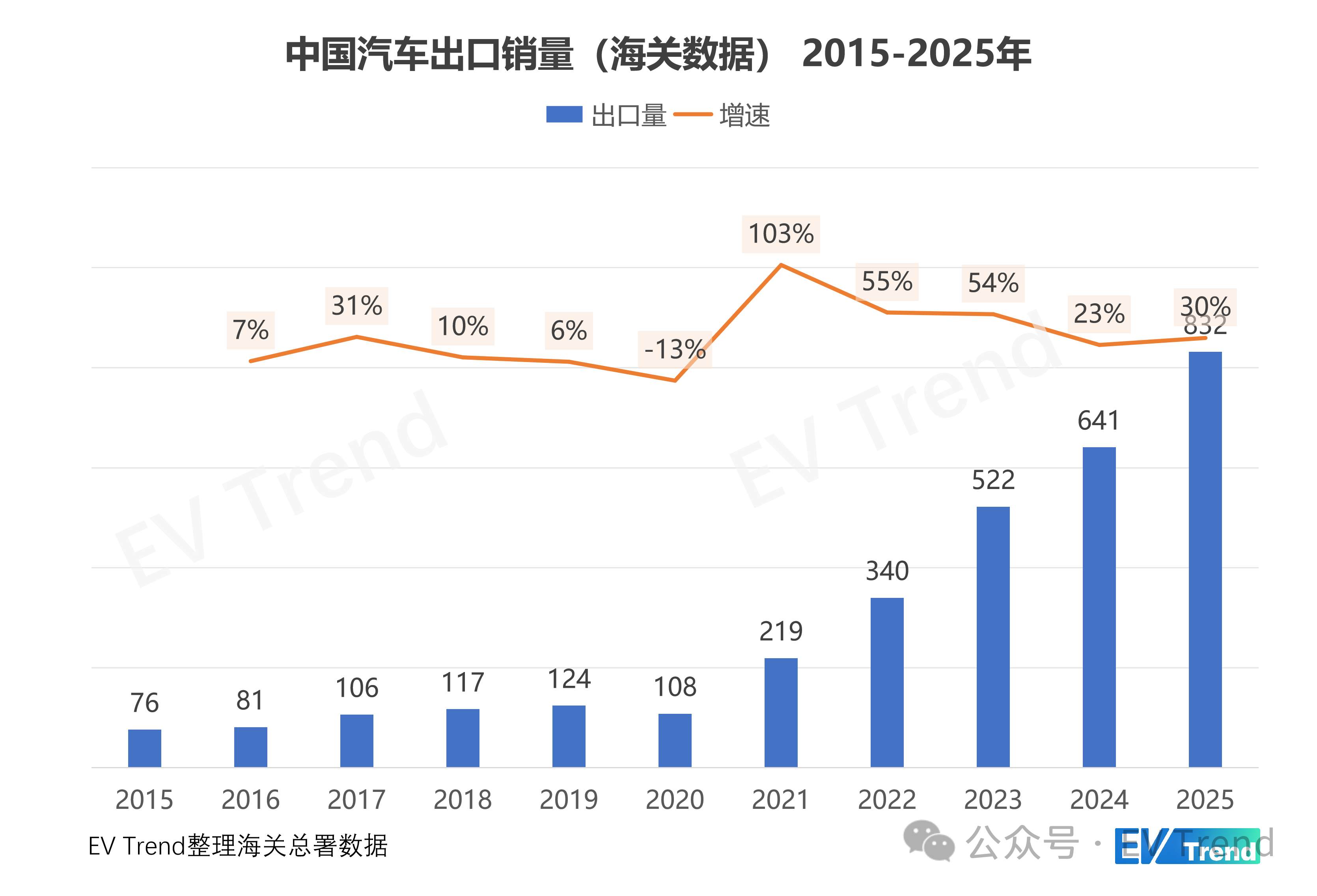
Vertical comparison, the scale of China's automobile exports has grown rapidly for 10 consecutive years. In the past five years, each year has hit a new high based on the high base of the previous year.
Horizontal comparison, China's automobile exports will surpass Japan in 2023, ranking first in the world for three consecutive years.
For the foreseeable period of time, the advantages of China automobiles will continue to be maintained. We have established the leadership of the new energy industry chain. Technology, cost and efficiency advantages cannot be surpassed in the short term.
From the perspective of the government stabilizing employment, industries, and GDP, and from the perspective of enterprises reducing risks and reducing investment, the best way to go to sea is to manufacture and re-export all cars in China.
But many things cannot be changed by personal will.
On the one hand, shipping capacity is limited and the speed is slow. A ro-ro ship can only transport a few thousand units at a time, and the cycle is in months. Shipping capacity/efficiency restricts the overseas development of China's automobiles.
On the other hand, no country with a bit of confidence can allow China cars to import in large quantities and impact the local market.
After a comprehensive assessment, China's automobiles have also embarked on the path of overseas manufacturing and industrial chains going overseas. Huang Yonghe, former senior chief expert of China Automobile Center, stated in his 25-year public speech:
"According to statistics from the International Development and Innovation Alliance of China Automobile Enterprises, as of the end of last year, 16 self-owned brand companies, including Great Wall, Geely, SAIC, Chery, Chang 'an and BYD, had established 87 factories overseas, with a production capacity of nearly 3 million vehicles, focusing on Europe, Southeast Asia, Central and South America."
Overseas factories can be roughly divided into two types based on the depth of localization:
1) KD factory (Knocked down): Only assembly plants are established in the export destination country. Parts and components produced in China are shipped locally and assembled into complete vehicles, with less investment. According to the scattered situation of parts and the depth of localization, it can be subdivided into SKD and CKD.
CKD is an assembly of all parts. In China, it completes high-cost and technically difficult aspects of equipment such as stamping, welding, and painting. Overseas factories are responsible for assembling other parts into Body in White. The car body in white is as shown below.
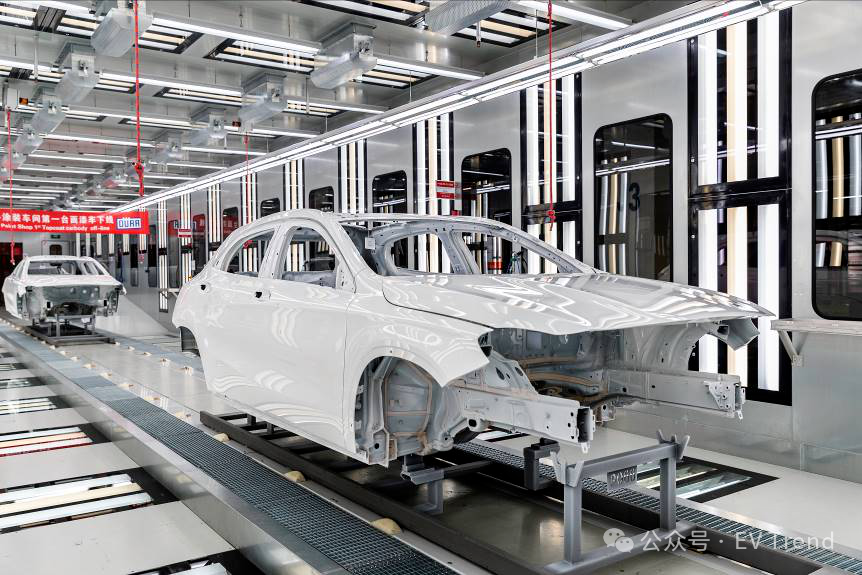
Mercedes-Benz EQ Body in White (painted with topcoat) Source: Automobile Manufacturing Network
SKD is a semi-discrete assembly, which is simpler than CKD and has a smaller investment. Different companies and different countries have different SKD methods and strategies. The simplest/crude SKD only installs 4 wheels overseas, and the rest is completed domestically.
2) Full-process factory: The four major processes of stamping, welding, painting, and final assembly of automobile production are all completed locally, and the parts and components industry chain is all deployed locally. This can be said to be the entire industrial chain going out to sea.
[Domestic standard automobile factories come standard with 4 major process workshops: stamping, welding, painting, final assembly, and on-demand supporting engine factories, battery pack workshops, die-casting workshops, etc. The KD factory with large overseas production capacity is an assembly workshop. Some SKD factories with smaller production capacity, especially those jointly built with dealers, are large-scale maintenance workshops by domestic standards. As long as you have a lift, it is not difficult to install thousands of sets of wheels a year]
Of course, if we dig deeper, there is a high probability that overseas manufacturing equipment (presses/molds/robots/fixtures, etc.), raw materials such as steel plates, and core parts (batteries/chips/motors, etc.) will be exported domestically.
On the one hand, based on local industrial capabilities and parts costs, for example, most third world countries cannot produce high-quality and stable automotive steel and need to be exported domestically.
On the one hand, the China government has clear management measures for the export of some key technologies and production equipment. Such as advanced batteries, materials and equipment.
In short, overseas localization layout must be done. This is the industry consensus. The difficulty is where to do it and how to do it?
2. Going to sea strategy: comprehensive choice of geography/market/cost
In the final analysis, the driving force and decision-making logic of overseas layout are one: reduce comprehensive costs under the premise of controllable risks and support selling more cars overseas.
I summarize the decision-making factors for overseas layout into three points: geography, market, and cost.
1) Geophysical relationship: Our relationship determines the life and death of the project
The world is reversing history and black swans exist every year. Whether relations between countries are friendly or not determines the safety of overseas investment principal.
This is the logic of friendly coastal and near-shore layout: good relationships and close proximity are relatively safer and safer.
The positive case of China companies 'friendship/near-shore is Southeast Asia, and the negative case is India.
Investment in overseas factories can often be tens of billions. For example, BYD's Hungarian factory invests as much as 35 billion yuan, and its Brazilian factory invests 7.1 billion yuan.
If you encounter a pig killing plate, the loss will be very heavy.
2) Market size: Is the local automobile market big and what is the market potential?
Building a factory also depends on the size of overseas markets. In extreme cases, for example, in most African countries and some island countries, the brand sells less than 100 units throughout the year, and the factory cannot recover the cost in any case.
With good geographical relations and large market size or great growth potential, this is a godsend opportunity market.
There are not many people that can satisfy both of the above points. Broadly speaking, only the EU, ASEAN, Latin America, Russia, the Middle East, and Central Asia should meet the above two requirements at the same time;
3) Comprehensive cost: How comprehensive cost determines the local layout
The final goal of all Business Cases is to settle accounts: Where should we build a factory and what kind of factory is the most suitable? The highest economic benefits?
This requires further finding the country/location with the lowest cost, most convenient, and best comprehensive among the large areas that satisfy 1) and 2), and determining the appropriate factory form and localization depth.
Benefit from local factories: circumventing import tariffs, meeting compliance requirements, and obtaining local policy support/subsidies;
Costs of building a local factory: one-time factory investment, parts transportation costs, local manufacturing costs, collaboration and coordination with suppliers, etc.;
If the local area has an industrial foundation and a local supply chain, a full-process factory can be considered.
If there is no industrial foundation, KD factories can only be laid out, and the depth of localization should be comprehensively considered by local conditions.
In addition, you can also learn from the joint venture model of foreign investment entering China, rely on local partners, share risks and benefits, and use the local influence of partners to operate.
III. SUMMARY
The world is becoming increasingly powerful and de-regulated. Once trust in the world of rules is destroyed, it will be difficult to establish it again, and it will be difficult for us to return to the previous era.
Fragmentation and regional integration of overseas markets should be irreversible.
As far as the automobile industry is concerned, China's automobile industry has cost advantages, technological advantages and efficiency advantages in global competition. This is the result of the efforts of colleagues in the industry under the guidance of national industrial policies.
Because our cars are too competitive, we face various policy barriers.
However, different regional policies also have different tendencies: local car companies in Southeast Asia are weak, and policies generally encourage and support the layout of China car companies; Europe does not oppose our localization, but it prefers to support its own companies. U.S. policies are relatively tough.
Therefore, our overseas layout needs to adapt to local conditions and adopt different strategies. If we consider the global layout comprehensively:
The first level: Determine which regions/countries will build full-process factories as the global core fulcrum;
Brazil, Thailand, Hungary, Spain and Russia seem to be the common choices of China car companies.
The second level: determine where KD factories will be built as important fulcrum of the region;
The third level: determine which places are only exported without factories, as a wide net;
Tier 4: complementary to determining which locations are re-exported by overseas factories rather than exported domestically;
Source: EV Trend
[Disclaimer] The content of this website (including pictures and texts) originates from the Internet, and the copyright belongs to the original author. Respect the rights and interests of originality, and select content is only used for information sharing. If copyright disputes are involved, please contact us to handle the deletion in time

 Online Evaluation
 I am Buyer
 Export Services
 subsites


 023-62852688
  No. 1-1, No. 2899, Longzhou Avenue, Banan District, Chongqing City
 Headquarters


