
 Chinese
 Russian
 Arabic

1. Basic situation
The Kingdom of Saudi Arabia (referred to as Saudi Arabia) is located on the Arabian Peninsula in southwestern Asia, bordering the Persian Gulf to the east, and borders Jordan, Iraq, Kuwait, Oman, Yemen, Bahrain, Qatar and other countries. The capital, Riyadh, has a land area of 2.25 million square kilometers. According to statistics from the International Monetary Fund, in 2024, Saudi Arabia's GDP will reach US$1.1007 billion, a growth rate of 3.1%, with a population of approximately 35.3 million, and per capita GDP reaching US$30746. China and Saudi Arabia have actively strengthened the strategic alignment of the "Belt and Road" construction with Saudi Arabia's "Vision 2030", and cooperation in the fields of economy, trade, production capacity, finance, infrastructure construction and other fields continues to develop in depth.
Saudi Arabia is my country's largest trading partner in the Middle East, and my country is also Saudi Arabia's largest trading partner. In 2024, the bilateral trade volume between China and Saudi Arabia will reach US$107.53 billion, a year-on-year increase of 0.3%. Among them, China's exports to Saudi Arabia will reach US$50.05 billion, a year-on-year increase of 16.8%, and China's imports from Saudi Arabia will reach US$57.48 billion, a year-on-year decrease of 10.7%. Saudi Arabia is my country's first billion-dollar trading partner in the Middle East. China mainly exports mechanical and electrical products, steel, clothing, etc. to Saudi Arabia, and mainly imports crude oil, petrochemical products, etc.
Saudi Arabia is rich in fossil energy, with proven crude oil reserves of 38.2 billion tons, accounting for 17.3% of the world's reserves, ranking second in the world. Proved reserves of natural gas are 6.19 billion tons, accounting for 4.5% of the world's reserves, ranking sixth in the world. In addition, it also has gold, copper, iron, tin, aluminum, zinc, phosphate and other mineral deposits.
2. Automobile market situation
Saudi Arabia has almost no automobile manufacturing industry, and automobiles mainly rely on imports. In recent years, higher oil prices and increased investment by private enterprises have driven Saudi Arabia's economic recovery and promoted the growth of Saudi automobile sales. According to data from the Ministry of Commerce, in 2024, car sales in Saudi Arabia will reach 827,000 units, a year-on-year increase of 13%, setting the best result in eight years. The top ten car companies in sales are Toyota, Hyundai, Kia, Nissan, Ford, Suzuki, Changan, Geely, Mazda and MG, selling a total of 659,000 vehicles, accounting for about 80% of Saudi car sales. Among them, Toyota has the largest share, with 28%, followed by Hyundai with 16%, and the rest of the companies have shares of 7% or less. Toyota leads for the fifth consecutive year.
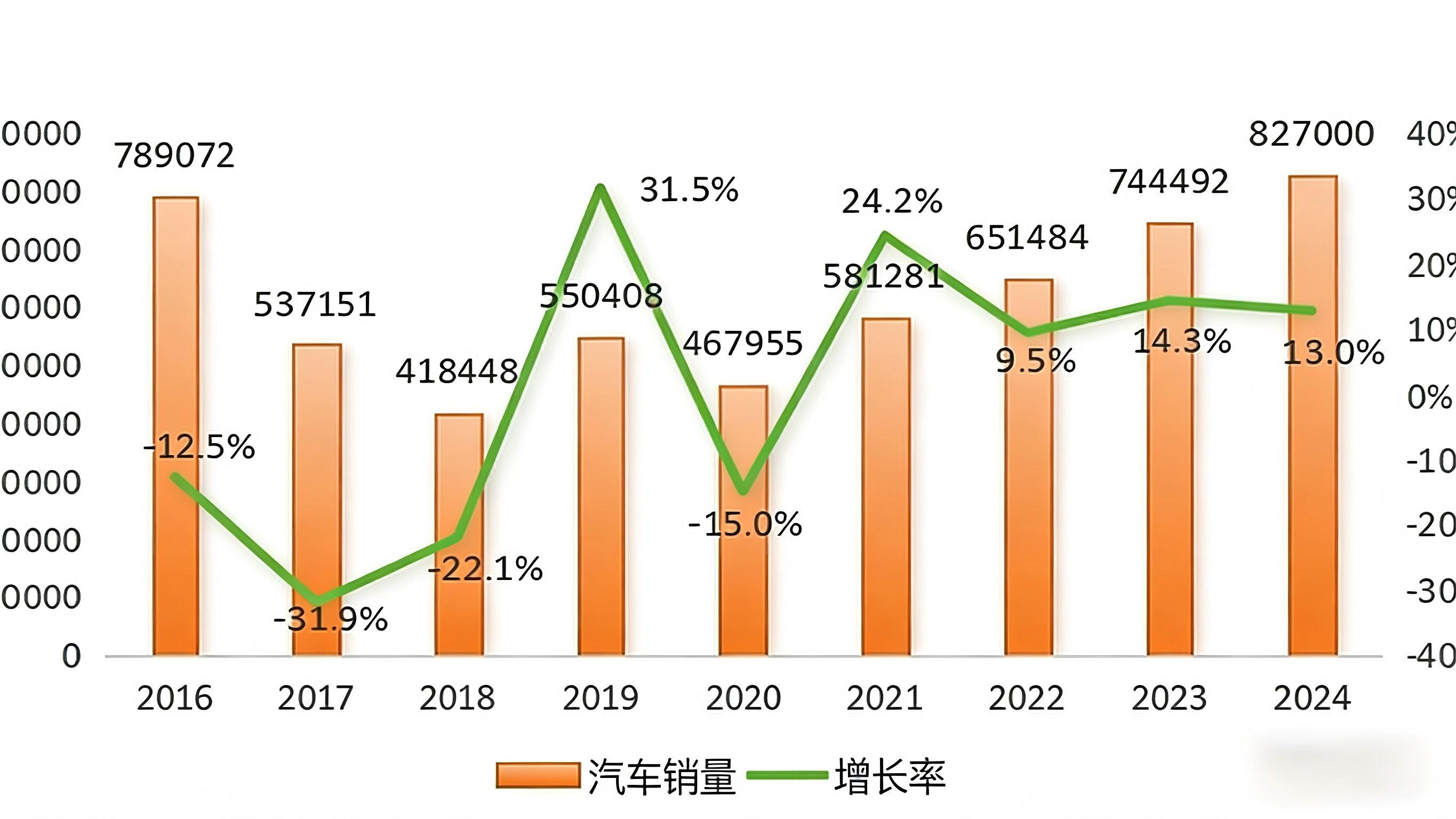
2016-2024 Saudi new car sales
Data source: China Automotive Industry Information Network, Ministry of Commerce
The Saudi electric vehicle market has shown explosive growth in recent years. Data shows that Saudi Arabia's electric vehicle sales in 2022 will only be more than 1000, but by the first half of 2023, its sales have surged by more than 300% year-on-year. At the end of 2023, an electric vehicle manufacturer controlled by Saudi Arabia's sovereign wealth fund started assembly and production in the King Abdullah Economic City, marking an important step for Saudi Arabia in the field of new energy vehicles. In addition, the Saudi government has also injected new vitality into the automobile market through a series of reform measures, such as lifting driving restrictions for women, attracting foreign investment and migrant workers. By 2030, Saudi Arabia plans to increase the proportion of electric vehicles in Riyadh to at least 30%, and is committed to achieving the 2060 net-zero emission target to provide strong policy support for the development of new energy vehicles.
According to data from the Economic and Trade Office of the Embassy in Saudi Arabia, the average annual import volume of used cars in Saudi Arabia is about 25,000 - 30,000, mainly Japanese, German and American cars. Saudi Arabia mainly imports used cars through ports such as Dammam Port, Jubail Port, and Jeddah Port. Because there is zero tariff on the circulation of goods between it and the United Arab Emirates, most used cars are re-exported from Dubai. The best-selling second-hand car models in the area include Toyota Elfa, Toyota Camry, Toyota Corolla, Toyota Hailax, Toyota Land Cruiser, Toyota Prado, Toyota Mark II, Honda Odyssey, Nissan Skyline, etc. Since the COVID-19 epidemic, Saudi Arabia has increased value-added tax from 5% to 15%, and new car prices have increased, so consumers have postponed their decision to purchase new cars. In addition, according to statistics from the Saudi Ministry of the Interior Data Center, 67% of Saudi citizens are under the age of 30. The huge young consumer group has shown high enthusiasm for consumption of used cars. At the same time, there are more than 10 million foreign workers in Saudi Arabia, accounting for about 30% of the population, and are usually willing to buy more affordable used cars. The above factors have promoted the development of the Saudi used car market and will continue to grow in the short term.
3. Policies and regulations on used car import
1. Import policy
Saudi Arabia only allows the import of left-hand rudder vehicles without modification of the vehicle's steering system. Imported used cars and other light vehicles must not exceed 5 years old. For imported second-hand large/heavy trucks, the vehicle age must be less than 5 years, starting from January of the year of manufacture. Second-hand cars should meet displacement requirements. The energy efficiency of used passenger cars should not be less than 10.3 km/L, and trucks and other transport vehicles should not be less than 9.0 km/L. When Saudi individuals import second-hand electric vehicles, they cannot adopt the model of obtaining inspection and customs clearance certificates in the exporting country. Vehicle inspections need to be arranged after arriving in Saudi Arabia. It is prohibited to import vehicles that have been involved in major accidents such as flooding, overfire, collision or overturning. It is also prohibited to import vehicles that have previously been used as police, emergency vehicles and taxis.
Saudi Arabia requires that the body of imported vehicles be in good condition, and if the body damage occurred at the port of arrival, corresponding certificates from the competent authority must be submitted. Citizens of Saudi Arabia and Gulf countries can import 2 non-prohibited imported vehicles a year. If the importer is not a citizen of a GCC country, he needs to hold a valid residence permit. The Saudi residence permit holder can only import one passenger car within 3 years and cannot sell it for 3 years from the date of import.
In addition, most used car parts cannot be imported into Saudi Arabia, but can be exempted if renovated engine and transmission parts meet certification standards.
2. Tax policy
The import tariff rate for used passenger cars is 5%, and for used trucks is 12%. At the same time, a 15% value-added tax is also required. When reviewing the price, the customs uses the guidance price issued by the automobile manufacturer as the basis, calculates the current value of the vehicle based on the model year and depreciation rate, and adds freight and insurance values. For specific calculations, the customs will deduct the value of the vehicle on a monthly basis. If it is imported in the first six months of its production year, it will be considered a new car and will not be deducted; for vehicles imported in the last six months of the production year, the deduction will be made at a rate of 2% per month; for vehicles imported between the second and fifth years of the production year, the deduction will be made at a rate of 1% per month; after more than five years from the production year, the maximum deduction rate is 60% of the price of the imported car. Special vehicles and antique vehicles are excluded.
3. Documents required for import
● Vehicle name
● Saber certificate
● Legal purchase invoices
● Certificate of origin
● Insurance certificate
● Customs declaration fee
● Copy of license
Source: "China's Used Car Export Country Guide 2024"
This article is reproduced from the "2024 Country Guide" and is only used for information sharing. If infringement is involved, please contact and delete it. This site does not bear relevant legal responsibilities.

 Online Evaluation
 I am Buyer
 Export Services
 subsites


 023-62852688
  No. 1-1, No. 2899, Longzhou Avenue, Banan District, Chongqing City
 Headquarters


