
 Chinese
 Russian
 Arabic
The domestic market has completed a profound transformation from being dominated by first purchases to being dominated by replacement and renewal, whilethe overseas market has become the core engine of industry growth. China's automobile industry has entered a new stage of structural transformation.
In the first quarter of 2026, China's automobile market showed a pattern of substitution dominated and export explosion.
According to data from the China Automobile Association, automobile production and sales in the first quarter were 7.039 million and 7.048 million respectively, down 6.9% and 5.6% respectively year-on-year. Specifically, domestic sales were 4.823 million units, a year-on-year decrease of 20.3%; exports were 2.226 million units, a year-on-year increase of 56.7%.
The domestic market has completed a profound transformation from being dominated by first purchases to being dominated by replacement and renewal, while the overseas market has become the core engine of industry growth. China's automobile industry has entered a new stage of structural transformation.
1. Domestic swaps stabilize the market
Xu Changming, former deputy director and senior economist of the National Information Center, introduced at the 2026 Smart Electric Vehicle Development High-Level Forum that my country's automobile market is still in a development stage of small growth and is in the third stage, starting from 2018., sales volume fluctuates in the period of slow growth, with an average growth rate of 2%-3%. Xu Changming predicts that the automobile market will show "domestic stability and international growth" in 2026.
Data released by China Association of Automobile Manufacturers shows that in the first quarter of 2026, China's automobile production and sales reached 7.039 million and 7.048 million respectively, down 6.9% and 5.6% respectively year-on-year. Among them, domestic sales of automobiles were 4.823 million units, a year-on-year decrease of 20.3%; domestic sales of traditional fuel vehicles were 2.817 million units, a year-on-year decrease of 17.6%.
Xu Changming believes that the decline in sales is mainly caused by consumers waiting for preferential prices and new local policies. In addition, there are two small factors: one is that low-priced electric vehicles are affected by the adjustment of vehicle purchase tax. The other is the rise in oil prices in March, which caused many people to wait and see.
Cui Dongshu, secretary-general of the Passenger Car Market Information Joint Branch of China Automobile Dealers Association (Passenger Car Federation Branch), introduced at the 2026 Smart Electric Vehicle Development High-Level Forum that in 2025, according to statistics from the Ministry of Public Security, a total of 21.69 million vehicles were sold, of which scrapping and renewal accounted for 13.19 million vehicles, and the increase was only 13 million vehicles. We have entered a new stage of scrapping and renewal promoting the development of the automobile market.
In addition, Cui Dongshu suggested that future policies should provide more support in stabilizing growth and require long-term policy support. "We cannot rely solely on short-term policy support. We will give 20 million yuan this year, 300 billion yuan last year, and 150 billion yuan later, and it will be gone the year after." He proposed that in the long run, certain policy support should be given, especially the inclusion of car purchase expenses into special personal tax deductions and pre-tax deductions of automobile consumer credit interest. These two should be long-term measures.
Wang Qing, deputy director of the Institute of Market Economics of the Development Research Center of the State Council, said at the 2026 Smart Electric Vehicle Development High-Level Forum that personalized, niche, and circle-based consumption will become more and more obvious in the future. The market will continue to be segmented, and everyone's feelings and consumer needs for decompression, companionship, socialization, nostalgia, and even stimulation are increasing day by day. Supply is to explore and satisfy it. Car consumers are not only consumers of cars, but also consumers of clothing, bags, sporting goods, electronics and even golf and yachts. They are also consumers of tourism, medical care, and culture. Whether it is one manufacturer or multiple manufacturers, to provide more choices in subdivided tracks, there must be many products for consumers to choose from.
2. Overseas exports drive growth
In contrast to the adjustment of domestic demand, China's automobiles continued to grow by leaps and bounds. In the first quarter, automobile exports were 2.226 million units, a year-on-year increase of 56.7%; of which 954,000 new energy vehicles were exported, a year-on-year increase of 1.2 times; traditional fuel vehicles were exported 1.271 million units, a year-on-year increase of 29.9%. Exports have become a driving force to hedge domestic pressure and support industry growth, forming a pattern of "new energy leading the way and fuel vehicles following up."
Xu Changming believes that the continued growth in global auto market sales is mainly due to emerging markets. "From more than 9 million vehicles to more than 40 million vehicles, the volume of emerging markets has surpassed that of mature markets. This is a historic surpass and it is impossible to go back." He pointed out that the growth of emerging markets is more beneficial to our country's automobile exports, because these regions have relatively low purchasing power, and China's cars are cost-effective at a certain price, which is conducive to our exports.
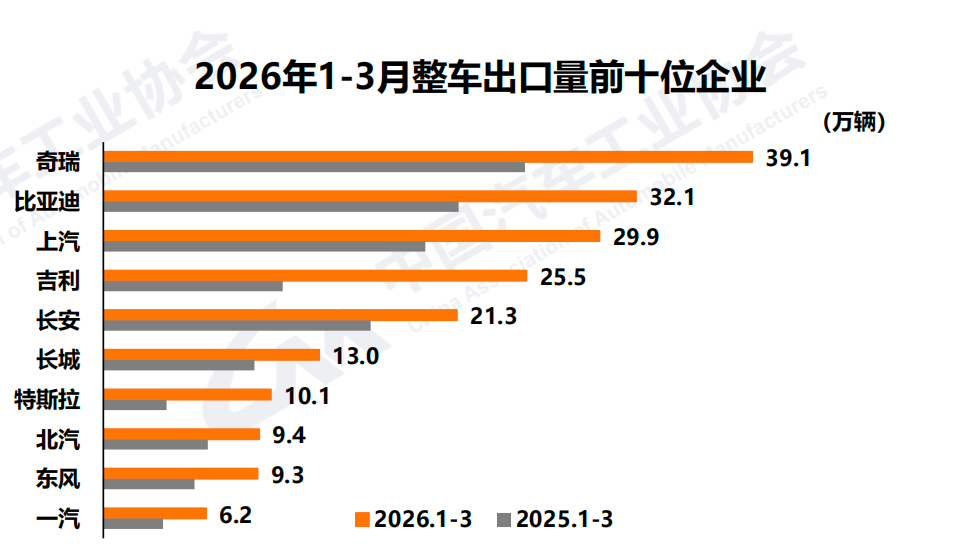
Source: China Automobile Manufacturers Association
In the first quarter, all the top ten companies in vehicle exports achieved positive growth. Chery Automobile (09973.HK), BYD (002594.SZ), and SAIC Motor Group (600104.SH) ranked among the top three, exporting 391,000 vehicles, 321,000 vehicles, and 299,000 vehicles respectively. (For details, see the recovery of the auto market, the intensification of differentiation, and the explosion of exports in March)
Xu Changming believes that automobile factories need to increase the construction of after-sales service systems, and the reputation of domestic automobile companies will be maintained. "The only risk is whether our after-sales system can follow up. Because many of the cars we export are used cars or zero-kilometer used cars, how to ensure the service network after these cars are exported is a problem. As long as this is guaranteed, the good reputation of Chinese cars will continue."
Nowadays, China's automobiles have gone beyond mere vehicle exports to deep globalization of CKD factories, local services, and industrial chain coordination. Parts and components, logistics, dealers, and auto finance go out simultaneously.
In 2026, China's auto market has formed a two-wheel drive pattern in which domestic swaps stabilize the market and overseas exports drive growth. The domestic market needs to rely on long-term consumption-promotion policies to continue to activate replacement demand, optimize product structure, and alleviate industry profit pressure; overseas markets rely on the advantages of the entire industry chain to consolidate their global leading position and achieve both volume and price increases and brand growth.
Source: Financial News
[Disclaimer] The content of this website (including pictures and texts) originates from the Internet, and the copyright belongs to the original author. Respect the rights and interests of originality, and select content is only used for information sharing. If copyright disputes are involved, please contact us to handle them in a timely manner

 Online Evaluation
 I am Buyer
 Export Services
 subsites


 023-62852688
  No. 1-1, No. 2899, Longzhou Avenue, Banan District, Chongqing City
 Headquarters


