
 Chinese
 Russian
 Arabic
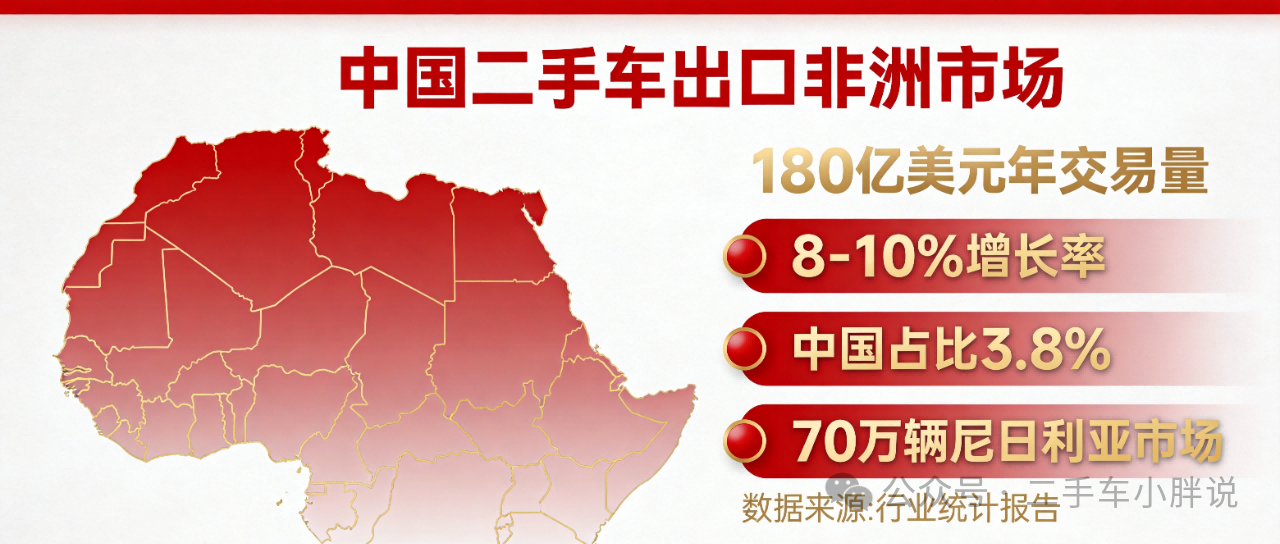
Recently, according to foreign reports, used cars from China have become "hot cakes" in Africa. These used cars exported to Africa are in good condition and complete procedures, and the price is only one-third of that of new cars.
At the same time, the annual transaction volume of the African used car market exceeds US$18 billion and is growing at an average annual rate of about 8% to 10%.
African market is growing rapidly
According to reports, Nigeria is currently Africa's largest used car market, with used cars accounting for more than 90% of the annual imports of approximately 700,000 vehicles. Kenya and South Africa are also important markets, with annual imports totaling more than 300,000 vehicles. The proportion of China's used cars in the African market has rapidly increased from 1.2% in 2020 to 3.8% in 2024, showing a good development momentum.
Some used car dealers have seen that despite the large differences in used car import policies among African countries, demand is growing rapidly. Among them, Nigeria only allows the import of left-hand steering vehicles, with a vehicle age limit of 12 years. It also imposes a 20% tariff, a 15% National Automobile Commission tax and a 7.5% value-added tax.
Egypt also only accepts left-hand steering vehicles, and the age limit is 3 years. Hybrid and electric vehicles have policy advantages. Ethiopia will ban the import of fuel vehicles from 2024 and only allow the import of electric vehicles. Ghana bans the import of used cars more than 10 years old and also requires compliance certificates.
China has implemented zero tariffs on 100% tax items on 53 African countries, and has fully liberalized the export qualifications of used cars, bringing favorable policy support to the market.
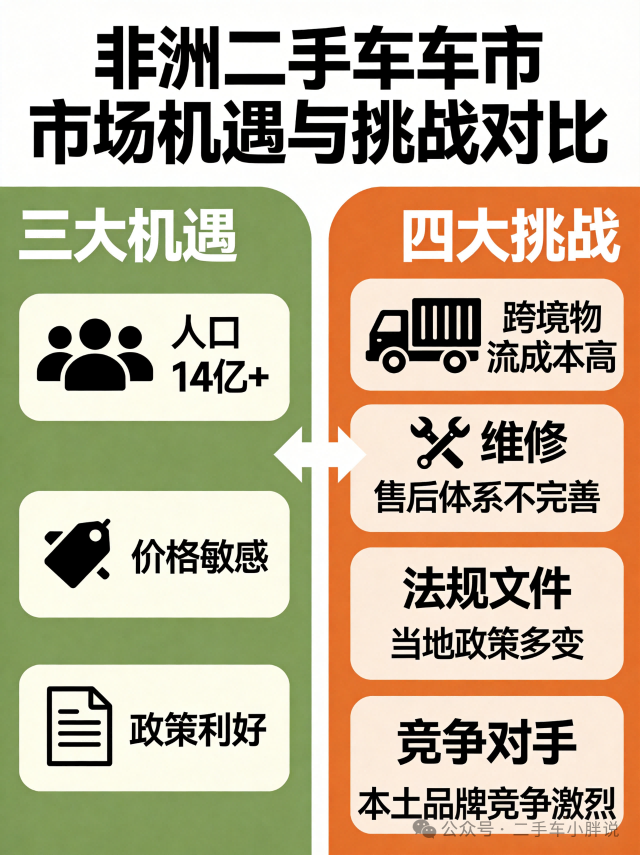
Objectively speaking, there are more opportunities than challenges in the African used car market. In terms of opportunities, Africa's population exceeds 1.4 billion and the average age is 20 years old. The demand for family transportation is mainly economical and practical. Used cars account for more than 70% of car ownership. New energy vehicles are expected to become new growth points encouraged by policies from many African countries. In terms of challenges, African markets are relatively fragmented, policy differences and supply chain issues all need to be addressed. Tariffs fluctuate in some countries. In addition, Africa's domestic automobile manufacturing industry accounts for only 8% of GDP, and the used car market has long been dominated by multinational brands.
Why are you optimistic about this blue sea?
In fact, judging from the current situation, not only in China, but also in many countries around the world, used cars can find markets in Africa. Moreover, the huge market potential and unique commercial value behind the used car trade in Africa have also attracted the attention of used cars around the world.
It is reported that used car trading accounts for more than 95% of the Nigeria automobile market, with a compound average annual growth rate of 8.9%. Such a strong growth trend demonstrates the vitality of the used car market in Nigeria. In Nigeria, roads are the core mode of transportation, and cars have become people's main means of daily travel. Due to the lagging development of the local automobile industry and its inability to meet the domestic market demand, the import of used cars has become an important way to fill the gap. Once upon a time, the import of a large number of used cars even caused port congestion, and some shipping companies had to transfer cargo to ports of neighboring countries such as Benin and Cote d'Ivoire. This phenomenon reflects the strong demand for used cars in Nigeria.
More critically, the warming up of the used car market in Africa is behind the growth in consumer demand. Previously, some Japanese and Korean brand used cars had low fuel consumption, which could meet local consumers 'considerations of fuel costs. Moreover, they had a mature after-sales service network in the local area, convenient maintenance and controllable costs, so they had relatively low income levels. It is highly attractive to ordinary African consumers.
Some industry sources said that the popularity of the used car market in Africa is no accident. Behind it is the rigid demand formed by the interweaving of local economy, transportation, usage habits and other factors. These factors together build the cornerstone for the vigorous development of the used car market in Africa.
In Africa, the income level of ordinary residents in some countries is relatively low, making them more price-sensitive when buying cars. The higher selling price of new cars is often difficult for ordinary Africans to accept. The price difference between used cars and new cars of some multinational brands is even close to 10 times.
At the same time, from the perspective of asset preservation, used cars also have unique advantages in the African market. Due to the sharp depreciation of new cars after landing, in some African regions where economic fluctuations are frequent, purchasing new cars often means a rapid decline in assets. The price of used cars is lower, the depreciation during use is relatively small, and its asset value is relatively more stable. This is also one of the important reasons why consumers tend to choose used cars.
In addition, the development of transportation infrastructure in some African countries is uneven, and roads are still the main mode of transportation, shouldering the heavy responsibility of transporting people and goods. As the core tool of road transportation, automobiles play an important role in people's livelihood and economic development in Africa.
Rational treatment deserves attention
One of the reasons why the used car market in Africa is relatively developed is that some countries in Africa do not have a mandatory car scrapping system. This policy environment provides convenient conditions for the long-term use of used cars. In Africa, even if a car exceeds its normal service life, it can continue to drive as long as necessary parts are replaced. This logic of "durability is king" is highly consistent with the characteristics of used cars.
At the same time, Africa's road conditions are complex and diverse, ranging from relatively flat urban roads to rugged rural dirt roads and harsh off-road sections. After imported used cars, they usually undergo a series of preparation work, such as reinforcing the chassis and replacing off-road tires, so that they can better adapt to complex road conditions in Africa, further enhancing the value of used cars in the African market and extending their service life.
It is reported that the rapid growth of China's new energy vehicle market has led to a significant acceleration of the replacement process of traditional fuel vehicles. A large number of second-hand cars with short age and good condition have poured into the market, providing sufficient and high-quality sources for second-hand car exports. At the same time, in the process of exploring the African used car market, China companies have gradually transitioned from purely vehicle exports to building a full-chain service system of "testing-logistics-overseas warehouse-after-sales".
Through overseas operation centers, some related companies can not only directly export used cars to the African market, but also provide technical support, after-sales services, training and other services to promote the coordinated development of upstream and downstream chains of used car export and improve the industrial ecology.
On the other hand, perhaps it is precisely because China's new energy vehicle industry continues to grow and has adapted to the corresponding needs of some African countries. For example, Ethiopia will completely ban the import of fuel vehicles in 2024. The implementation of this policy has brought unprecedented development opportunities for new energy used vehicles in the country and even some African markets. At the same time, Egypt, Ghana and other countries have also introduced policies to provide preferential measures such as tariff exemptions and exemptions for new energy used vehicles, further stimulating market demand for new energy used vehicles.
For China used car exporters, this is undoubtedly a market full of potential. However, to succeed in this market, we still need to address practical challenges. One of them is that charging infrastructure construction in some regions of Africa is relatively lagging behind, which deserves rational consideration.
"This is a win-win path worth exploring." Some industry insiders suggest that Africa's immediate demand for used cars and the supply dividend of China's used car exports have created development potential, which not only provides a new path for China to absorb existing car sources, but also helps Africa improve people's livelihood. The export of China's used cars to Africa is not just a mere commercial trade, but also a in-depth expansion of China-Africa cooperation in the economic field. In this process, whether it is the market development of used cars and new energy used cars, the coordinated development of the auto parts market, or the construction of a localized industrial ecosystem, it has demonstrated the complementary advantages of China and Africa in terms of resources and markets.
In the future, with the continuous construction of relevant full-chain service systems and the continuous advancement of localization, China's used car exports to Africa are expected to transform from a "short-term opportunity" to a "long-term normal", becoming a new highlight of China-Africa economic and trade cooperation and writing a new chapter of mutual benefit and win-win results.
Source: Used car Xiaopang said
[Disclaimer] The content of this website (including pictures and texts) originates from the Internet, and the copyright belongs to the original author. Respect the rights and interests of originality, and select content is only used for information sharing. If copyright disputes are involved, please contact us to handle them promptly

 Online Evaluation
 I am Buyer
 Export Services
 subsites


 023-62852688
  No. 1-1, No. 2899, Longzhou Avenue, Banan District, Chongqing City
 Headquarters


