
 Chinese
 Russian
 Arabic
In the first five months of 2026, the overall domestic automobile market showed a negative growth trend. During the same period, automobile production and sales totaled 12.235 million and 12.207 million respectively, down 4.6% and 4.2% respectively year-on-year. Obviously, the dividend period of the incremental era is over, and the moment of "bayonet fighting" in the stock era has arrived.
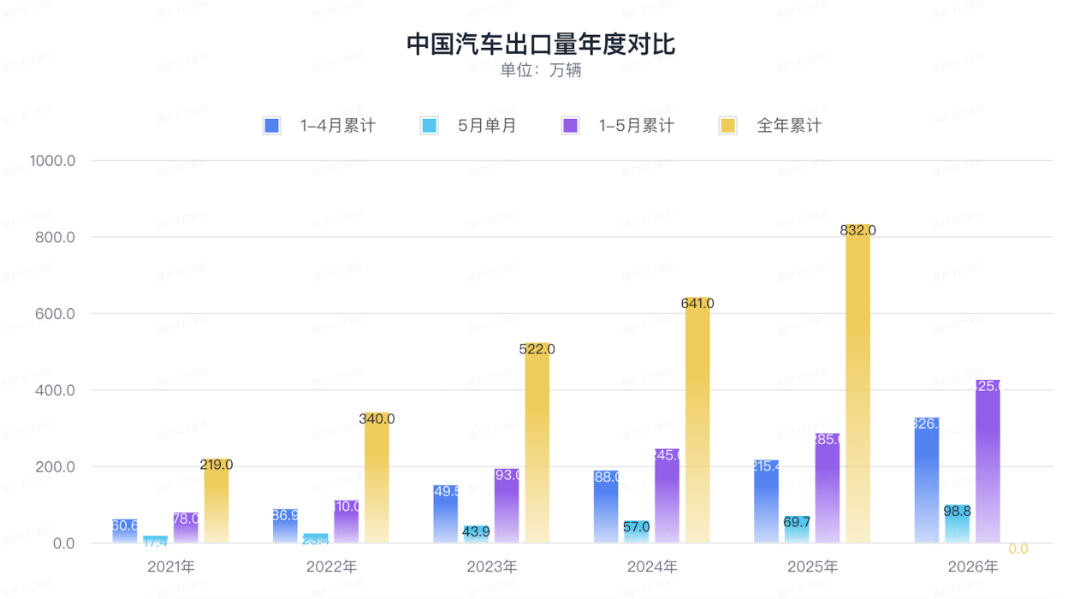
In this context, export performance will determine a key link in the growth of China's automobile industry. Exports are also very competitive. In the first five months of this year, China exported 4.059 million vehicles, a year-on-year increase of 63%. The average monthly export scale stabilized at 810,000 vehicles, which has become a key factor driving industrial resilience. Among them, domestic automobiles exported 930,000 vehicles in a single month in May, a year-on-year increase of 68.7%.
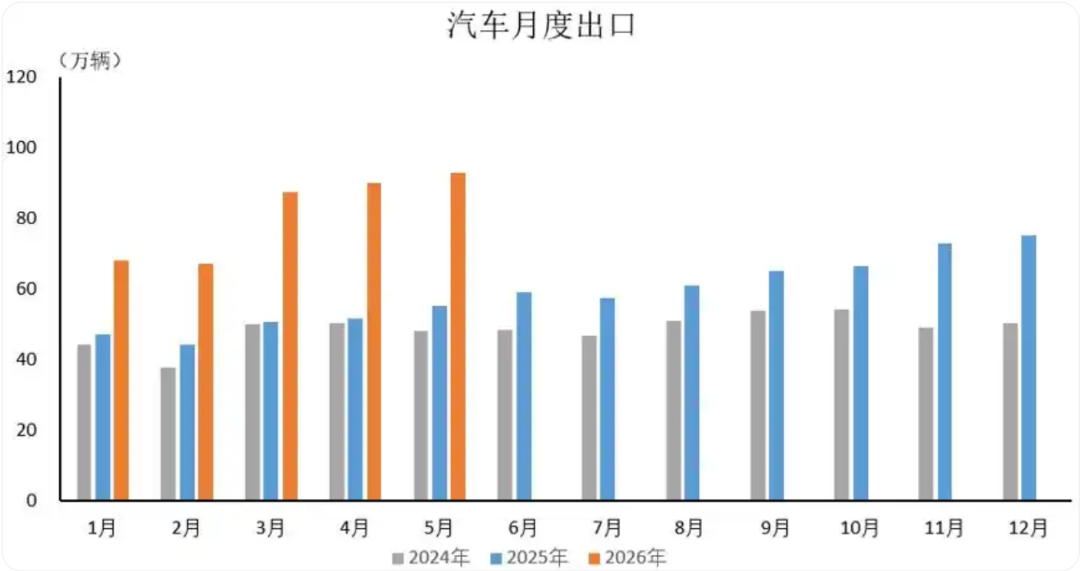
If extrapolated based on the current growth rate, there is a high probability that China's annual automobile exports will exceed 10 million units. By then, the new export volume in a single year will directly equate to the total export volume for the whole year three or four years ago.
Looking at this round of growth, we found that the export explosion is not simply an increase in sales volume, but a simultaneous upgrade in dimensions such as diversity of energy forms, continuous optimization of overseas market layout, formation of automobile companies 'echelon and product structure. Based on these growth, we can also confidently say that China's cars have completely bid farewell to the low-cost and volume model of their early years when going out to sea.
1. The total export volume has increased significantly, becoming an inseparable growth pole for the industry
However, when you look at this year's export data, you may not feel it, but if you compare the export data over the years, you will find that this export growth has made a very big breakthrough. Previously, it had been many years for domestic automobile exports to exceed 5 million units, but in 2026, more than 4 million units were delivered in the first five months alone, and the growth rate far exceeded industry expectations.
With the overall increase encouraging, both passenger cars and commercial vehicles have achieved good growth.
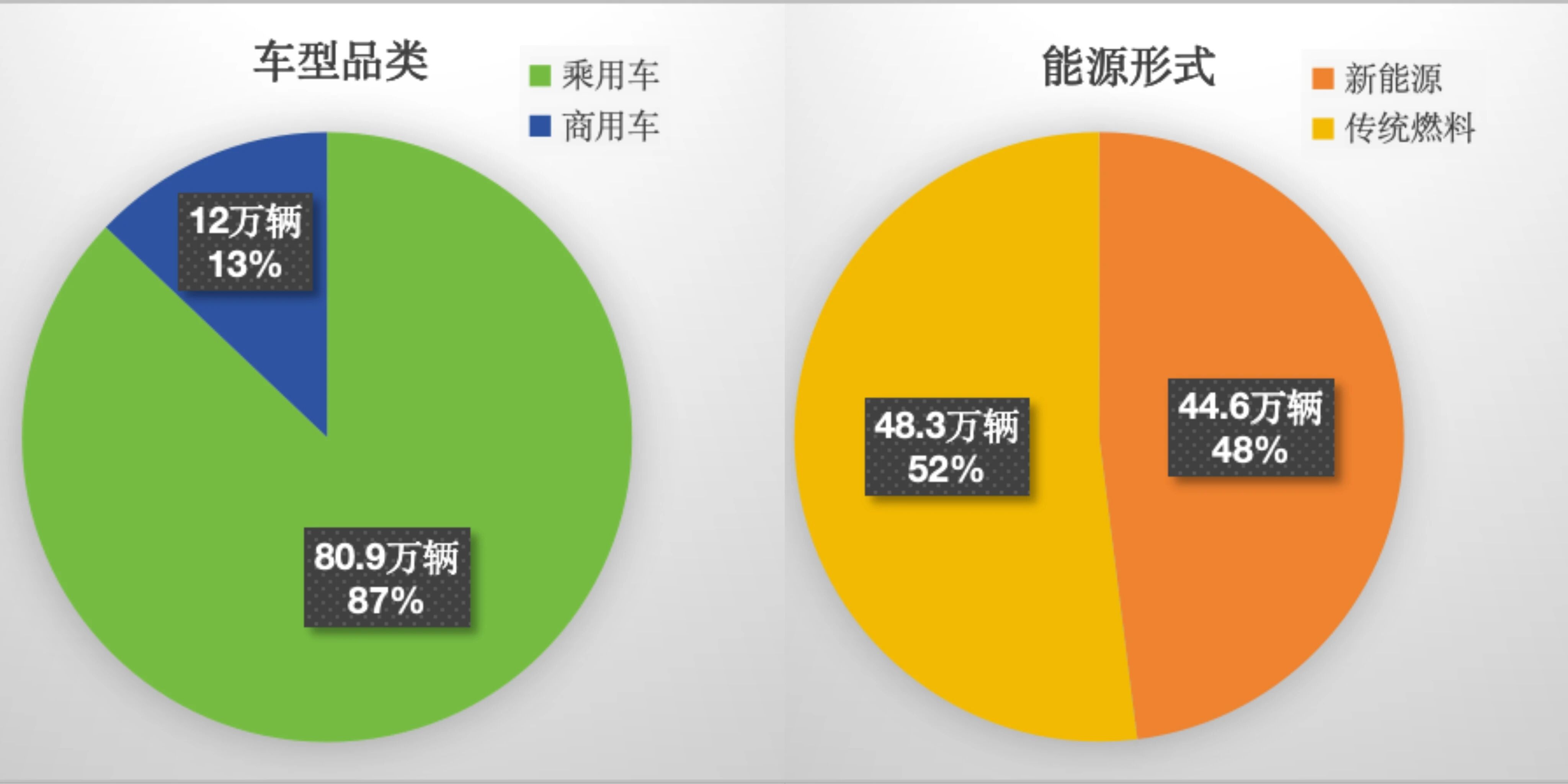
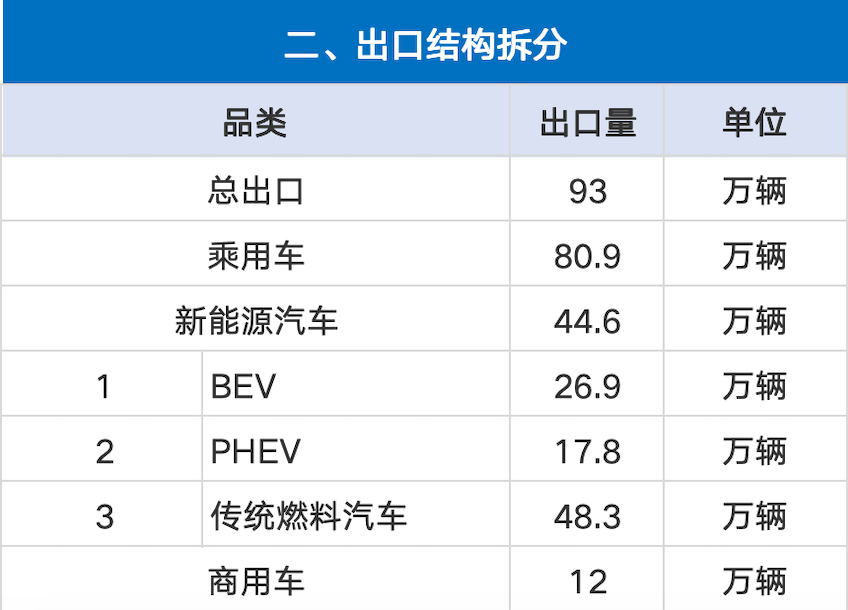
According to data from the China Automobile Association, the cumulative export of passenger cars from January to May was 3.528 million, a year-on-year increase of 69.6%, supporting 87% of the export volume; the cumulative export of commercial vehicles was 532,000, a year-on-year increase of 29.5%. Among them, 120,000 commercial vehicles were exported in May, a month-on-month increase of 13.4%.
Of course, the growth logic of the two types of models is different, each with its own focus. Among them, passenger cars rely on new energy products to open up the global civilian consumer market, and commercial vehicles rely on mature industrial manufacturing advantages to take root in developing countries 'just-needed tracks. The rapid and steady growth pace has freed the export business from dependence on a single category, and the industry's export chassis has become more solid. This is also an important basis for the rapid increase in the total volume.
At the same time, products with different energy forms have performed.
This is also one of the biggest advances in this round of exports, that is, new energy and fuel vehicles are about to complete the status change. Data from the China Automobile Association in May showed that the export of new energy vehicles in the month was 446,000, doubling year-on-year, accounting for nearly 48%; the export of fuel vehicles was 483,000, a year-on-year increase of 42.6%. The growth rate of new energy exports reached that of fuel vehicles. Three times.
If the current pace is followed, new energy exports in the second half of the year will officially surpass fuel vehicles and reach the top of the largest export power type.
In more subdivided power tracks, plug-in and hybrid models achieve overtaking in corners. Data shows that from January to May, a total of 708,000 plug-in and hybrid models were exported, a year-on-year growth rate of 1.2 times, which was higher than the 1.1 times increase of pure electric vehicles; in the single-month dimension, plug-in and hybrid exports surged 1.4 times year-on-year in May, further expanding the advantages.
If placed in the global market context, this data is of great industry significance.
Because unlike pure electric vehicles that rely on improving charging pile infrastructure, plug-in and hybrid models have no anxiety about replenishing energy, they are perfectly suitable for overseas markets with weak infrastructure such as Latin America, Southeast Asia, and Eastern Europe, and smooth down barriers to consumption in the regional market. This also confirms that domestic car companies accurately grasp global differentiated needs, and product research and development truly suits overseas localization scenarios.
Data from the Federation further supports the structural change. In May, exports of new energy passenger vehicles accounted for 54.1% of total passenger vehicle exports, an increase of 9.5 percentage points year-on-year, setting a record high. For every two exported passenger cars, more than one is a new energy model.
At the same time, the difference between the two major statistical standards also clarifies industry misunderstandings. The statistics of the China Automobile Association include micropassenger car types, while the Association only counts passenger cars, SUVs, and MPVs in its narrow sense. The two sets of data complement each other and are more in line with the industry's research and judgment needs.
2. Diversified layout to get rid of dependence on a single market
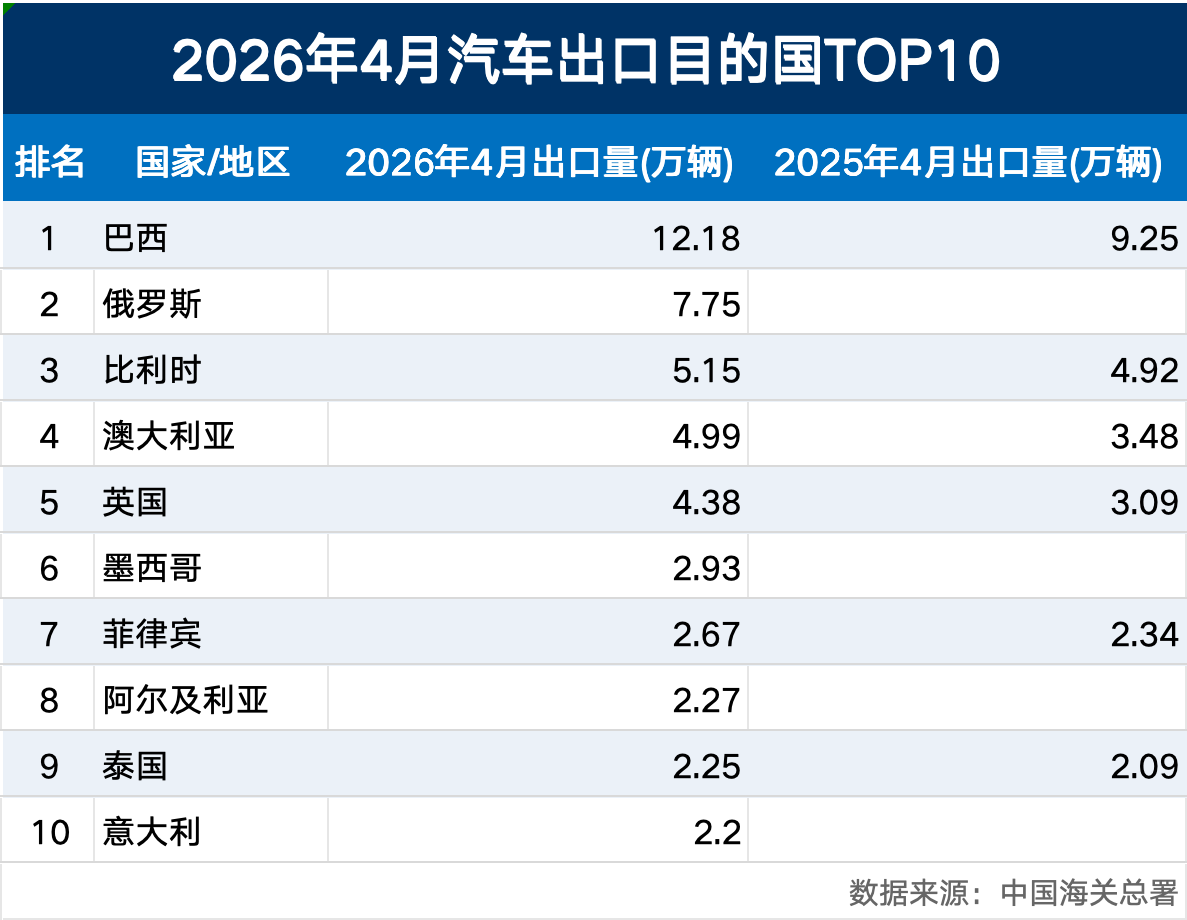
In the early years, China cars went to sea to gather in the low-end markets of the Middle East and Africa, with weak brand premiums and poor risk resistance. The overseas destination data for the first five months of 2026 fully demonstrates the iterative upgrading of the market layout (customs export data from January to April).
At present, the top three destinations for China's overall automobile exports target Brazil, Russia, and the United Kingdom. Brazil and Russia have contributed a total of 60% of the export increase, taking into account emerging economies and mature European markets. Among them, Brazil received 295,000 domestically produced vehicles from January to April, and Russia received 270,000 vehicles; the United Kingdom ranked third with 155,000 vehicles.
Of course, the popular energy forms in different markets are also different.
Brazil topped the list in new energy exports with its local subsidy policy, while Belgium relied on ports to become a transit station in Europe. The United Kingdom, Australia and Thailand followed closely, covering the four core sectors of South America, Europe, Oceania and Southeast Asia. This allows China's car exports to not only penetrate into the European high-end market, but also deeply cultivate the localized and just-needed markets in Southeast Asia and Latin America, achieving two-way consideration of high and low markets.
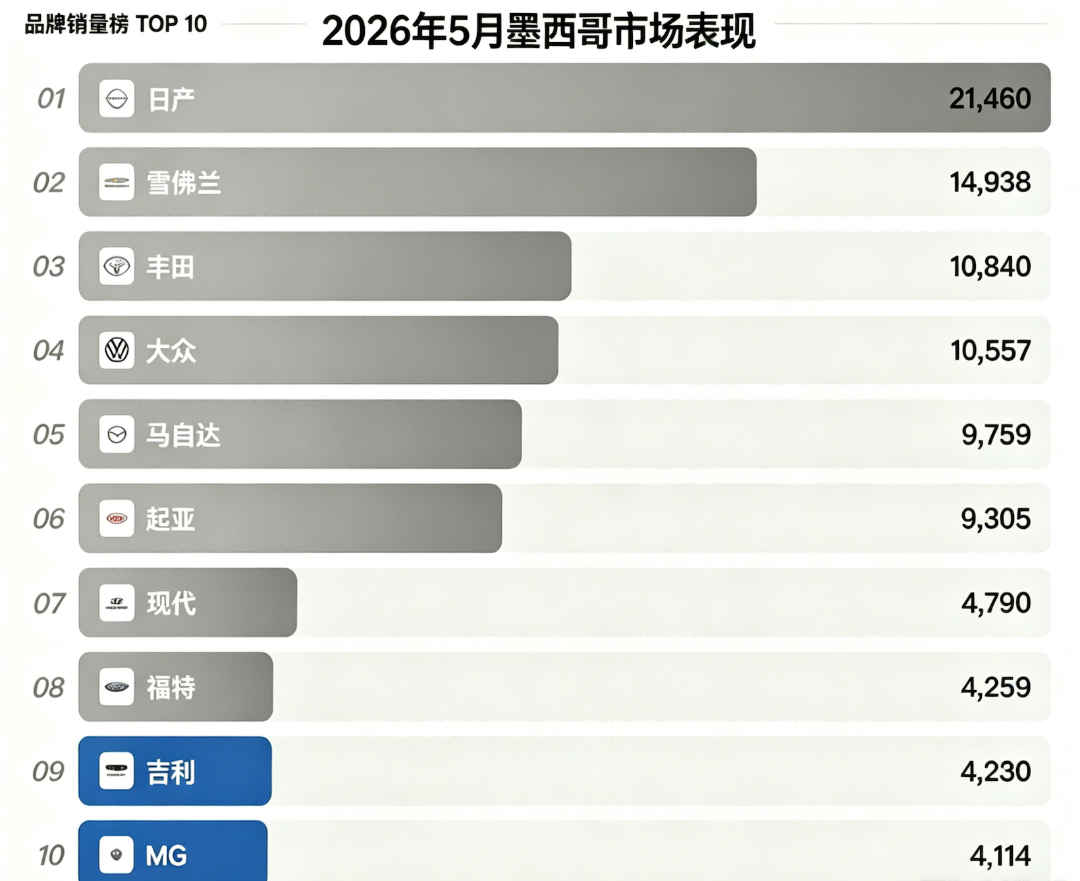
Combined with overseas vehicle registration data from 32 countries, product positioning in the regional market is highly clear. For example, Russia mainly consumes fuel SUVs, and the Haval brand has advantages; Germany and the United Kingdom focus on high-end new energy, and BYD ranks among the top 15 German car companies in sales; Italy relies on cost-effective models to top the sales list of local China brands.
The implementation of differentiated sea-going strategies has allowed domestic car companies to bid farewell to the homogeneous price war.
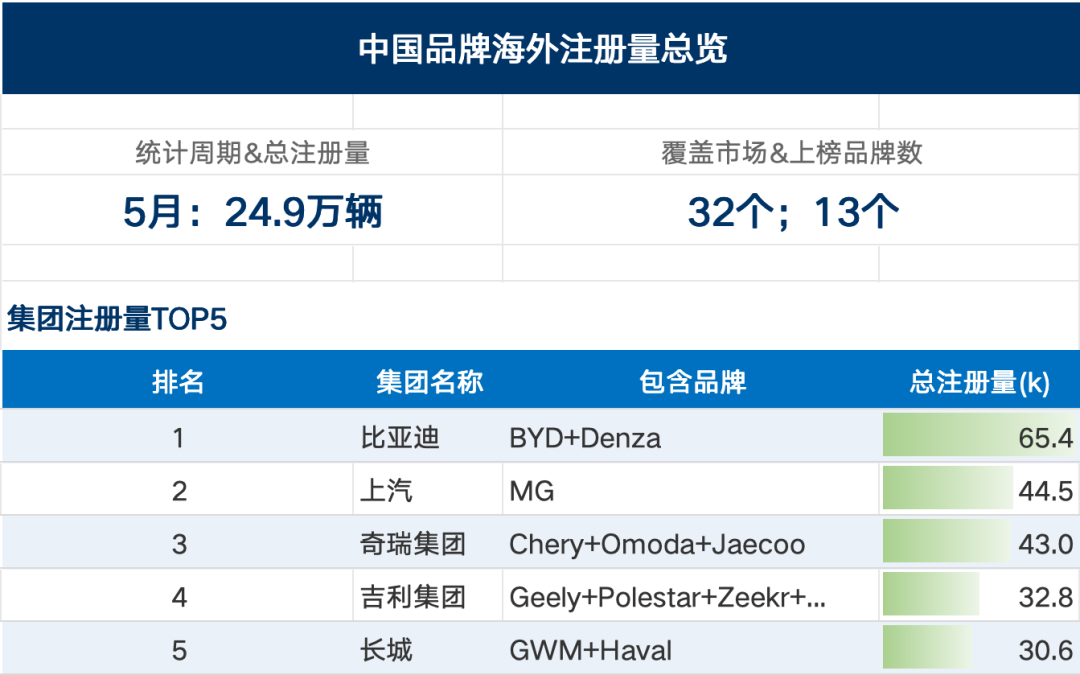
Returning to the level of competition among automobile companies, the current pattern of the TOP 10 echelon of China's automobile exports is stable, with independent local leaders leading the way, and foreign investment and joint ventures are supplemented (China Automobile Association's May Enterprise List).
Among them, Chery ranked first with 749,000 units in cumulative exports in the first five months, monopolizing 18.5% of the export share; BYD followed closely with 617,000 units, with rapid catch-up momentum. The average monthly volume helped the brand's annual exports exceed one million; SAIC, Geely and Chang 'an ranked 3-5.
Among the top five car companies, Geely led the way with a year-on-year growth rate of 1.5 times; Tesla, the only top ten foreign brand, relied on East China ports to export; FAW merged zero-run export data and surged 1.6 times year-on-year, winning the top ten growth rate crown.
The overall situation shows that leaders have stabilized their fundamentals, second-tier car companies have quickly broken through, foreign brands have increased production capacity, and the echelon of export car companies has completed diversified upgrades.
In addition, in terms of model structure, it also continues the advantages of the domestic market, and SUVs have become the core pillar of sailing. In May, 596,000 SUVs were exported among exported passenger cars, a year-on-year increase of 89.4%, and the growth rate far exceeded that of sedans and MPVs.
Source: One sentence comment
[Disclaimer] The content of this website (including pictures and texts) originates from the Internet, and the copyright belongs to the original author. Respect the rights and interests of originality, and select content is only used for information sharing. If copyright disputes are involved, please contact us to handle them in a timely manner

 Online Evaluation
 I am Buyer
 Export Services
 subsites


 023-62852688
  No. 1-1, No. 2899, Longzhou Avenue, Banan District, Chongqing City
 Headquarters


