
 Chinese
 Russian
 Arabic
Nigeria's "Fiscal Policy Measures (FPM) for the Fiscal Year 2026" was officially issued by the Finance Minister on April 1. Vehicle import taxes and displacement surcharges have been adjusted simultaneously. The window for the implementation of the new regulations is locked on July 1. As West Africa's largest market for population and used car consumption, this tax rate reduction, combined with green emission taxation and update of import access rules, directly changes the selection logic and cost structure of domestic used car exports. This article combines official documents to break down tax and fee changes, rigid entry conditions and market layout ideas to help practitioners adjust the direction of stocking in compliance with regulations.
1. Vehicle taxes and fees have been reduced, and the comprehensive cost of imports has dropped significantly
In accordance with Nigeria's new fiscal and taxation policy, the tax standards for passenger cars, SUVs, and station wagons (including second-hand vehicles) entering the country are uniformly adjusted. Previously, the comprehensive import cost of vehicles consisted of 35% basic tariffs and 35% additional taxes, and the overall comprehensive tax burden reached 70%. After the new regulations were implemented in July, the comprehensive tax rate was uniformly reduced to 40%, and the overall tax rate was reduced by approximately 42.9%. Significantly reduce the comprehensive cost of vehicles to land.
This tax reduction is a key part of Nigeria's fiscal and taxation reform this year. The original intention of the policy is to reduce people's car purchase expenses and activate the local automobile consumer market. Relevant provisions are incorporated into the ECOWAS unified tariff framework, making long-term implementation highly certain. For domestic exporters, the terminal pricing space has been further expanded, and the market competitiveness of compliant vehicle sources has been simultaneously improved.
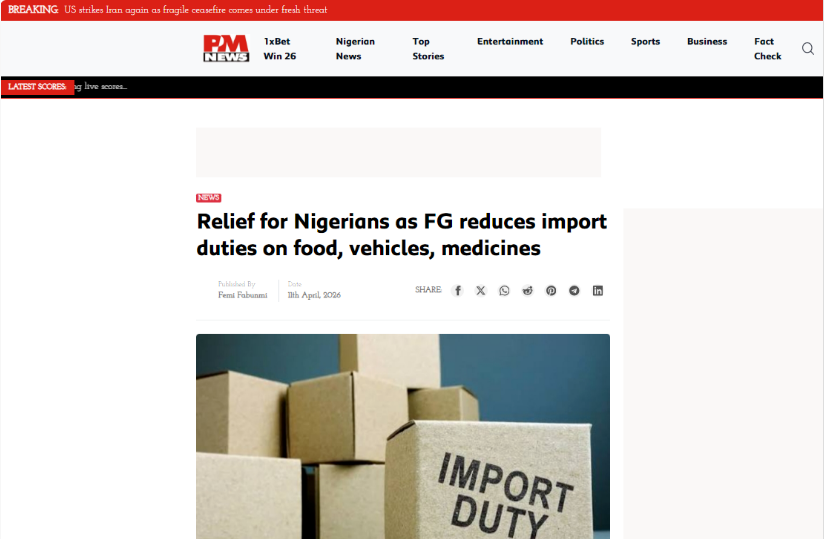
Screenshot of a document officially issued by the Ministry of Finance of Nigeria on April 1, 2026 by FPM (Source: PM News Nigeria)
Link to the original policy:https://pmnewsgeria.com/2026/04/11/relief-for-Nigerians-as-fg-reduces-duties-on-food-vehicles-medicines/
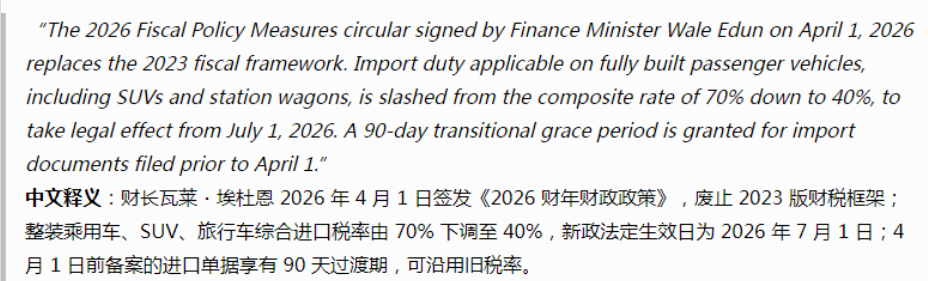
Sources: Ministry of Finance of Nigeria 2026 FPM Official Announcement, Finance in Africa, PM News Nigeria
2. Implementing supporting green emission tax will increase the cost of large-emission models
Also implemented in parallel with the tariff reduction is graded green environmental protection taxes. The taxes and fees are charged differently according to engine displacement, which has become a key factor affecting the selection: models with a displacement of less than 2000cc are exempt from green surcharges, and the advantages of 1.5L, 1.6L, 1.8L mainstream household models are prominent; the displacement is in the range of 2000cc-3999cc, with an additional 2% surcharge; for models with a displacement of 4000cc and above, the surcharge rate rises to 4%.
The tax grading guidance is very clear. The policy is intended to guide the import of small-displacement energy-saving models and control the inflow of high-fuel-consuming and large-displacement vehicles. The import cost of large-displacement off-road and luxury models will passively rise, and subsequent market circulation will gradually shrink.
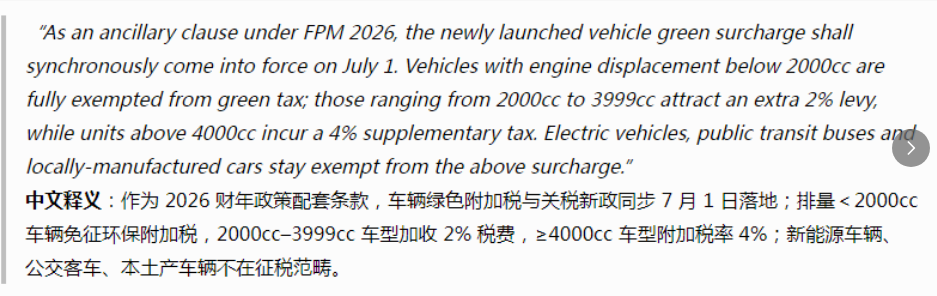
Sources: Ministry of Finance of Nigeria 2026 FPM Official Announcement, Finance in Africa, PM News Nigeria
3. Fixed access standards for used cars, and compliance is the primary prerequisite for customs clearance
In addition to changes in taxes and fees, Nigeria has implemented normalized import control rules in 2026, and three mandatory requirements will continue to take effect throughout the year. First, only left-hand rudder vehicles will be released, and right-hand rudder vehicles without official approval will not be allowed to enter the country; second, the vehicle accounting period is based on the ex-factory production date, and only models less than 12 years old have been exported for customs clearance. Corresponding to this year, only vehicles produced in 2014 and later can be exported; third, all categories of vehicles must complete VehCAP compliance certification before being shipped. Vehicles lacking corresponding qualified documents cannot go through customs clearance procedures after arriving at the port, posing a risk of being detained and returned.
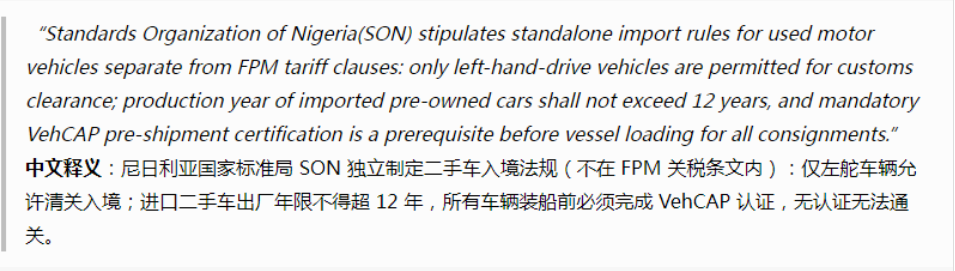
Sources: Ministry of Finance of Nigeria 2026 FPM Official Announcement, Finance in Africa, PM News Nigeria
4. Domestic car dealers 'stocking and operating ideas under the New Deal
With the two major changes in the comprehensive tax rate reduction and emission tax classification, family cars and small SUVs with 3 to 8 years old and a displacement of 1.6L-2.0L have become the preferred categories for the Nigeria market. This type of model not only meets the dual compliance standards of vehicle age and displacement, but also enjoys the tax-free bonus of small displacement. The terminal landing cost is the best, which meets the daily transportation needs of ordinary local families.
On the other hand, for medium and large displacement models, the profit margin continues to shrink after the addition of additional taxes. It is recommended to appropriately reduce the stock ratio. At the same time, the entire export process must apply for VehCAP certification in advance, improve vehicle procedures, and rely on compliant vehicle sources to seize the market increase brought by tax reduction.
The new tax regulations that will come into effect on July 1 will open a cost dividend window for the import of used cars in Nigeria. However, the tightening of environmental taxes and access certification has also forced the industry to bid farewell to the extensive stocking model. Based on the guidance of the New Deal, focusing on small-displacement, low-life compliant family cars, and strictly adhering to local vehicle age, model and certification regulations can we steadily expand the Nigeria market based on tariff dividends.
The content of this article is original sharing, and everyone is welcome to read and communicate. Please indicate the source for reprinting, and thank you for your respect and support for the original content. The published content is only used for industry popularization and reference, and does not provide any express or implied guarantee of the accuracy and integrity of the content. If there is any graphic infringement, please let us know and we will deal with it as soon as possible. Thank you!

 Online Evaluation
 I am Buyer
 Export Services
 subsites


 023-62852688
  No. 1-1, No. 2899, Longzhou Avenue, Banan District, Chongqing City
 Headquarters


