
 Chinese
 Russian
 Arabic
Ethiopia: China's first stop for second-hand new energy vehicles to Africa
Ethiopia is indeed the most strategic entry point for China's second-hand new energy vehicle exports to Africa. The core reason comes from a world-first policy and a statistical fact.
1. The world's first ban on burning: policy barriers become market windows
On January 29, 2024, the Ministry of Transport and Logistics of Ethiopia officially confirmed a complete ban on the import of fossil fuel vehicles, becoming the first country in the world to ban the import of fuel vehicles at the national level.
The driving logic behind it is not purely environmental ideals, but rigid economic and energy security accounts:
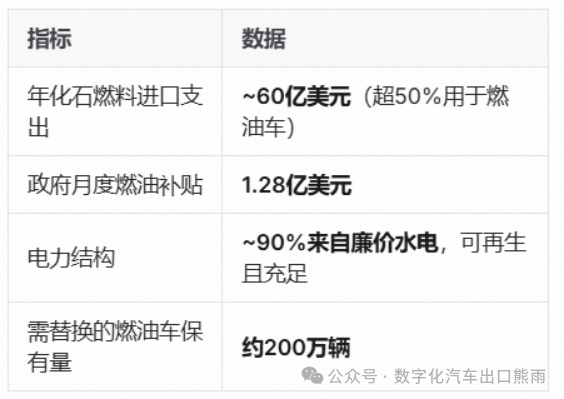
Simply put: foreign exchange cannot hold on and continue to burn oil, while domestic water and electricity are cheap and sufficient, and electrification is the only way out.
This means that starting from February 2024, the Ethiopian market will completely close the door to fuel-fueled used vehicles, and pure electric vehicles will become the only legal import option. For China's used car exporters, this is not an ordinary incremental market-it is an exclusive market where policy barriers naturally filter all non-new energy competing products.
2. China's export data: Ethiopia alone consumes one third of Africa's total
According to China's Ministry of Commerce and industry data:
2024: China exports 19,386 electric vehicles to Africa
2025: China exported 44,358 electric vehicles to Africa (year-on-year +129%), of which Ethiopia accounted for about 1/3, with an amount exceeding US$200 million
Ethiopia has surpassed traditional key markets such as South Africa, Egypt, Morocco, and Nigeria to become the largest destination country for China's electric vehicle exports to Africa.
Entering 2026, the growth rate is still accelerating:
- In the first five months of 2026, sales of electric vehicles in Ethiopia reached 24,356 units (only 10,431 units in the same period in 2025)
- There are more than 115,000 electric vehicles on roads across the country, accounting for about 8% of car ownership.
3. Policy resonance: China zero tariffs + Ethiopia ban = double dividends
The two policies were implemented almost simultaneously, forming a rare combination of exporting countries pushing + importing countries pulling:
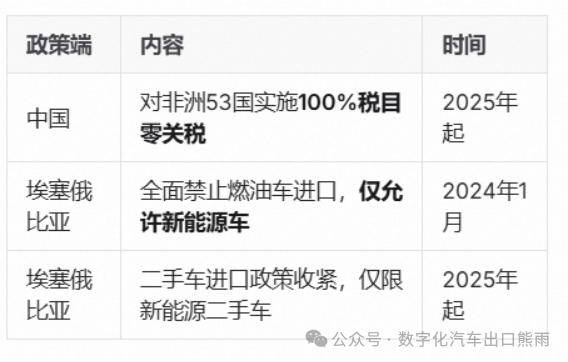
In addition, many African countries are also following suit:
- Ghana: Exemption from tariffs on electric vehicles
- Egypt: Duty-free for pure electric used cars
Ethiopia is among the countries with the most thorough policies and the earliest implementation, forming a de facto policy moat.
For those who export used cars, the core proposition of the Ethiopian market has changed from whether they can enter the market to whether they can bring charging, maintenance, accessories, and after-sales. In the future, the focus is no longer the price of bicycles, but the overall delivery capabilities of cars + services + supporting facilities.
Source: Xiong Yu, digital automobile export
[Disclaimer] The content of this website (including pictures and texts) originates from the Internet, and the copyright belongs to the original author. Respect the rights and interests of originality, and select content is only used for information sharing. If copyright disputes are involved, please contact us to handle them in a timely manner

 Online Evaluation
 I am Buyer
 Export Services
 subsites


 023-62852688
  No. 1-1, No. 2899, Longzhou Avenue, Banan District, Chongqing City
 Headquarters


