
 Chinese
 Russian
 Arabic
Introduction: The export of new energy used cars has changed from "multiple choice questions" to "must-answer questions"
In the first quarter of 2026, China's total automobile exports reached 2.226 million units, a year-on-year increase of 56.7%, of which 954,000 new energy vehicles were exported, a year-on-year increase of more than 120%. At the same time, with the new regulations in 2026 strictly controlling the export of "zero-kilometer used cars", the industry is accelerating its transformation to real used car trade, and pure used car exports have become the mainstream of transformation.
New energy used car exports face a more complex international policy environment: countries have different import standards, tariff policies and age limits for electric vehicles. This article will focus on the three target markets of Jordan (gateway to the Middle East), Thailand (hub of Southeast Asia), and Mexico (bridgehead of Latin America) to provide the most cutting-edge access guidance for China new energy used car exporters.
1. Jordan: Tax rates have been significantly reduced, but thresholds have been upgraded simultaneously
Policy overview: Starting from November 1, 2025, Jordan will implement comprehensive new regulations on imported vehicles. All imported vehicles (including new, used cars, fuel/electric/hybrid models) will need to pass compliance assessment with EU, US or Gulf standards.
Tax rate adjustment (positive): gasoline vehicles: from 71% to 51%(decrease by 28%); hybrid vehicles: from 60% to 39%(decrease by 35%); electric vehicles: unified low tax rate of 27%(previously planned to increase to 55%).
Key restrictions (challenges): Prohibition of the import of electric vehicles over 3 years old (including the year of customs clearance); prohibition of the import of damaged and scrapped vehicles; approximately 50,000 previously obtained exemptions for electric vehicles will be cancelled.
Impact and suggestions for Chinese companies: The tax rate reduction directly reduces export costs-Guangdong's second-hand car exports to Jordan have increased by 2.3 times year-on-year in the first seven months of 2025. After the implementation of the policy, the price advantage of compliant new energy models will be further amplified. However, the ban on the import of electric vehicles for more than three years old requires companies to quickly adjust the vehicle source structure and focus on high-quality second-hand electric vehicle resources within three years. Compliance assessment also requires additional investment in testing and certification costs.
2. Thailand: Southeast Asia's new energy hub, policies continue to be favorable
Market background: Southeast Asia has the fastest growth rate, with a year-on-year growth of 89%. It is the demand area for used cars that the World Bank focuses on. As the automobile industry center in Southeast Asia, Thailand's demand for new energy used vehicles has increased significantly.
Core advantages: Close geographical location, low logistics costs, and direct radiation from land corridors such as China-Laos railways; acceptance of electric vehicles continues to increase, and charging infrastructure is accelerated; in the right-hand rudder market, it is necessary to adapt to right-hand rudder models, which requires the right-hand rudder vehicle sourcing capabilities of China car dealers.
Hot sales direction: Small electric vehicles and household SUVs are hot categories in the Southeast Asian market. New energy used cars have higher premium capabilities and considerable profit margins in Southeast Asia.
Suggestion: Give priority to the layout of second-hand vehicles with new energy within three years, and combine the advantages of China-Laos railways to reduce logistics costs. The source of right-hand rudder vehicles is the core prerequisite for entering the Thai market.
3. Mexico: Strategic markets under the challenge of high tariffs
Policy changes (major challenges): Starting from 2025, Mexico will impose import tariffs on complete vehicles on countries that have never signed a free trade agreement (FTA) with it, including China. Tariffs on light vehicles have been significantly increased from 20% to 50%.
Cost impact: Taking a new energy vehicle with an export price of US$25,000 as an example, the total cost under the original 20% tariff is about US$31,000. After the tariff rises to 50%, the tariff cost for a single vehicle will increase by US$7500. The Mexican Automobile Manufacturers Association predicts that the market share of China brands in Mexico may fall below 6% in 2025.
Solutions and opportunities: The Mexican market is still huge, and tariff barriers can be circumvented through the CKD/SKD model or local cooperation in building factories; China's new energy vehicles have a high overall acceptance in Latin America, and BYD and other brands have performed strongly in Argentina, Chile and other markets; Argentina is exempt from tariffs on used electric vehicles under US$16,000, and the source of compliant vehicles will increase by 40% in 2026.
Recommendation: In the short term, the Mexican market recommends wait-and-see or choose a local cooperation model. The Latin American market can give priority to policy-friendly countries such as Argentina and Chile. Models such as BYD Yuan and Oura R1 are highly recognized in South America.
4. Comprehensive comparison of the three markets
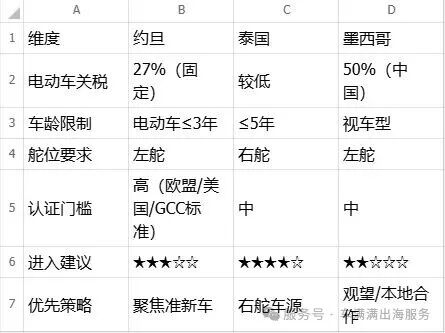
5. Strategic recommendations: Three paths for the export of used new energy vehicles
Path 1: Middle East market (Jordan + Gulf countries). The tariff reduction is the biggest benefit, but the threshold for compliance certification is high. It is recommended to concentrate resources to make certification breakthroughs. After passing the GCC standard certification, you can enjoy a 5% low tariff and car purchase subsidy, covering the zero-tariff market of the seven Gulf countries.
Path 2: Southeast Asian market (Thailand + Laos + Cambodia). With close logistics and fast capital turnover, it is suitable for small and medium-sized car dealers to start. Giving full play to the advantages of domestic new energy vehicles in "dimension reduction and strike"-comprehensively leading the way in intelligence, battery life, and appearance, they have become a "hot potato" in Laos and other countries.
Path 3: Latin American market (Argentina + Chile). The policy dividend is significant, and the profit margin of used electric vehicles is large, with bicycle profits reaching US$12,000 to US$20,000. Under Mexico's high tariffs, Argentina and Chile are more realistic entry points.
Source: Full of cars to sea service
[Disclaimer] The content of this website (including pictures and texts) originates from the Internet, and the copyright belongs to the original author. Respect the rights and interests of originality, and select content is only used for information sharing. If copyright disputes are involved, please contact us to handle them in a timely manner

 Online Evaluation
 I am Buyer
 Export Services
 subsites


 023-62852688
  No. 1-1, No. 2899, Longzhou Avenue, Banan District, Chongqing City
 Headquarters


