
 Chinese
 Russian
 Arabic
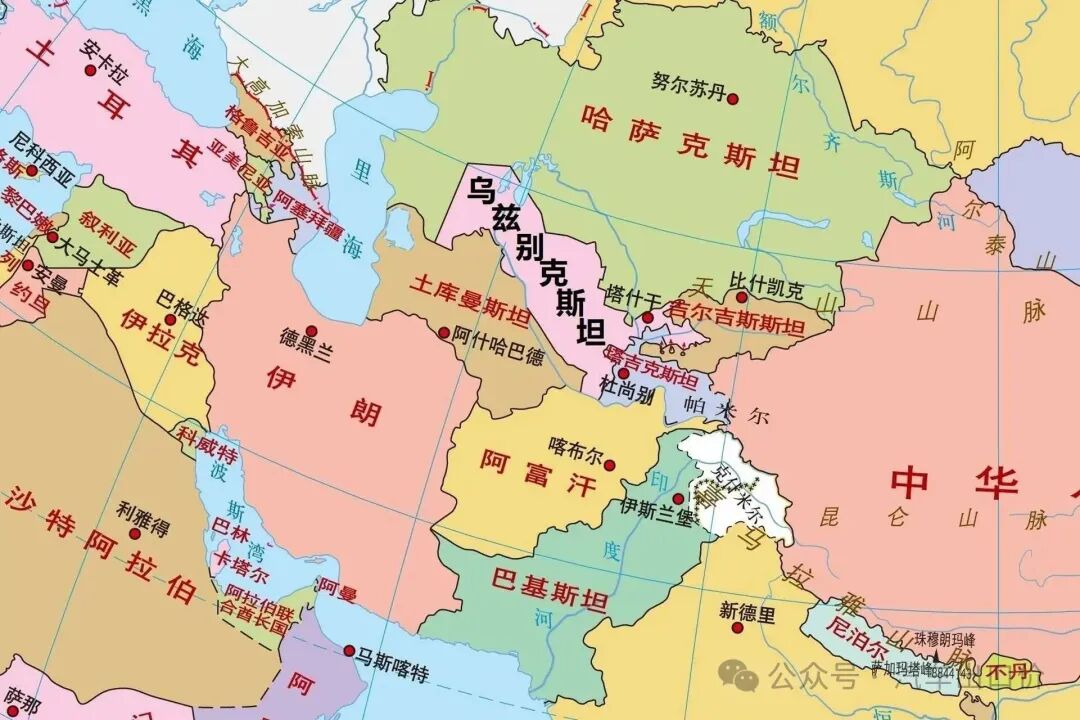
[Core Warning] At the beginning of 2026, Uzbekistan's automobile import policy will usher in a "disruptive adjustment"-the elimination of preferential tariffs on small-displacement fuel vehicles, the increase in new energy support, and the mandatory implementation of environmental protection certification, directly reconstructing the market competition landscape. For China small and medium-sized automobile foreign traders seeking a new blue ocean to go to sea, this is not only a "stress test" for rising costs, but also a "golden window period" for seizing the core markets of Central Asia.
As the ceiling of Central Asia's automobile consumption potential, Uzbekistan's total sales of new cars (including light commercial vehicles) in 2025 will reach 427,100 units, a year-on-year increase of 6.1%; 53,300 imported passenger cars, accounting for 12.5%, and sales of new energy vehicles are 40,700 units, a year-on-year increase of 35%. With the opening of the China-Kyrgyzstan-Uzbekistan railway and the entry into force of mutual visa exemption between China and Uzbekistan, this hot land is becoming a battleground for China's automobile foreign traders-from January to September 2025, more than 90% of Uzbekistan's imported passenger cars come from China. This article combines the latest policies, authoritative data and practical cases to break down the opportunities and risks of the entire link and help you accurately break the 2026 situation!
1. Market status: policy-driven structural changes
Uzbekistan's automobile market is undergoing a key transformation from "inclusive growth" to "structural optimization." Its core characteristics highlight three major changes:
1.The overall scale is steadily expanding:in 2025, the country's passenger car output will reach 457,900 units, a year-on-year increase of 6.7%; 79,800 imported passenger cars will be imported, a year-on-year increase of 7.1%. Although the import volume dropped slightly by 8.1%, the import volume of parts and complete vehicles surged by 34.4% year-on-year to US$1.7 billion, reflecting the gap in supporting demand for the industrial chain. Locally produced vehicles account for 85.5% of new car sales. The trend of market autonomy is obvious, but import demand is concentrated on new energy and mid-to-high-end models.
2.New energy has become an absolute outlet:In 2025, Uzbekistan's sales of new energy vehicles will be 40,700 units, a year-on-year increase of 35%, of which Tashkent City will account for more than 70%, becoming a core consumption area; the import volume of electric vehicles has surged 2.4 times year-on-year. Driven by policy dividends and consumption upgrades, the growth space for new energy tracks has been completely opened up.
3.Regional radiation advantages are prominent:As a party to the Free Trade Area of the Commonwealth of Independent States, Uzbekistan is building an automobile trade hub in Central Asia. Local imported vehicles exported to Kazakhstan and Kyrgyzstan can enjoy preferential tariffs, providing China foreign traders with an expansion path of "one place layout and multiple country coverage."
2. Policy Environment: Dismantling of the Core of the 2026 New Deal (must-see for foreign traders)
The three major new policies implemented from January 1, 2026 directly determine foreign trade merchants 'product selection, pricing and compliance strategies, and need to focus on controlling "dividends" and "risk points":
Good policies: New energy and supporting facilities usher in an explosion period
Extension of tariff exemption: The import tariff exemption period for electric vehicle charging stations, components, and supporting facilities will be extended to 2028, and charging pile companies will welcome policy dividends.
Financial policy tilt: The loan interest rate for imported electric vehicles dropped from 22.5%-33% to 16%, directly stimulating the purchasing power of local consumers.
Speed up logistics customs clearance: China-Europe (Asia) trains are operating normally, Horgos Port achieves 7×24-hour customs clearance, and the number of vehicle export inspection links has been reduced to 4, greatly improving circulation efficiency.
Risk red line: Small-displacement fuel vehicles and upgrading compliance thresholds
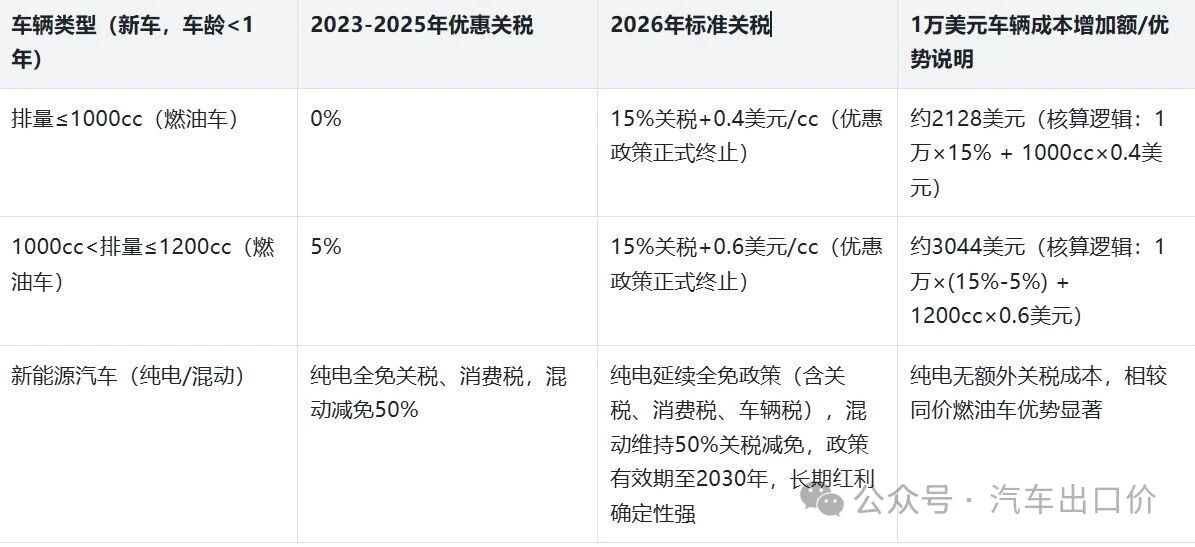
Preferential tariffs on small emissions are terminated: tariffs on new cars under 1.0L increase from 0% to 15%+ US$0.4/cc, and below 1.2L increase from 5% to 15%+ US$0.6/cc. Taking the US$10,000 1.2L model as an example, the cost increased by approximately US$3044, and the profit margin was almost compressed.
Mandatory environmental certification: Fuel vehicles must meet Euro 2 (gasoline)/Euro 4 (diesel) standards and affix environmental protection stickers. Vehicles that fail to meet the standards will face restrictions in Urban area and delays in licensing; new energy vehicles are exempted from this requirement, resulting in lower compliance costs.
Strengthening tax compliance: Operators with an annual turnover of less than US$80,000 are subject to a 1% business tax, and ecological tax needs to be calculated in advance. Incomplete documents may face customs penalties.
3. Competitive landscape: The rise of China brands and the disintegration of the old landscape
The Ukrainian market, which has long been monopolized by Chevrolet, is being rapidly broken by China brands. The changes in the pattern in 2025 will be particularly significant:
1. The share of traditional giants has declined: Chevrolet's market share has dropped from 87.9% in 2024 to 83.2% in 2025. The production of core models such as Cobalt and Damas has dropped by 2.3% and 8.1% respectively. Onix's production has plummeted by 20.5%, and the market gap continues to widen.

2. China brands have made a strong breakthrough: BYD's output has more than quadrupled year-on-year, reaching 20,200 units in 2025; Haval's output has almost tripled, from 3315 units to 9344 units; Chery has increased by 32%, and the Great Wall Tank 500 has achieved localized assembly and mass production. BYD Song Plus DM-i, Yuan Up and other models rank among the top sales leaders of non-local brands. Kia, Haval and others have achieved localized production through the ADM Jizzakh factory, further expanding market share.
3. The focus of competition has shifted: from "low-cost and small-displacement fuel vehicles" to "new energy + mid-to-high-end fuel vehicles", new energy SUVs and compact cars in the range of RMB 100,000 - 200,000, as well as pickup trucks and commercial vehicles that meet infrastructure needs. Become the core of competition.
4. Needs and preferences: Accurately match local consumption pain points
Grasping the needs of Ukrainian consumers is the key to accurate selection of products for small and medium-sized foreign trade merchants:
1. Differentiation of consumption levels: The rise of the middle class has driven demand for new energy vehicles. Tashkent City, as a core market, accounts for more than 70% of new energy sales; economic models are still needed in the sinking market, and Chevrolet Cobalt, Damas and other models still occupy the forefront of sales. The demand for high-quality used cars is strong, and the growth rate of new energy used cars is significant. It is recommended that foreign traders take into account the business layout of new cars and compliant used cars.
2. Product preferences are clear: SUVs are more popular because they are suitable for local road conditions. Extended range electric vehicles are suitable for the current status of charging facilities, and their acceptance is higher than pure electricity; fuel vehicles are preferred to choose large-displacement (more than 1.2L) and high-configuration models to make up for tariff increases. The cost-effective disadvantage.
3. Service demand gap: The local aftermarket is dominated by small stores. The lack of standardized after-sales and long parts distribution cycle have become core pain points. The "car + parts + after-sales" integrated model is extremely competitive.
5. Tariff list: 2026 latest tax rate table (accurate cost calculation)
6. Core advantages of China foreign trade merchants: grasping differentiated competitiveness
Compared with brands from other countries, China's small and medium-sized foreign trade merchants have three irreplaceable advantages:
1. Supply chain advantages: China's new energy vehicle industry chain is complete, with vehicle models covering from economic to mid-to-high-end, price ranges suitable for Uzbekistan's consumption capabilities, and spare parts supply is sufficient, making it possible to quickly build a "complete vehicle + spare parts" export system.
2. Policy synergy advantages: Policies such as China-Uzbekistan mutual visa exemption, China-Europe freight logistics support, and "tax refund upon entry" in the Urumqi Comprehensive Guaranteed Zone have greatly reduced trade costs and time costs, allowing small and medium-sized foreign trade merchants to take advantage of them to enjoy dividends.
3. Localization adaptation capabilities: China brands have accumulated mature experience in localization cooperation. Small and medium-sized foreign trade merchants can learn from NIO's ideal model and bind local dealers to quickly implement the project without building channels from scratch.
7. 6 practical suggestions for small and medium-sized foreign trade merchants
In the face of the reshuffle of the New Deal, blind entry will lead to losses. Only by precise layout can we break through. The following suggestions can be implemented directly:
1. Rapid optimization of product structure: Immediately eliminate small-displacement fuel vehicles of 1.0-1.2L, shift to mid-to-high-end fuel SUVs and MPVs of more than 1.2L, or focus on new energy models of 100,000 - 200,000 yuan, and combine charging pile exports to create a "one-stop solution".
2. Bind local high-quality channels: Give priority to connecting with leading local dealers such as Control Auto and Abu Sahari Automobile, sign long-term cooperation agreements, and use their networks to quickly deploy volume to avoid the high cost risks of self-built channels.
3. Risk avoidance in advance of compliance: fuel vehicles check environmental standards in advance and entrust third-party agencies to obtain European standard certification; improve commercial invoices, certificates of origin and other documents, and connect with local customs clearance agencies to avoid customs clearance delays.
4. Post-deep market services: Parts suppliers within the United Nations have set up spare parts warehouses in Uzbekistan to shorten the delivery cycle; provide technical training to local maintenance stores to enhance customer stickiness through standardized after-sales sales and make up for price disadvantages.
5. Leveraging the regional radiation effect: use Uzbekistan as a transit point, lay out surrounding markets such as Kazakhstan and Kyrgyzstan, and use tariff preferences in the CIS Free Trade Zone to expand trade volume.
6. Establish a policy early warning mechanism: pay close attention to Uzbekistan's single window system and China Council for the Promotion of International Trade information, promptly follow up on tariff and environmental protection policy adjustments, and optimize product and pricing strategies in advance.
Conclusion:
The new policy reshuffle of Uzbekistan's automobile market is essentially a structural adjustment to eliminate backward production capacity and support green industries. For China small and medium-sized automobile foreign traders, this is not a "departure signal", but an opportunity to "change lanes and overtake"-the exit gap for small-displacement fuel vehicles is an opportunity for new energy and mid-to-high-end vehicles to enter the market. By grasping policy dividends, accurately matching needs, and building a solid compliance bottom line, China's small and medium-sized foreign trade merchants can fully seize a place in this hot land in Central Asia. In 2026, the golden age of Uzbekistan's automobile market has arrived. If you choose the right track and find the right method, you will be able to share the trillions of blue seas!
Source: Automobile export price
[Disclaimer] The content of this website (including pictures and texts) originates from the Internet, and the copyright belongs to the original author. Respect the rights and interests of originality, and select content is only used for information sharing. If copyright disputes are involved, please contact us to handle the deletion in a timely manner.

 Online Evaluation
 I am Buyer
 Export Services
 subsites


 023-62852688
  No. 1-1, No. 2899, Longzhou Avenue, Banan District, Chongqing City
 Headquarters


