
 Chinese
 Russian
 Arabic
China Economics reporters Yin Limei and Zhang Shuo report from Beijing
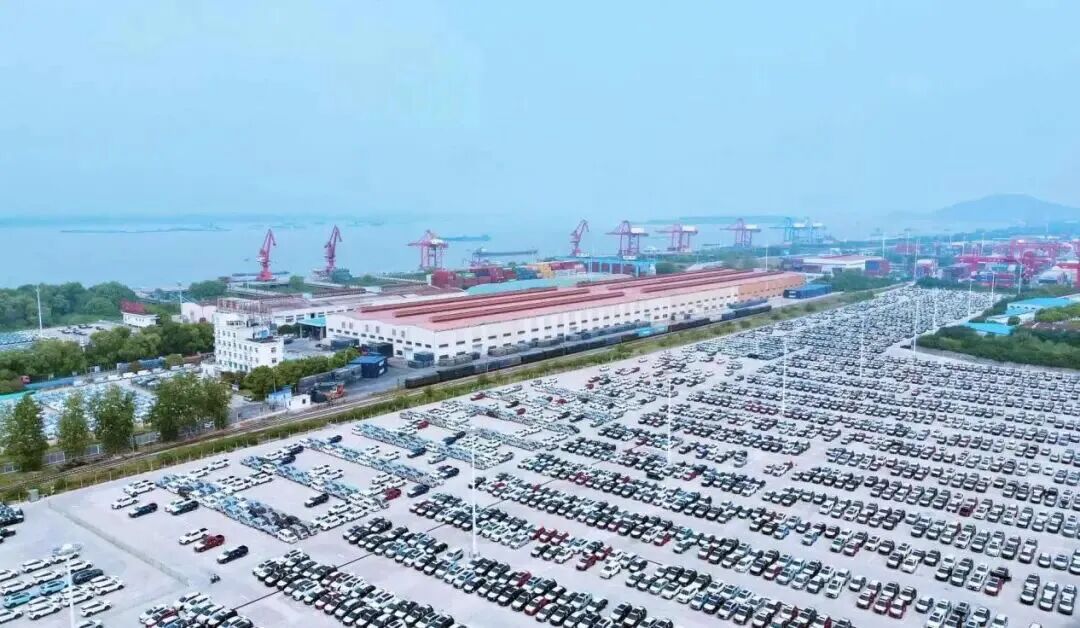
The sea breeze swept across the dock, the iron arm of the crane stretched and moved, and new energy vehicles slowly entered the cabin. Recently, the 7000-car LNG dual-fuel vehicle ro-ro ship "Kunpeng" steadily docked at Dalian Automobile Terminal. 2040 self-owned brand new energy vehicles drove onto the deck one after another, took ocean-going giant ships, and rushed to overseas markets. This scene has become a vivid epitome of the current craze of China's cars going to sea.
Recently, data disclosed by China Association of Automobile Manufacturers (hereinafter referred to as the "China Automobile Association") showed that in January, my country's automobile exports were 681,000 units, a year-on-year increase of 44.9%, and a month-on-month decrease of 9.5%. Among them, the export of new energy vehicles was 302,000, a year-on-year increase of double and a month-on-month increase of 0.5%; the export of traditional fuel vehicles was 380,000, a year-on-year increase of 18.8%, and a month-on-month decrease of 16.1%. Entering 2026, the growth momentum of automobile exports will remain unabated, and new energy vehicle exports will continue to grow at a high rate.
Looking at different models, pure electric and plug-in hybrid models have dual lines. In January, the export of pure electric vehicles was 202,000 units, a year-on-year increase of 16.9% month-on-month; the export of plug-in hybrid vehicles was 99,000 units, a year-on-year increase of 97.3%. New energy is the core driving force for the growth of my country's automobile exports.
In terms of passenger car exports, new energy vehicles already account for half of the country. According to data disclosed by the Passenger Car Market Information Joint Branch of China Automobile Dealers Association (hereinafter referred to as the "Passenger Car Federation Branch"), my country's passenger car exports in January (including complete vehicles and all parts assembled 576,000 vehicles, a year-on-year increase of 52%; New energy passenger vehicles exported 286,000 vehicles, accounting for 49.6% of passenger car exports, an increase of 12.5 percentage points over the same period last year. The proportion of new energy passenger car exports has approached 50%.
Xu Haidong, deputy secretary-general of the China Automobile Association, said in an interview with a reporter from China Business News that the growth of China's automobile exports no longer relies solely on price advantages, but more importantly, the overall leap in product competitiveness. "After years of technical accumulation, independent brands have developed positive research and development capabilities, intelligent and motorized technologies have been rapidly popularized, and the supply chain system has been improved, providing support for product upgrades."
Visible "change"
China's automobile exports are undergoing obvious changes.
Data disclosed by the Passenger Federation Branch shows that pure electric vehicles accounted for about 65% of new energy passenger vehicle exports in January. Among them, A00+A0 pure electric vehicles are still an important support, accounting for about half of pure electric exports. However, compared with the previous period, the proportion of mid-to-high-end pure electric and plug-in hybrid models is increasing, and the structure of automobile export products is gradually optimized, promoting the transformation of exports from "low-price sales" to "mid-to-high-end value upgrades."
At the same time, according to data from the Passenger Federation Branch, the top 10 countries in China's total new energy vehicle exports in 2025 are Belgium, the United Kingdom, Mexico, Brazil, the Philippines, the United Arab Emirates, Thailand, Australia, Indonesia and India, reaching 284,900, 231,200, 221,000, 200,800, 200,500, 191,900, 151,600, 145,800, respectively. 126,500 vehicles and 102,700 vehicles. Among them, the top five countries with the largest year-on-year increase are Mexico, United Arab Emirates, the United Kingdom, the Philippines and Indonesia, with increases of 140,600 vehicles, 115,000 vehicles, 112,000 vehicles, 86,000 vehicles and 73,400 vehicles respectively.
Cui Dongshu, secretary-general of the Chenglian Branch, pointed out that the high growth of new energy vehicle exports in Europe, Southeast Asia and other places means that the influence of China new energy vehicle brands in the international market continues to expand, laying the foundation for future export growth.
What deserves more attention is the changes in product technical content. China's new energy vehicles have begun to participate in competition in mid-to-high-end market segments in overseas markets. Relying on core advantages such as intelligent driving and self-developed third electric systems, China car companies no longer rely on cost-effective advantages. Instead, they compete head-on with international brands with their leading technical strength to achieve price and brand image in high-end markets such as Europe and the Middle East. Improve simultaneously.
"First of all, the relevant support policies and financial subsidies introduced by the state in previous years have directly promoted the development of the new energy vehicle industry. Secondly, under the guidance of national policies, China's automobile industry chain enterprises continue to promote the iterative upgrading of new energy vehicle products. After 2020, my country's new energy vehicle products have become very mature and achieved explosive growth. More importantly, after more than 40 years of learning and accumulation, my country's automobile industry has got rid of the past development model of relying on reverse R & D, and its own brands have fully developed positive design capabilities. In addition, the well-equipped supply chain system also provides solid support for vehicle production and technological improvement." Xu Haidong pointed out that unlike the export pattern of "low quality and low price" in the past years, China's cars have now achieved a significant leap in quality, and their capabilities such as design, smart cockpit, and assisted driving have also been simultaneously enhanced. These technologies have not only accelerated their popularization in new energy vehicles, but have also begun to be widely used in fuel vehicles. After product strength has reached a higher level, China car companies are forming new competitiveness of "high quality and low price."
Concentrate firepower on export markets
According to data from the China Automobile Association, my country's automobile exports will hit a new high in 2025, reaching 7.098 million units, a year-on-year increase of 21.1%. Compared with 5.859 million units in 2024 and 4.91 million units in 2023, achieving continuous leapfrog growth, demonstrating strong industry development resilience.
However, as the scale of automobile exports continues to expand, constraints and challenges from overseas markets also increase. Many countries and regions have increasing requirements for the proportion of localized manufacturing, and promoting localized manufacturing in target markets has become the choice of many companies.
The reporter noted that in 2025, domestic mainstream automobile companies will accelerate the layout of overseas production capacity and gradually form a global production system with multi-point implementation and regional coordination. The local factories of major independent brands in overseas markets will be put into production one after another. Entering 2026, many car companies have also clearly proposed to build the overseas market as the "second growth pole."
According to publicly disclosed data, many automobile companies achieved sales growth in the export market in January. Among them, BAIC Group's overseas market sales exceeded 26,000 units in January, a year-on-year increase of 16%. Great Wall Motor's overseas sales in January were 40,300 units, nearly half of total sales, a year-on-year increase of 43.77%. Great Wall Motor is making automobile exports the second growth pole.
China FAW has not disclosed January auto export data. However, Qiu Xiandong, Chairman and Secretary of the Party Committee of China FAW, recently pointed out at the deployment meeting of China FAW to accelerate the breakthrough of overseas businesses in 2026 that we must unswervingly regard meeting the needs of overseas users and serving overseas markets as the key starting point for solving development bottlenecks and cultivating new driving forces, and resolutely build overseas businesses into new sales and profit growth poles. This reflects the weight of export business in its overall strategy.
Great Wall Motor is also making efforts in overseas markets. For 2026, Great Wall Motors said that overseas markets are the key direction for Great Wall Motors in 2026. In the past, the models sold by Great Wall overseas were mainly Haval brands. In 2026, it will successively launch Haval brand Haval Raptors and Haval Xiaolong, Wei brand Gaoshan and Blue Mountains, Tank 500 and Oula models on new platforms overseas.
Behind the increased layout efforts of automobile companies, on the one hand, it stems from the profound changes in the competitive landscape of the domestic market. At present, the penetration rate of new energy in the domestic market continues to increase, price competition is fierce, and corporate profit margins are squeezed. Overseas markets have become an important channel to share production capacity pressure and optimize income structure.
On the other hand, it is also a major question that China automobile brands have to deal with when they are implemented in overseas markets. Bao Jiacheng, deputy director of the Automobile Marketing Division of the National Information Center, recently told participants, including reporters, at an industry forum that during the "15th Five-Year Plan" period, China automobile companies will transform from being sea-based enterprises in the past to global industrial chain layout enterprises. "More and more China car companies have chosen to deploy part of their production capacity overseas, and the proportion may have reached about 10% of total production." He pointed out that as vehicle production capacity goes out to sea, parts and components systems, service networks and supply chain resources should also simultaneously move to overseas markets.
This path has international experience as a reference. Take Toyota Motor as an example. About two-thirds of its global production is located in overseas markets, forming a highly localized production system. Its global layout is not simply a complete vehicle export, but a closed-loop system covering R & D, manufacturing and sales. For China car companies, if they want to achieve long-term competitiveness in the global market, they must complete similar transitions and upgrades.
International consulting firm Roland Berger also pointed out in its latest "2025 China Automobile Globalization Development Report" that before 2030 is a key window period for the globalization of China's automobile industry, and China is expected to create a number of global automobile industry chain enterprises. Today, the window for globalization of China's automobiles is halfway through. Although its achievements are very significant and it has entered the global mainstream camp, the overseas localization rate of China brands still lags significantly behind that of Japanese, European, American, Korean and other automobile companies. China's automobile industry needs to accelerate its move towards the global operation stage, that is, to achieve global integrated operations such as planning, design, R & D, production, procurement and marketing, which is the key topic in the next stage.
Source: China Business News Vision
[Disclaimer] The content of this website (including pictures and texts) originates from the Internet, and the copyright belongs to the original author. Respect the rights and interests of originality, and select content is only used for information sharing. If copyright disputes are involved, please contact us to handle the deletion in a timely manner.

 Online Evaluation
 I am Buyer
 Export Services
 subsites


 023-62852688
  No. 1-1, No. 2899, Longzhou Avenue, Banan District, Chongqing City
 Headquarters


