
 Chinese
 Russian
 Arabic
China's automobiles have entered a new stage of two-wheel drive of product exports + overseas factories: exports have ranked first in the world for three consecutive years, and new energy has exploded; overseas factories have moved from KD assembly to full-process manufacturing, with the core being to avoid barriers, cultivate local cultivation, and build an ecology. In the future, it will be upgraded from "scale to sea" to "value to sea" to form a new energy vehicle industry system dominated by China in the world.
1. Export status: No. 1 in the world, the explosion of new energy
1. Core data (2025)
Total volume: 8.324 million vehicles were exported (General Administration of Customs),+29.9% year-on-year, ranking first in the world for three consecutive years; China Automobile Association's caliber was 7.098 million vehicles,+21.1% year-on-year.
Structure: New energy exports were 2.615 million units,+103.7% year-on-year, and the proportion increased to 37%.
Amount: Vehicle exports were US$142.46 billion,+21% year-on-year.
Pattern: Chery (1.344 million), SAIC (1.07 million), and BYD (1.04 million) exported more than one million, accounting for nearly 50% of total exports.
2. Major Markets (2025)
Mexico (625,000): The largest exporter, the bridgehead of North America.
Russia (583,000), United Arab Emirates (572,000): The second and third largest markets.
Europe (810,000): Share of 6.1%, MG and BYD performed outstandingly.
Southeast Asia: Thailand, the Philippines, etc. all exceeded 100,000, and the RCEP dividend was significant.
Middle East: Saudi Arabia and United Arab Emirates totaling 874,000, a high-profit market.
3. Export characteristics
Leading by new energy: Hot models such as YuanPLUS, Dolphins, and Seagulls drive growth.
Capacity upgrade: SAIC, BYD and Chery have built their own ocean-going ro-ro ship teams to reduce logistics costs and improve delivery efficiency.
Trade barriers have intensified: EU countervailing investigations and Mexico's proposed tariff increases have forced localized production.
2. Build factories overseas: from KD to full-process, going to sea ecologically
1. Layout status (2025 - 2026)
Southeast Asia (core hub)
Thailand: Seven China automobile companies have built factories with a total planned production capacity of 600,000 vehicles +. BYD Luoyongfu (150,000/year), Chery, Chang 'an, etc. have been put into production.
Vietnam: Chery Xing 'an Province factory (put into operation in 2026, 200,000 yuan/year, the largest in ASEAN).
Malaysia: Geely AHTV Industrial Park plans to integrate 500,000 yuan per year of "research, production, marketing and service".
Europe (high-end breakthrough)
BYD Hungary: 4 billion euros, put into production in Q2 2026, 150,000 yuan/year, the first Dolphin Surf.
Chery Spain: Renovation of the old Nissan plant and large-scale production in 2026.
Zero running +Stellantis: Spanish joint venture to produce B10 and B05 in 2026Q3.
Latin America (scale expansion)
Brazil: BYD (put into production in 2025.7), Great Wall (put into production in 2025.8, acquired the old Mercedes-Benz factory, 50,000 yuan/year).
Mexico: Many car companies are promoting KD/full-process layout to circumvent North American barriers.
Others: Great Wall has full-process/CKD factories in Russia, Ecuador, etc.; Chang 'an Overseas 9 factories, covering 103 countries.
2. Upgrading of factory building model
1.0 KD assembly: Export of spare parts, local assembly, low-cost, fast implementation (early mainstream).
2.0 Full-process manufacturing: Complete factory for stamping, welding, painting, and final assembly, adapt to local regulations and improve response (current mainstream).
3.0 Ecological sailing: complete vehicle + battery/electric drive + parts + R & D + service integration (representatives of BYD, Great Wall, and Geely).
3. core purpose
Avoiding tariffs/barriers: The EU, Mexico, etc. impose additional tariffs, and local production costs can be reduced by 30%+.
Close to the market: Quickly respond to demand and customize right-hand rudder/hybrid/plug-in hybrid models.
Enhance brand: From "Made in China" to "Made in Local" to enhance trust.
Supply chain collaboration: Drive Ningde Times, Fedi and other parts to go out to sea to build a local ecosystem.
3. Future trends: From scale to value, global systematization
1. Exports: Stable growth + structural optimization (2026 - 2030)
Total volume:7.4 - 8 million vehicles are expected in 2026, and may exceed 10 million in 2030.
Structure:New energy accounts for more than 50%, and the proportion of high-end and intelligent models has increased.
Market:Europe's share ranges from 6% to 15%+; Southeast Asia, the Middle East, and Latin America continue to increase; Africa and Central Asia have become new growth points.
Mode:Export + local production is parallel, and local production is the main focus in high-barrier markets.
2. Overseas factories: global layout + deep localization
regional focus
Southeast Asia: Theworld's largest new energy vehicle production base has been built with a total production capacity of 2 million +.
Europe:All leading car companies have installed factories, and the local procurement rate has increased to 50%+(excluding batteries).
Latin America:Brazil and Mexico have become hubs of North and South America, with a production capacity of 1 million +.
Middle East/Russia:Consolidate full-process factories and radiate to surrounding areas.
model innovation
Acquisition and transformation:Acquisition of idle factories such as Ford and Mercedes-Benz, and rapid implementation (Geely, Great Wall, Zero Run).
Joint venture cooperation:Share production capacity and technology with Stellantis, Magna, etc. to reduce risks.
Supply chain clusters:"China Automobile Industrial Parks" have been formed in Thailand, Hungary, etc., where complete vehicles + parts are clustered.
Technology output:technologies such as SPCO, 800V, and smart driving are authorized to be produced locally, from "product output" to "technical output".
3. challenges and countermeasures
Trade barriers:EU carbon tariffs, U.S. IRA, Mexico tariffs → Accelerate local production + supply chain localization.
Brand premium: Theaverage price of China brands is lower than that of Japan and South Korea → High-end models + technology + service upgrades.
Supply chain security:insufficient overseas parts and components → simultaneous shipping of core parts and components + local procurement.
Cultural compliance:Differences in market regulations, labor, and environmental protection → local team + compliance system.
IV. Summary
China's automobiles are moving from "product going global" to "industry going global": exports are the foundation, and overseas factories are the growth pole. In the next 5 - 10 years, China automobile companies will form a complete system of R & D, manufacturing, supply chain, and services around the world, upgrading from "the world's largest automobile exporter" to a global leader in the new energy automobile industry.
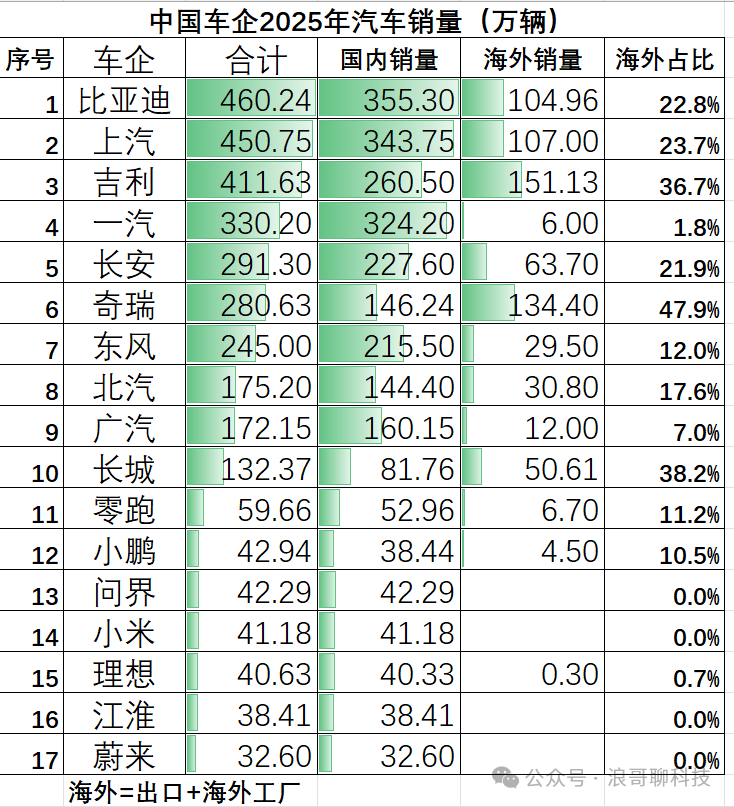
Source: Lang Ge Talk Technology
[Disclaimer] The content of this website (including pictures and texts) originates from the Internet, and the copyright belongs to the original author. Respect the rights and interests of originality, and select content is only used for information sharing. If copyright disputes are involved, please contact us to handle the deletion in a timely manner.

 Online Evaluation
 I am Buyer
 Export Services
 subsites


 023-62852688
  No. 1-1, No. 2899, Longzhou Avenue, Banan District, Chongqing City
 Headquarters


