
 Chinese
 Russian
 Arabic

1. Basic situation
The Russian Federation (referred to as Russia) is located in the northern part of Eurasia, spanning both continents of Europe and Asia. The capital, Moscow, has a land area of 17.098 million square kilometers and a population of approximately 146 million. According to statistics from the Russian Federation's State Statistics Office, Russia's GDP will grow by 4.1% in 2024, reaching a record high of 200 trillion rubles. Faced with the turbulent and changing world political landscape and the profoundly changing international trading environment, China-Russia economic and trade cooperation continues to deepen and the trade structure is stable and improving. Cooperation in automobiles, electromechanical, agriculture and other fields has achieved dazzling results, and cooperation in emerging fields such as service trade and cross-border e-commerce has strong momentum. According to data released by the General Administration of Customs of China, in 2024, the annual trade volume between China and Russia will reach US$244.82 billion, an increase of 1.9%. Among them, China's exports to Russia increased by 4.1%, totaling approximately US$115.5 billion; imports of goods to Russia remained the same as in 2023, totaling US$129.32 billion. my country's exports to Russia are mainly industrial products, of which mechanical and electronic products account for 37.5%. In addition, transportation equipment products, textiles and clothing, metals and their products, chemicals, etc. are also the main commodities China exports to Russia. China mainly imports energy products, metal minerals, agricultural and sideline foods, etc. from Russia.
Russia is rich in natural resources and has a high degree of self-sufficiency. Forest coverage reaches 65.8%, ranking first in the world. Timber storage ranks first in the world. The proven reserves of natural gas account for 25% of the world's proven reserves, ranking first in the world. Proved oil reserves account for 9% of the world's proven reserves. Coal reserves rank fifth in the world. The reserves of iron, nickel and tin rank first in the world. Gold reserves rank third in the world. Uranium reserves rank seventh in the world.
2. Automobile market situation
Russian car sales have been recovering steadily since the end of 2022, but growth slowed at the end of 2024 as high inflation, high loan rates and scrapping taxes push up prices. Since November 2024, the scrapping tax policy on imported cars in Russia has greatly affected sales, resulting in negative growth in China's automobile exports to Russia. Sales in the Russian automobile market have dropped by 28% month-on-month. Russian sales of most China automobile companies such as FAW and Dongfeng have shrunk sharply month-on-month.
In 2024, Russia will remain the largest importer of cars from China and the country with the fastest import of cars from China. Data from the Russian Ministry of Industry and Trade shows that sales of new passenger cars in Russia will increase by 47% year-on-year to 1.55 million units in 2024. Among them, the number of cars imported from China by Russia increased by 248,000 year-on-year. In the Russian automobile market in 2024, Haval will become the most popular foreign automobile brand in the Russian market. The brand's annual sales in the Russian market reached 190,600 units, a year-on-year increase of 70.6%. The top ten foreign automobile brands in the Russian market also include Chery, Geely, Chang 'an, Chery Omunda, Xingtu and Jetu.
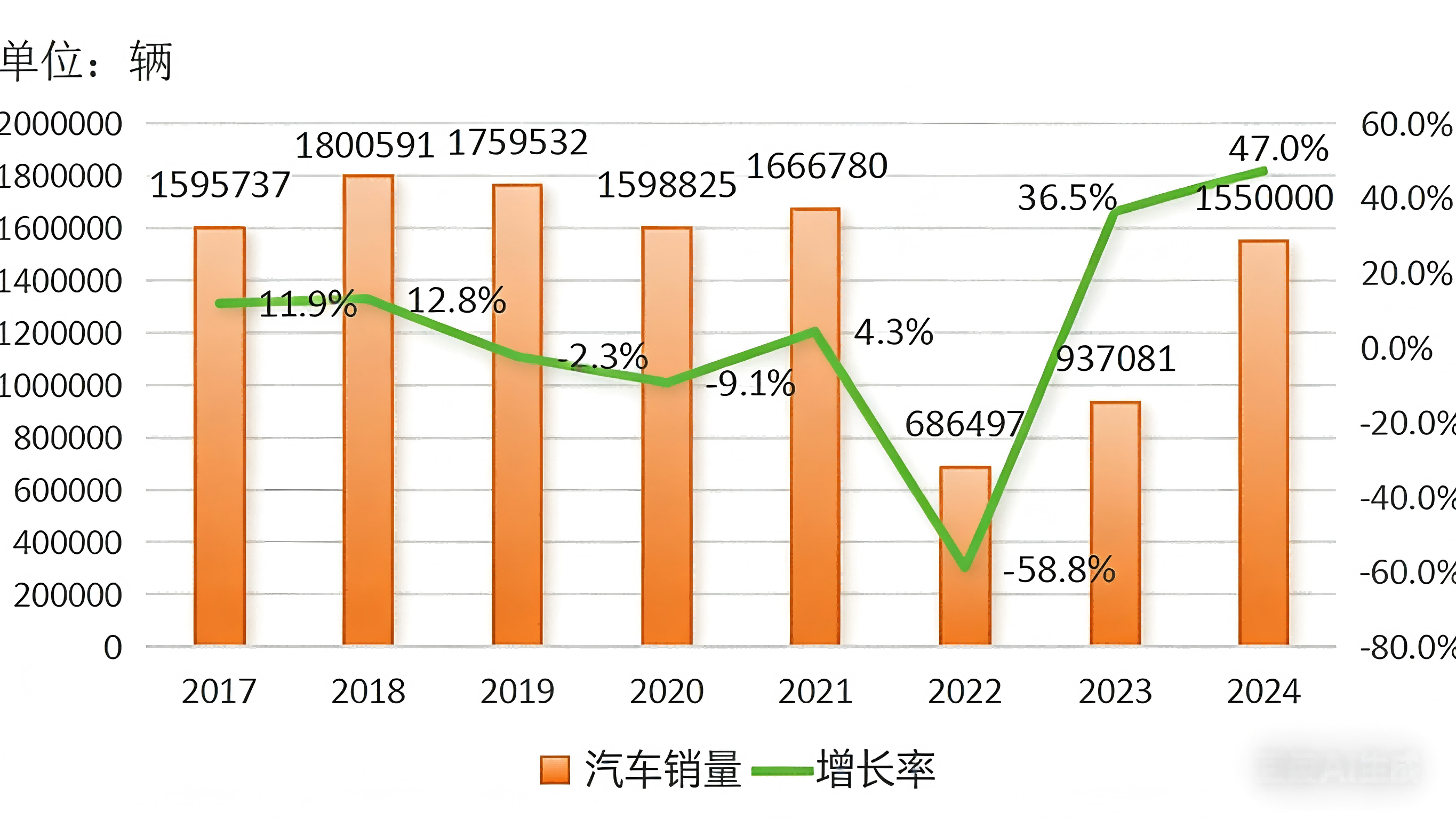
2017-2024 Russian car sales in 2009
Data source: China Automotive Industry Information Network, Russian Ministry of Industry and Trade
In terms of used cars, according to ABTOCTAT data, a total of 6.04 million used cars were sold in Russia throughout the year, a year-on-year decrease of 6%. Lada remains the leader in the Russian used car market. This was followed by Japanese brand Toyota, with sales of 619,500 units. South Korean brands Kia and Hyundai ranked third and fourth respectively, with sales of 349,500 units and 332,200 units, while Japanese brand Nissan ranked fifth with 282,700 units. Among them, China's second-hand car sales in Russia reached 196,800 units, a year-on-year increase of 69%. Among the best-selling models of used cars, new energy brands such as Krypton, Ideal, and BYD have become new favorites in the market. In addition, according to Autostat data, the trading volume of used electric vehicles in Russia will reach 12,300 in 2024, a year-on-year increase of 18%, a record high.
3. Policies and regulations on used car import
1. Import policy
Imported cars from Russia need to meet European V emission standards. There are no restrictions on the age of imported vehicles. However, high tariffs are imposed on individuals who import used cars for more than 5 years and those imported by legal entities who import used cars for more than 7 years. At present, Russia's automobile imports are generally divided into three methods: individual imports, legal entity imports and parallel imports.
(1)private import
When Russian natural persons import cars of different vehicle ages, they can obtain a Vehicle Structural Safety Certificate (SBKTS Certification) and conduct import customs declaration. However, the number of cars that each natural person can import per year does not exceed one and cannot be resold within one year.
(2)Import by legal entity
When a Russian legal entity imports a car over 3 years old, it needs to obtain a Vehicle Structural Safety Certificate (SBKTS Certification); when importing a car under 3 years old, it needs to obtain a Vehicle Type Approval Certificate (OTTC Certification) to prove that the imported vehicle complies with the relevant requirements of the Customs Union 1 "Technical Regulations on the Safety of Wheeled Vehicles"(TR-CU018/2011).
(3)parallel import
On April 1, 2024, Russia will tighten regulations on car imports through Federal Government Decree No. 152, introducing a new method to calculate the price of cars imported from Eurasian Economic Union (EAEU) countries, including Armenia, Belarus, Kazakhstan and Kyrgyzstan. The regulation aims to restrict those who import cars into Russia at lower customs prices and avoid the loss of tax revenue. This change will have a significant impact on the export of China cars to Russia. Companies must obtain OTTC certification for imported cars to conduct business; importing China cars requires strict rules and procedures, including passive safety testing and certification; licenses will be targeted at specific production facilities. This will increase the complexity, cost and duration of the import process.
In addition, Russia also requires imported cars to be equipped with the ERA-GLONASS emergency call system (costing 300-400 US dollars). However, as the public generally reports that the emergency call system cannot be matched with airbags and is difficult to install in used cars, Russia currently allows imported right-hand steering used vehicles from the Far East or residents relocated to the area not to install emergency call systems. Eligible vehicles include passenger cars with no more than 8 passenger seats (Category M1) and cargo vehicles with a maximum weight of no more than 3.5 tons (Category N1), and are limited to personal use.
2. Tax policy
Used cars imported into Russia need to pay customs duties, 20% value-added tax, consumption tax, customs clearance fees, scrapping and recycling fees, etc. At the same time, the preferential policy of zero tariff for pure electric vehicles imported into Russia from May 4, 2020 has been suspended from January 1, 2022, and imported electric vehicles are subject to a 15% tariff.
(1)Tariffs are determined based on the type of importer, vehicle age, vehicle value and engine displacement.
a. Personal imports: For vehicles under 3 years old, tariffs will be determined based on the value of the vehicle.
b. Personal imports: For vehicles older than 3 years, tariffs will be determined based on vehicle age and displacement.
c. Import by legal entities: Tariffs are fixed based on displacement and vehicle age.
(2)The consumption tax is a consumption tax of 0- 1,302 rubles/horsepower based on the power of imported used cars.
(3)Customs clearance fees range from 500 to 100,000 rubles depending on the value of the vehicle.
(4)Scrap tax: Russia has issued a decree to implement increased vehicle tax returns starting from October 1, 2024. The decree clarifies that Russia will increase the vehicle scrapping tax by 70%-85% starting from October 1, 2024, and continue to increase it by 10%-20% every year starting from January 2025 until 2030. The scope of application covers all wheeled vehicles, including multiple vehicle types including passenger cars, light commercial vehicles, trucks, buses, trailers, semi-trailers, and certain road construction equipment.
Russia's vehicle scrapping tax rate has increased significantly, especially the scrapping tax on fuel passenger cars with a displacement of more than 2.0L has increased by more than 718,000 rubles (about 50,000 yuan), resulting in a decline in exports in the Russian market (the tax rate for electric vehicles and hybrid vehicles will be increased from January 1, 2025).
3. Documents required for import
● Commercial invoices
● Customs value declaration
● Bill of lading
● Freight insurance
● Contract
● Single Administrative Document (SAD), etc.
Source: "China's Used Car Export Country Guide 2024"
This article is reproduced from the "2024 Country Guide" and is only used for information sharing. If infringement is involved, please contact and delete it. This site does not bear relevant legal responsibilities.

 Online Evaluation
 I am Buyer
 Export Services
 subsites


 023-62852688
  No. 1-1, No. 2899, Longzhou Avenue, Banan District, Chongqing City
 Headquarters


