
 Chinese
 Russian
 Arabic

1. Basic situation
The Republic of Turkey (referred to as Turkey) spans both Asia and Europe, with its capital, Ankara, with a land area of 783,600 square kilometers and a population of 85.27 million. According to data from the Turkish Statistics Bureau, Turkey's GDP in 2024 will be approximately US$1.3 trillion, an increase of 63.5%, and per capita GDP will reach US$15,463 million. According to statistics from China Customs, in 2024, the bilateral trade volume between China and Turkey will be US$42.89 billion, a year-on-year decrease of 1.2%. Among them, China's exports to Turkey were US$38.11 billion, a year-on-year decrease of 1.9%; China's imports from Turkey were US$4.77 billion, a year-on-year increase of 5.5%. Turkey is rich in mineral resources, mainly granite, marble, boron ore, chromium, thorium and coal, with a total value of more than 2 trillion US dollars. Among them, granite and marble reserves account for 40% of the world, and the number of varieties ranks first in the world.
2. Automobile market situation
Turkey is a left-hand car country, with approximately 250 cars owned by 1,000 people. The automotive industry is one of Turkey's largest industrial sectors and a hub for several European and Japanese manufacturers. On the basis of meeting its own needs, Turkey's automobile industry also exports to Europe, the Levant and North Africa. In 2024, Turkish car sales will be 1.24 million units, a year-on-year increase of 0.5%. Among them, passenger car sales increased by 1.3% compared with last year to 980341 units, while the light commercial vehicle market fell by 2.7% to 258168 units.
In terms of power types, sales of gasoline vehicles were 588914 units, accounting for 60.1%; sales of hybrid vehicles were 184177 units, accounting for 18.8%; sales of electric vehicles were 105315 units, accounting for 10.7%; sales of diesel vehicles were 95985 units, accounting for 9.8%; sales of liquefied petroleum gas vehicles were 5,950 units, accounting for 0.6%.
In terms of brand, Fiat ranked first in sales, with total sales of 138749 units, a year-on-year decrease of 28.3%. Renault ranked second in sales, with total sales of 133596, a year-on-year decrease of 1.5%. Ford ranked third with sales of 104907 units, a year-on-year increase of 2.5%. Chery, MG and BYD have become the top 3 brands of China. Among them, the sales volume of the Chery brand exceeded 50,000 units, reaching 57047 units, with a market share of 4.6%, surpassing Skoda;MG's total sales volume was 17162 units, with a market share of 1.4%; BYD's sales volume was 8331 units.
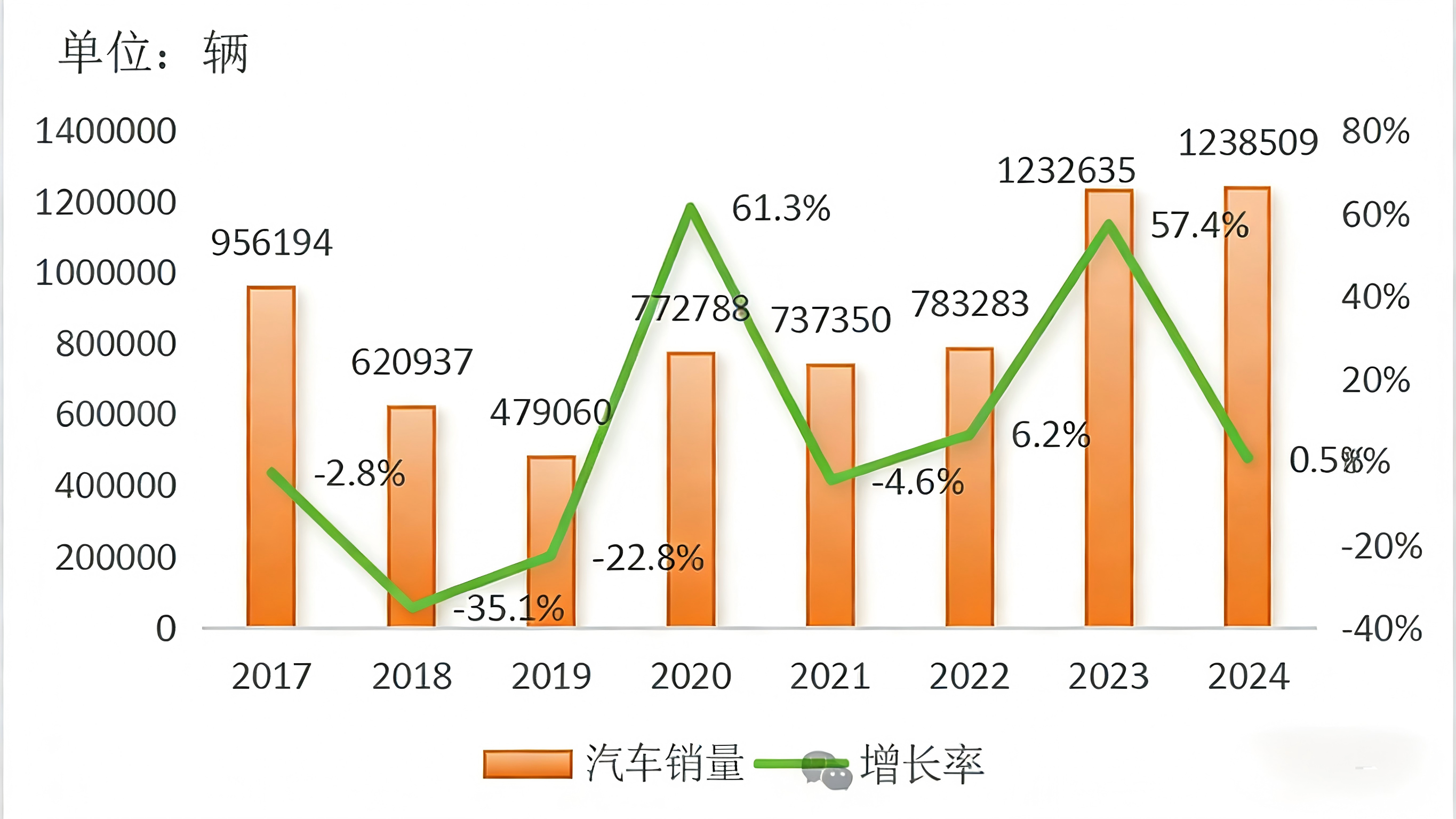
2017-2024 Car sales in Turkey
Source: Focus2Move
In terms of used cars, due to higher oil prices in Turkey, small-displacement economical cars are more popular in the automobile market. In terms of used car imports, Turkey mainly imports used cars through ports such as Istanbul Port, Ambari Port, Jimlik Port, Sansen Port, Trabzon Port, Iskenderun Port, Mersin Port and Izmir Port.
3. Policies and regulations on used car import
1. Import policy
Importing used cars in Turkey requires permission from the Ministry of Trade. Turkey has no restrictions on the age of imported used cars, but it requires regular testing at an authorized testing center. TUVTURK is the only company authorized to conduct inspection and performance testing. Imported vehicles need to be declared and registered at the customs, and a certificate of conformity issued by the Ministry of Industry and Technology or its authorized agency is submitted to the customs.
When bringing individuals into Turkey using a vehicle, they must register on their passport. Turkish residents are not allowed to temporarily import vehicles from abroad, but diplomats returning permanently are allowed to import used cars that are no more than three years old. For non-Turkish residents, imported foreign registered vehicles can enjoy tax exemptions and are allowed to drive on the road within 24 months from the date of import.
2. Tax policy
Importing used cars from Turkey requires customs duties, value-added tax, special consumption tax, etc., of which the tariff rate is 10%, and the value-added tax rate is 18%. In November 2020, Turkey announced an increase in the tax on imported vehicles, increasing the total tax rate on imported vehicles with a displacement of more than 1600ml from 60% to 80%, and the total tax rate on high-end imported vehicles from 160% to 220%. In February 2021, Turkey will increase the special consumption tax on pure electric vehicles from 3-15% to 10- 60%, which runs counter to Europe's policy of promoting the popularization of pure electric vehicles.
3. Documents required for import
● Commercial invoices
● Certificate of origin
● Original Bill of Lading (BOL)-must show chassis and engine numbers
● Proforma invoice
● Original purchase/commercial invoice
● One insurance policy
● Original ownership and registration certificate
Source: "China's Used Car Export Country Guide 2024"
This article is reproduced from the "2024 Country Guide" and is only used for information sharing. If infringement is involved, please contact and delete it. This site does not bear relevant legal responsibilities.

 Online Evaluation
 I am Buyer
 Export Services
 subsites


 023-62852688
  No. 1-1, No. 2899, Longzhou Avenue, Banan District, Chongqing City
 Headquarters


