
 Chinese
 Russian
 Arabic
Uzbekistan is a landlocked country located in Central Asia. Russian is the common language. It is one of the only two dual landlocked countries in the world (the other is Liechtenstein), with a land area of 448,900 square kilometers and its capital Tashkent.
Uzbekistan has a population of 37.36 million (as of October 2024). Among the five Central Asian countries, it has the largest population, accounting for about 45% of the Central Asian population. There are more than 130 ethnic groups, of which Uzbeks account for 83.8%. Most residents believe in Islam (Sunni), while the rest are mostly Orthodox.
Uzbekistan is rich in resources and is an important producer of natural gas, coal, copper, oil, silver and uranium in the region. The total value of mineral resource reserves is approximately US$3.5 trillion. There are currently nearly 100 mineral products identified.

Overview of the economy of Uzbekistan
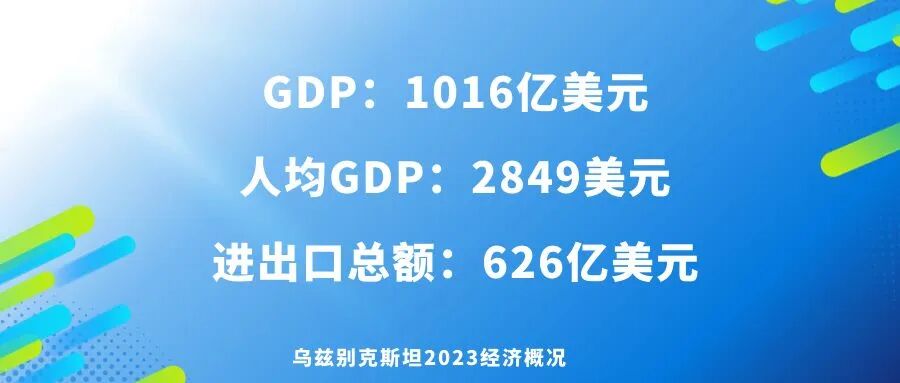
In 2023, the total GDP of Uzbekistan will be US$101.6 billion, exceeding US$100 billion for the first time; per capita GDP will be US$2849. According to data released by the World Bank, the proportions of agriculture, industry and services in GDP are 24.3%, 32.3% and 43.4% respectively.
Uzbekistan's total foreign trade in 2023 will be US$62.6 billion, of which total imports will be approximately US$38.2 billion, a year-on-year increase of 24%; total exports will be approximately US$24.4 billion, a year-on-year increase of 23.8%.
The top five trading partners are China, with a foreign trade proportion of 21.9%; Russia, 15.8%, Kazakhstan, 7%, Turkey, 5%, and South Korea, 3.7%.
Automobile market in Uzbekistan
Uzbekistan is one of the five Central Asian countries that started the automobile industry early and is also the country with the most mature automobile industry chain in the region. The number of cars in the country exceeds 4 million. Production and sales are dominated by passenger cars, accounting for more than 90% of domestic automobile production.
In 2023, Uzbekistan's automobile output will increase by 25% compared with the previous year to 425,876 units, exceeding 400,000 units for the first time.
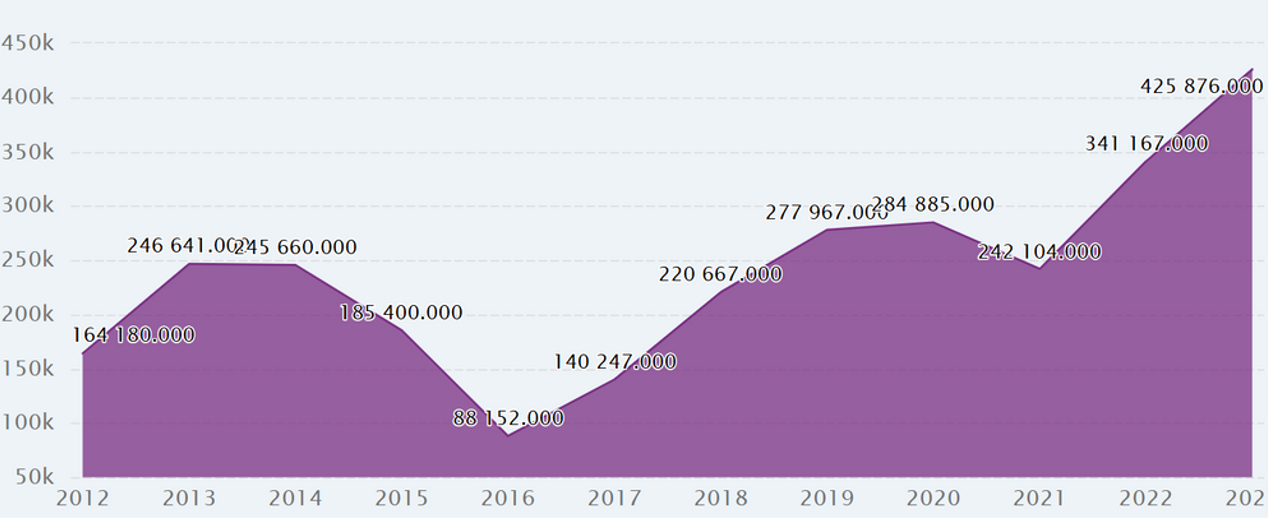
In 2023, the total sales volume of the automobile market in Uzbekistan will reach 456,300 units, and the sales volume of passenger cars will reach 379,000 units, a year-on-year increase of 33%. Among them, sales of domestically produced cars in Uzbekistan exceeded 333,000 units, a year-on-year increase of 25%.
Current situation of new energy vehicle industry in Uzbekistan
Uzbekistan's new energy vehicle market is mainly imported, especially electric vehicle brands from China, South Korea and Europe. Most of these imported models are pure electric vehicles (BEVs) and partially plug-in hybrid vehicles (PHEVs).
According to data from the Customs Committee in 2024, Uzbekistan imported a total of 80235 vehicles in 2024. Its imports of electric and hybrid vehicles exceeded those of traditional gasoline vehicles for the first time, accounting for 55.8%.
Tax policy:In 2022, it will be announced that imported electric vehicles will be exempted from tariffs and consumption taxes (tariffs on traditional fuel vehicles are 30%-50%); before 2030, taxi drivers who transport passengers in electric or hybrid vehicles will be exempted from license fees.

Infrastructure construction:Increase financial support for charging infrastructure construction and encourage investment in charging pile projects. The government plans to increase the number of charging stations to 2500 by 2025.
Localization strategy: Thelocal government requires a localization rate of 60% in the automobile industry by 2030, and provides a five-year tax exemption for CKD/SKD component assembly projects. nbsp;
New energy transformation:Starting from 2025, the import of fuel vehicles below the European standard will be banned, and the import tariff on electric vehicles will be reduced to 0%.
Opportunities for Uzbekistan's automobiles in the overseas market
1. Competitive advantages in the export market The free trade agreement between CIS countries stipulates that Uzbekistan's passenger car export market enjoys a zero-tariff preferential policy, which allows about 95% of its exports to flow to countries such as Russia and Kazakhstan.
2. Political stability Since President Shavkat Mirziyoyev came to power in 2016, the domestic political situation in Uzbekistan has been generally stable, without major social unrest, creating a safe environment for foreign investment to enter. According to the Global Peace Index 2023, Uzbekistan has the highest security rating among Central Asian countries.
3. Advantages of Business Environment According to the World Bank's Business Environment Report, among the 190 economies in the world, Uzbekistan ranks 69th, an increase of 7 places over the previous year. The "2024 Global Innovation Index" released by the World Intellectual Property Organization shows that among 133 countries and regions, Uzbekistan ranks 83rd in the comprehensive index.
Source: Yangtze River Delta new energy vehicle industry offshore base
This article is reproduced from the Yangtze River Delta New Energy Vehicle Industry Offshore Base and is only used for information sharing. If infringement is involved, please contact and delete it. This site does not bear relevant legal responsibilities.

 Online Evaluation
 I am Buyer
 Export Services
 subsites


 023-62852688
  No. 1-1, No. 2899, Longzhou Avenue, Banan District, Chongqing City
 Headquarters


