
 Chinese
 Russian
 Arabic
Armenia is located in the southern Caucasus, at the junction of Europe and Asia. It is a landlocked country. It borders Turkey in the west, Iran in the south, Georgia in the north, and Azerbaijan in the east.
As of 2024, the country's permanent population is 2.9912 million, with Armenians accounting for about 98% of the total population, Christians accounting for about 94% of the total population, and the population rejuvenation rate is about 38%(World Bank, 2024).

Overview of the basic situation in Armenia
Data from the National Statistical Committee of Armenia shows that the total GDP in 2023 will reach US$24.22 billion, a year-on-year increase of 8.7%. Per capita GDP in 2023 will be US$8,168. As of the end of 2023, Armenia's foreign exchange reserves were US$3.6 billion, and remittance income was US$5.69 billion, an increase of 9.6% over the previous year, of which remittance income from Russia accounted for 69.2%.
Scale of digital economy: In 2023, the output value of Armenia's information technology industry will be US$1.14 billion, accounting for 4.7% of GDP.
Main city: The capital Yerevan is the political, economic and cultural center of Eastern Armenia with a population of 1.1063 million. The main economic center cities are Gyumri and Vanazor, which are the second and third largest cities in Armenia respectively.
Natural resources: Armenia is rich in metallic and non-metallic mineral deposits, poor in energy resources, and relies on imports for both oil and natural gas. The main metal deposits are: copper, molybdenum, iron, lead, zinc, gold, silver, antimony and aluminum, etc. At the same time, lithium resources are also abundant.
Power facilities: Armenia is rich in power resources, and power production is its pillar industry and a key project supported and developed by the government. It is the only electricity exporter in the Transcaucasia region and is currently building Armenia-Georgia and Armenia-Iran power transmission and transformation projects, and is implementing a "gas-for-electricity" project with Iran.
Armenian automobile industry foundation and market status
1. Market size and structure:Imports dominate, with used cars accounting for more than 60%.
Market size: As of 2022, there are approximately 500,000 registered vehicles nationwide, and passenger cars account for 80%(approximately 400,000 vehicles). Annual sales of new cars have stabilized at 20,000 units, and the annual trading volume of used cars is about 30,000 units, accounting for more than 60% of total sales. New energy vehicles account for less than 2%.
Brand distribution: International brands dominate the market, with Toyota, Renault and Hyundai accounting for 60% of the total. European luxury brands (BMW, Mercedes-Benz) deploy the high-end market through local dealers (such as ArmAuto), and China brands gradually penetrate through the market based on cost performance.
Consumption characteristics: In price-sensitive markets, used cars have become the mainstream due to low tariffs and high cost performance (the tariff on new imported cars from Armenia is about 15%-20%, and the tariff on used cars aged 5-7 years is 20%). The main consumer groups are low-and middle-income families.
2. Industrial foundation: Local manufacturing gaps, dependence on imports and re-exports
Manufacturing capacity: There are no local vehicle manufacturing companies, and 100% of vehicles are imported, mainly transported through the Port of Batumi in Georgia (accounting for 60% of the total logistics volume) and land in Iran.
Re-export economy: In 2022, taking advantage of the tariff advantage of the Eurasian Economic Union, we will re-export more than 30,000 vehicles to Russia, with an import value of US$800 million (a year-on-year increase of 245%). However, in 2023, due to rising logistics costs (the cost of Iranian routes increased by 30%) and China car companies directly entering the Russian market, business plummeted.
Industrial chain supporting facilities: The automobile aftermarket is mainly for maintenance and modification. 90% of the 7,313 related enterprises in the country are micro enterprises, lacking professional new energy services.
Armenian policy support
Strategic Plan: The "2030 National Development Strategy" clarifies that new energy vehicles account for 15%, provides 30% car purchase subsidies, exemptions from value-added tax and import tariffs, and cities such as Yerevan plan to add 500 new public charging piles by 2025.
Attraction of foreign investment: Free economic zones (such as the Megri Free Trade Zone) exempt new energy companies from profit tax and value-added tax, and encourage battery assembly and the construction of charging piles.
Relevant data:
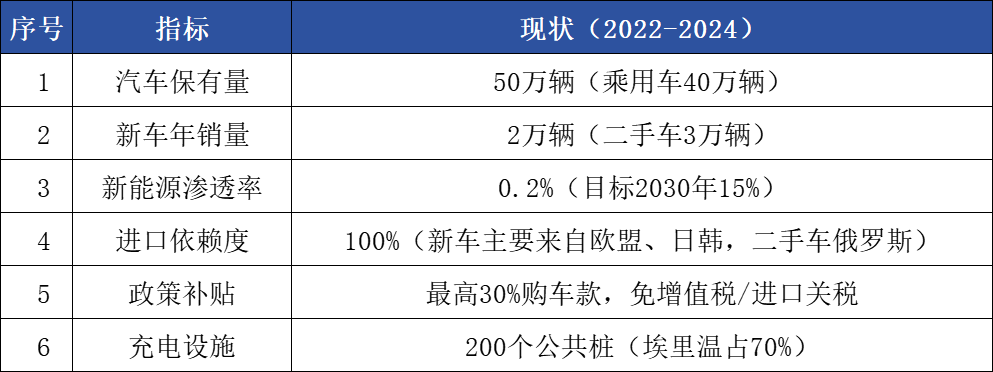
Source: Yangtze River Delta new energy vehicle industry offshore base
This article is reproduced from the Yangtze River Delta New Energy Vehicle Industry Offshore Base and is only used for information sharing. If infringement is involved, please contact and delete it. This site does not bear relevant legal responsibilities.

 Online Evaluation
 I am Buyer
 Export Services
 subsites


 023-62852688
  No. 1-1, No. 2899, Longzhou Avenue, Banan District, Chongqing City
 Headquarters


