
 Chinese
 Russian
 Arabic
Recently, the latest data disclosed by Cui Dongshu, Secretary-General of the Passenger Federation Branch, shows that in 2025, China's automobile exports to Mexico will reach 625,200 units, an increase of 180,500 units over the same period, becoming China's number one export destination, while Russia, once the largest market, dropped to 582,700 units.
This change marks a profound adjustment in China's automobile export pattern. China's automobile exports are shifting from relying on a single market to a diversified layout.
But with the implementation of Mexico's new tariff policy, this export pattern may be reshaped again in 2026.
Reconstruction of export market map
In 2025, China's automobile export landscape will undergo significant changes. Cumulative data for the whole year shows that Mexico surpassed Russia for the first time with an export volume of 625,000 vehicles, becoming the largest destination of China's automobile exports. At the same time, the United Arab Emirates ranked third with 572,000 exports, while the United Kingdom, Brazil and Saudi Arabia ranked fourth to sixth respectively.
From an incremental perspective, the United Arab Emirates will become the fastest-growing market for China's automobile exports in 2025, with an increase of 241,700 vehicles compared with the same period. Mexico ranks second with an increase of 180,500 vehicles.
However, it is worth noting that the Mexican Congress approved a bill on December 10, 2025 that will impose tariffs of up to 50% on imports of automobiles and other goods from China starting in January 2026. Combined with December monthly data, the current export market pattern may be broken again in the near future.
In December, the United Arab Emirates soared to the first place in the month with exports of 106,400 vehicles, a year-on-year increase of 67844 vehicles. The UK ranked third with 54,800 vehicles, a year-on-year increase of 40,800 vehicles.
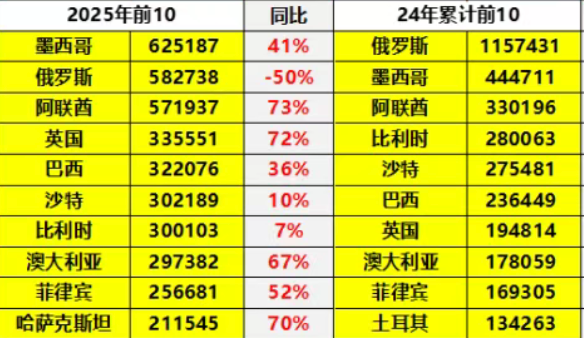
Photo source: Cui Dongshu
Judging from the structure of export markets, the market share of the Middle East, Central and South America and Europe will increase in 2025. Cui Dongshu pointed out in the analysis: "China car companies have increased their awareness of risk prevention in the Russian market. Although domestic sales in Russia have not declined much throughout the year, our exports to Russia will decline significantly throughout 2025."
This change reflects that China auto companies are actively adjusting their global market layout, reducing their dependence on a single market, and enhancing their ability to resist risks. Especially in the face of uncertainty in international trade policies, diversified market strategies are particularly important.
New energy vehicles lead growth
The export performance of China's new energy vehicles will be particularly eye-catching in 2025. The annual export volume will reach 3.43 million units, a year-on-year increase of 70%, and the growth rate is much higher than the 16% in 2024.
The strong growth of new energy vehicles, especially plug-in hybrid models, shows that China's automobile industry has become internationally competitive in electrification technology.
From the perspective of power structure, China's automobile exports are undergoing obvious electrification transformation. In 2025, pure electric vehicles accounted for 28% of total exports, a year-on-year increase of 2 percentage points; plug-in hybrid models accounted for 13%, a year-on-year increase of 8 percentage points; hybrid models accounted for 6%, a year-on-year increase of 2 percentage points. The proportion of pure fuel vehicles dropped to 43%, a year-on-year decrease of 11 percentage points, indicating that China's automobile export structure is rapidly adjusting in the direction of new energy.
The top five markets for new energy vehicle exports in 2025 are Belgium, the United Kingdom, Mexico, Brazil and the Philippines. Exports of new energy vehicles in these markets increased significantly, with Mexico increasing by 140,600 units, United Arab Emirates increasing by 115,200 units, and the United Kingdom increasing by 111,900 units.
Export growth faces global challenges
In terms of average export prices, the average price of China's automobile exports in 2025 will be US$16,000, which will continue to fall from US$19,000 in 2023 and US$18,000 in 2024. Cui Dongshu analyzed that this change is mainly due to the structural impact of the decline in Tesla's export share.
Looking to the future, China's automobile exports still face multiple challenges and opportunities. Changes in international trade policies, economic conditions in target markets and geopolitical factors will all affect the trend of China's automobile exports.
Cui Dongshu believes: "Recently, China's automobile exports have shown ultra-high growth. As long as the international market environment is stable in the future, there will still be huge room for the development of China's automobile exports."
As China's new energy vehicle technology continues to mature and costs continue to decline, the competitiveness of China's automobiles in the global market is expected to further enhance.
In December 2025, China's automobile exports reached 990,000 units, a year-on-year increase of 73% and a month-on-month increase of 23%, showing strong growth momentum, but this momentum will also face the growth challenges of the global market.
According to reports, data from Benchmark Mineral Intelligence, which does research on the electric vehicle supply chain, shows that although global electric vehicle sales will increase by 20% to 20.7 million units in 2025, the growth rate at the end of the year has dropped to the lowest point in nearly two years. Agencies predict that global electric vehicle sales growth will slow down to 15.7% in 2026. The global electric vehicle market is experiencing a significant cooling, and the willingness to purchase pure electric vehicles in all major markets has declined.
Whether the high growth of China's automobile exports is sustainable will depend on whether China automobile companies can continue to provide competitive products and the overall trend of global automobile market demand.
This article is reproduced from First Finance and Economics
author| First Finance Ge Hui
The article is only for information sharing. If it involves infringement, please contact and delete it. This site does not bear relevant legal responsibilities.
 Online Evaluation
 I am Buyer
 Export Services
 subsites


 023-62852688
  No. 1-1, No. 2899, Longzhou Avenue, Banan District, Chongqing City
 Headquarters


