
 Chinese
 Russian
 Arabic
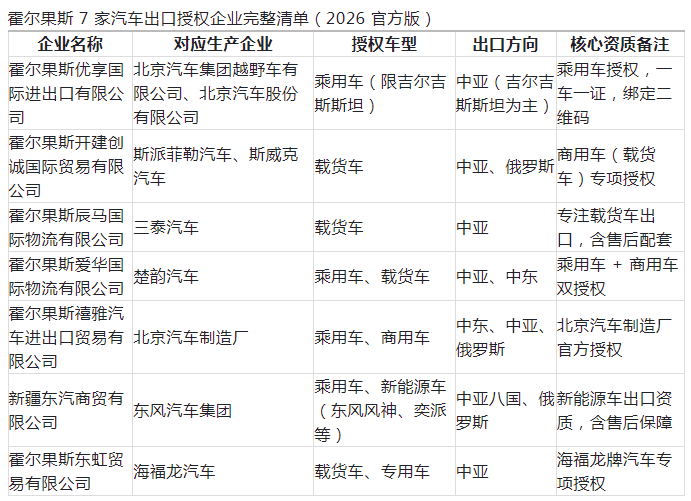
Recently, the 2026 automobile export authorization list has triggered heated discussions in the industry: a total of 1264 companies across the country have obtained export licenses, while Horgos, my country's important port for Central Asia and Europe, has only 7 companies on the list. This huge number makes many practitioners wonder: Even the authorized quota at popular ports is so small, is the automobile export industry no longer able to squeeze in? In fact, the answer is not that simple. Let's slowly talk about it from three popular perspectives: "Why are there so few places?""Are there still opportunities in the industry?" and "What should we do?"
Let's get this clear first: Horgos only authorized seven companies, which is not "industry saturation", but "increased threshold." Starting from 2026, the automobile export industry has ushered in the strictest new regulatory policy in history. The core is to eliminate "small scattered" non-compliant enterprises and promote high-quality development of the industry. In the past, some companies relied on "parallel exports" and "passing off zero-kilometer used cars as new cars" to make quick money, which not only disrupted market order, but also ruined the overseas brand of China cars because they could not keep up with after-sales sales and product quality was not up to standard. Now the New Deal clearly requires that only automobile manufacturers and authorized entities can apply for export licenses, and must also meet rigid requirements such as the number of overseas after-sales outlets and annual export volume. For the export of modified vehicles, true modification certification materials must be submitted. Those that do not comply will not be issued.
The seven authorized companies in Horgos are all "regular troops" that have been screened at various levels. These seven companies are either authorized dealers of large automobile companies or import and export companies with complete logistics and after-sales systems, which can withstand the compliance costs and operational pressures under the New Deal. The total number of 1264 authorized companies across the country may seem quite a lot, but compared with the previous mixed industry pattern, it is actually the result of "careful selection"-eliminating those companies that rely on opportunism and leaving behind real players. Strong, long-term players. Therefore, a small number of places does not mean that there is no market. On the contrary, it means that the industry is "reshuffling and upgrading", eliminating backward production capacity, and freeing up more room for development for high-quality enterprises.
Answer the core question again: Can the automobile export industry still do it in 2026? The answer is: Yes, but you have to "use the right method". Judging from the general trend of the industry, the fundamentals of China's automobile exports are still improving. From January to November 2025, China's automobile exports have reached 6.343 million units, a year-on-year increase of 18.7%, of which new energy vehicle exports have grown by as high as 102.9%. Many institutions predict that China's automobile exports are expected to reach about 8 million units in 2026, with Europe, Southeast Asia and Latin America all major incremental markets. In particular, new energy vehicles have become the core engine of China's automobile exports and are very popular in overseas markets. This is the biggest opportunity.
However, it should be noted that automobile exports in 2026 are no longer the era of "pulling a few cars and selling them overseas can make money". Two core directions must be grasped: one is "compliance" and the other is "ecological going to sea". Compliance is the bottom line. Whether it is a new or used car export, we must strictly abide by the license management regulations. Details such as the "180-day red line" for used car exports, the consistency of license information and motor vehicle registration certificates must not be sloppy, otherwise it is easy to face the risk of detention in Hong Kong, fines or even cancellation of qualifications. "Ecological going to sea" is the key to long-term development. Simply put, it is upgrading from "selling products" to "selling services + building systems". Nowadays, overseas markets not only value the cost performance of cars, but also value full-chain experiences such as after-sales protection, charging facilities, and financial services. Car companies such as BYD and VSMC have already built factories overseas, driving core component companies to go abroad simultaneously, building a localized manufacturing system of "complete vehicle + parts", and building a full life cycle covering sales, after-sales, and charging. Service network, in order to gain a foothold in overseas markets.
Different types of practitioners have different paths to break through. If it is a small and medium-sized enterprise, it is very difficult for it to bear compliance costs alone and build an overseas system. You may wish to try "group heating": cooperate with other companies to purchase testing equipment, share technical personnel, and establish unified testing standards; jointly invest in building after-sales outlets in overseas core markets, stock parts and components, train maintenance personnel, and reduce the operating costs of individual companies. At the same time, you can also find cooperation with large automobile companies to become their authorized dealers, and use the brand influence and overseas channels of large automobile companies to quickly open up the market. If it is a strong company, it can lay out "localized operations" and establish production bases or assembly plants in key overseas markets. By being close to the market, it can reduce logistics costs and deal with trade barriers. For example, although Mexico imposes tariffs on non-FTA countries, if you can build factories locally, you can avoid tariff risks and seize the North American market.
Finally, to sum up: The number authorized by the seven Horgos companies is more like a "sobering agent" for the industry, reminding practitioners to bid farewell to their speculative thinking of the past and embrace a compliant and high-quality development model. In 2026, the automobile export industry will not be "unable to do", but "difficult to mix"-what will be eliminated are speculators who only want to make quick money, and what will be left behind are long-term people who are willing to deepen the market and make good products and services. Doctrine. For companies that are truly powerful, understand compliance, and know how to layout, this is not only a challenge, but also a golden opportunity to seize global market share. After all, the overseas competitiveness of China's automobiles is constantly improving. In the process of transformation from a "exporting country" to a "automobile power," opportunities will always be left for people who work hard.
Source: New energy at the forefront of the sea
[Disclaimer] The content of this website (including pictures and texts) originates from the Internet, and the copyright belongs to the original author. Respect the rights and interests of originality, and select content is only used for information sharing. If copyright disputes are involved, please contact us to handle the deletion in a timely manner.

 Online Evaluation
 I am Buyer
 Export Services
 subsites


 023-62852688
  No. 1-1, No. 2899, Longzhou Avenue, Banan District, Chongqing City
 Headquarters


