
 Chinese
 Russian
 Arabic
In recent years, China's automobile exports have maintained a strong growth trend overall. The regional pattern of automobile exports has been optimized in stages. The Middle East, Africa and Oceania have jointly become the core driving force for export growth. Although wars in the Middle East have continued in recent years and conflicts between Israel and neighboring countries have escalated, China's automobile exports to the Middle East have achieved steady growth relying on regional market dividends, forming development characteristics that suit local needs in dimensions such as export structure, new energy layout, and market competition. Car companies have also completed the leap from product export to brand deep cultivation. This Iranian crisis is complex. Although the obstruction of logistics in the Strait of Hormuz brings short-term cost pressure, I think it is difficult to shake the core advantages of China's supply chain. I believe that the diversified response measures of automobile companies will be more effective than other international automobile companies. At present, I still maintain an optimistic judgment on exports. The short-term interference in the Middle East market has not changed the overall growth trend of China's automobile exports.
1. Regional trends of China's automobile exports
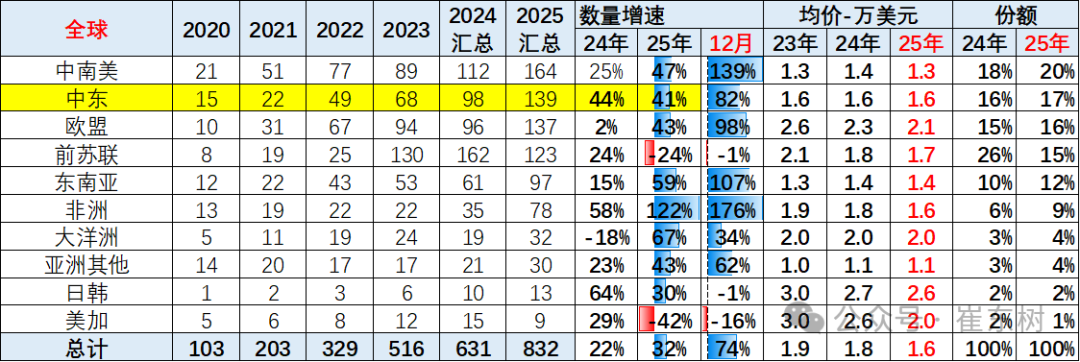
China's automobile exports have generally maintained a strong development trend, with export performance to the three major regions of the Middle East, Africa, and Oceania being particularly outstanding and becoming the core driving force for export growth. In contrast, in the markets of the former Soviet Union, the United States and Canada, affected by multiple factors, China's automobile exports are facing greater market pressure and their performance is relatively weak.
Judging from the evolution of the export pattern, China's core advantageous areas of automobile exports were previously concentrated in Central and South America, while the export performance of other Asian regions such as Southeast Asia and South Asia was also relatively prominent; the current export pattern has completed a phased transformation, and Central and South America still remains strong. The performance of the European market continues to rise, and the two together have become the core growth pole of China's automobile exports.
Judging from recent export data, China's exports to the Middle East, Central and South America and other regions have achieved steady growth compared with the same period last year, and the vitality of the export market has continued to be released; the decline in exports is only concentrated in the former Soviet Union region, and the region's export share has dropped from 26% in 2024 to 15% in 2025, becoming one of the few regions that has lowered export performance. China's automobile exports generally performed strongly, with exports to the Middle East and Africa and Oceania performing relatively well. However, there is greater pressure on exports from the former Soviet Union and the United States and Canada.
2. Trend of China's automobile exports to Middle Eastern countries
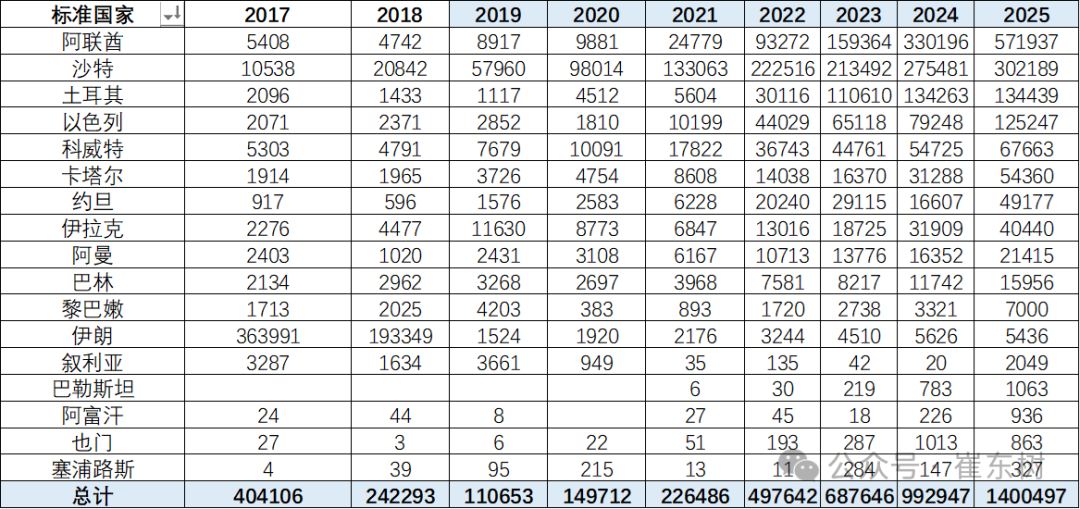
China's automobile exports to different countries in the Middle East show differentiated development characteristics. Relying on the overall market dividend in the Middle East, the export scale of most countries has maintained a growth trend, and some core markets have become key fulcrums for export growth. A few countries are affected by local market policies, changes in consumer demand and other factors, export performance fluctuates slightly.
3. Structure of China's automobile exports to the Middle East in 2025
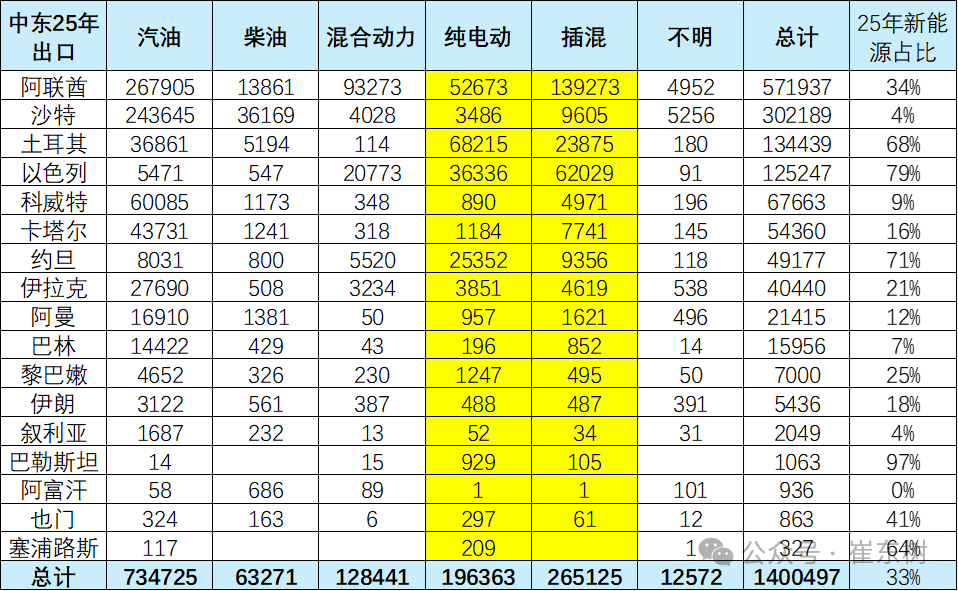
In 2025, China's automobile exports to the Middle East have formed a very distinctive market structure, showing clear distribution characteristics in terms of model categories, brand echelons, price ranges and other dimensions, which not only conforms to the car purchase needs and consumption preferences of consumers in the Middle East, but also In line with the product layout and competitive advantages of Chinese automobiles, the rationality of the export structure has laid a solid foundation for the steady growth of export scale.
4. Analysis of the new energy structure of the Middle East automobile market
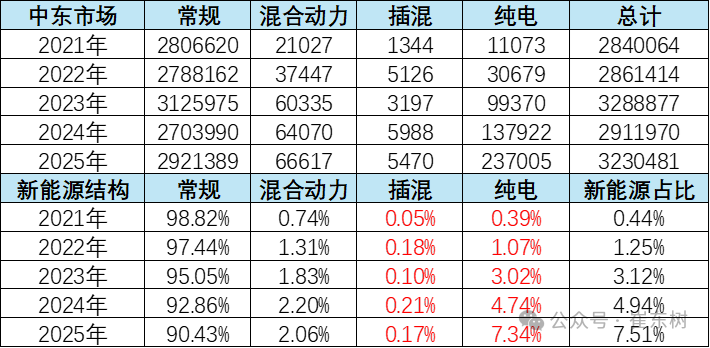
The new energy vehicle market in the Middle East auto market is in a stage of rapid development. The market structure continues to be optimized and upgraded, showing new development characteristics in terms of the proportion of new energy vehicles, power type distribution, and brand competition pattern. Local consumption demand for new energy vehicles has gradually been released, and policy support for the new energy industry has been continuously increased, promoting the development of the new energy market structure in a diversified and high-quality direction, creating a good market environment for China's new energy vehicle exports.
5. Competition structure of the auto market in the Middle East
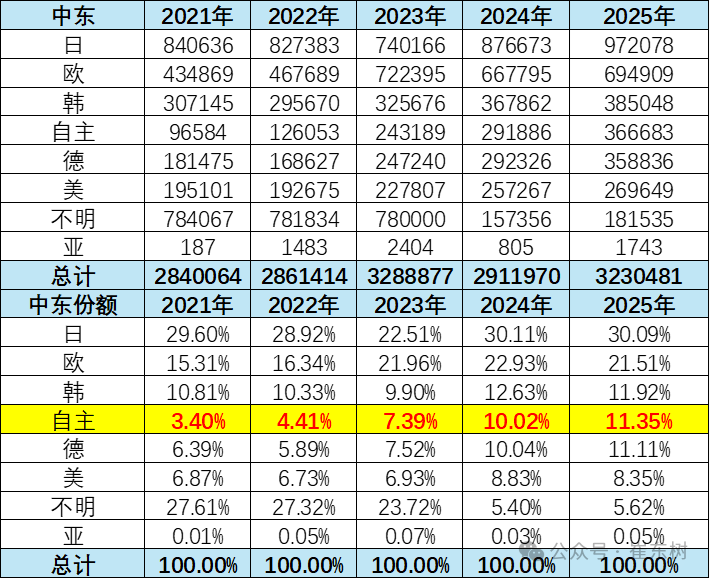
Competition in the automobile market in the Middle East has become increasingly fierce, forming a diversified competitive pattern in which international brands compete with local brands on the same stage, and traditional fuel vehicle brands and new energy brands compete with each other. Traditional European and American car companies have certain advantages based on years of market accumulation, while China car companies rely on core competitiveness such as product cost performance, technological innovation capabilities, and localized service layout, and their market share continues to rise, becoming a leverage for the competitive landscape of the Middle East auto market. An important force in the reconstruction of the Middle East auto market.
6. Competitive performance of countries in the Middle East
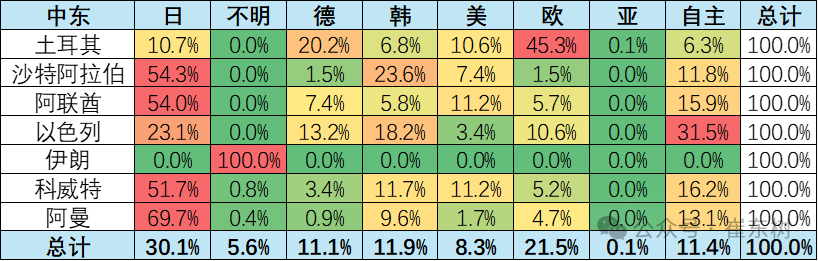
The competitive performance of China automobiles in countries in the Middle East is characterized by "improving overall and leading locally." In most countries in the Middle East, China automobiles have successfully gained recognition from local consumers with their rich model choices, excellent product performance, and highly competitive prices, and their market share has steadily increased; In some core markets, China's leading car companies have ranked among the forefront of sales in the local automobile market, forming strong brand influence. A few niche markets are still in the market expansion stage, and their competitive performance needs to be further improved.
7. Performance of China car companies in the Middle East
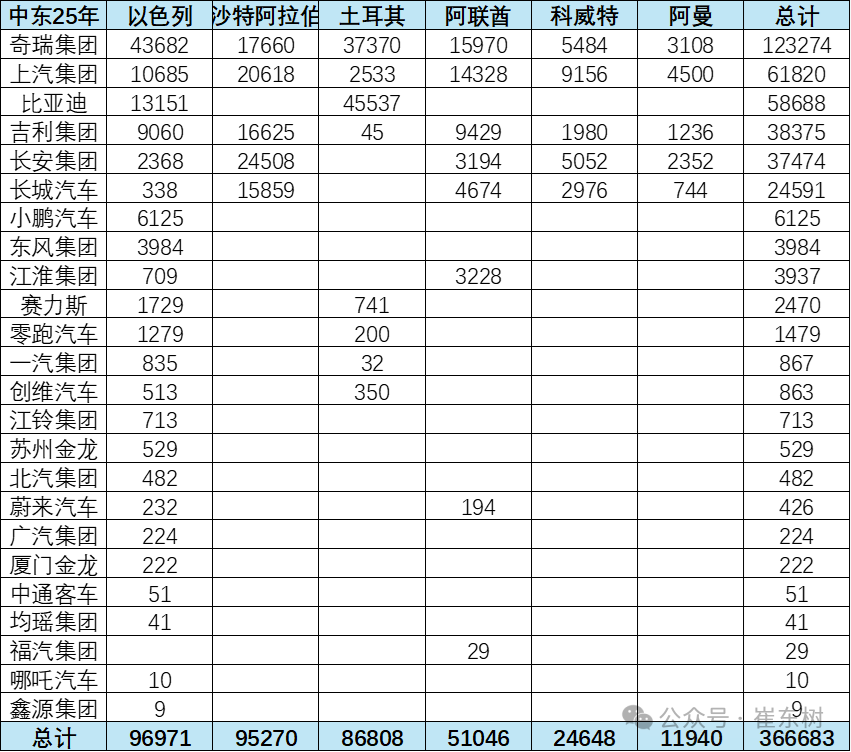
The overall development performance of China automobile companies in the Middle East market is outstanding, and they have completed a phased leap from "product export" to "brand deep cultivation." Leading car companies took the lead in deploying the Middle East market and establishing complete sales channels and after-sales service networks locally. Some companies also promoted localized production and research and development to further enhance brand competitiveness; small and medium-sized car companies relied on characteristic models to segment the market., forming differentiated competitive advantages. Although some automobile companies were affected by local disturbance factors in the Middle East market and their development rhythm slightly adjusted, the overall development trend still maintained steady growth.
8. The value of Middle East exports to China car companies is huge
Against the background of the continued increase in European and American auto trade barriers with China, the Middle East is the most critical incremental and profit market for China auto companies. It has strong consumption power, urgent willingness to transform new energy, and friendly policies. It can not only undertake a large number of exports, but also support brand premiums, becoming a core growth pole to hedge risks in the European and American markets.
The Middle East is located at the hub of Asia, Europe and Africa and has the value of a springboard for globalization. Relying on the advantages of local free trade and re-export, China automobile companies can circumvent some trade barriers through localized production and distribution, radiate to surrounding markets such as Africa and West Asia, and at the same time complete technical verification in extreme environments such as high temperature and sand and dust. Enhance global product competitiveness.
The Middle East is also the strategic fulcrum for China automobile companies to move from product to system. In-depth participation in the construction of local new energy and automobile industry chains can not only achieve market diversification and reduce geographical risks, but also use capital and industrial cooperation to promote high-end brands and build a solid foundation for safety and profitability for long-term global layout.
9. The short-term Middle East crisis will have little impact-the more storms, the more expensive the fish are.
In the short term, the obstruction of logistics in the Strait of Hormuz and the sharp increase in freight and insurance costs will significantly reduce the export profits of China car companies, but it is still not enough to offset the core cost advantages of China's vehicle supply chain in terms of scale, supporting facilities and efficiency, and will only eat up part of the original profit margin. In particular, China's exports are huge and export flexibility is high. Coupled with the huge fleet size of mainstream automobile companies, the cost advantage is more obvious.
In the medium term, rising costs will accelerate the differentiation of sea-going models: low-profit models will have the greatest export pressure, and high-value new energy models will be more resilient; car companies will switch to KD spare parts export + localized assembly faster, shifting from "complete vehicle direct transportation" to "Regional manufacturing", increase the construction of overseas logistics transfer platforms, and avoid logistics risks across the Strait from the root cause.
In the long run, continued high logistics costs will not weaken the advantages of China car companies, but will force the supply chain to be more stable: diversified routes, regional stocking, and local factories will be promoted simultaneously, ultimately making the layout of China car companies in the Middle East more risk resistant, closer to the market, and further strengthening their overall competitiveness.
10. Judgment on future Middle East exports
Current view: Maintain overall export optimism. In its public judgment at the beginning of 2026, the Passenger Federation Branch still expected that automobile exports would maintain medium-to-high growth of more than 10% throughout the year, and did not issue a separate official statement to lower expectations for the Middle East market. The core logic is that the Middle East is a strategic market with high profits and high growth. Short-term logistics shocks can be hedged through route adjustments, KD spare parts exports, localized production, etc., and long-term demand and policy dividends are still there.
The obstruction of the Strait of Hormuz has led to soaring freight and insurance costs and lengthening delivery cycles, which mainly affects the pace of short-term direct vehicle transportation. However, China car companies have responded quickly: turning to alternative ports such as Oman and Jordan, increasing China-Europe freight trains + land transport multimodal transport, accelerating the commissioning of KD factories in Saudi Arabia, Egypt and other places, and compounded by the rigid demand for new energy and commercial vehicles in the Middle East. The overall export resilience is stronger than expected.
Possibility of subsequent downward adjustments: depends on the duration of the situation
Since we do not export complete vehicles to Iran in a standardized manner, we will have no impact on the apparent exports of core countries. If the Strait blockade lasts for more than three months and the Red Sea route continues to be interrupted, resulting in large-scale delivery delays and order cancellations in the core markets of the Middle East (United Arab Emirates, Saudi Arabia), we may lower our Middle East export forecast after quarterly data tracking. Considering that the armed conflict between Israel and surrounding areas was also severe in the early period last year, it did not significantly affect China's car exports to Israel. At present, observation and dynamic evaluation are still the main focus, and no adjustment of the annual total will be made for the time being.
Source: Cui Dongshu
[Disclaimer] The content of this website (including pictures and texts) originates from the Internet, and the copyright belongs to the original author. Respect the rights and interests of originality, and select content is only used for information sharing. If copyright disputes are involved, please contact us to handle the deletion in a timely manner.

 Online Evaluation
 I am Buyer
 Export Services
 subsites


 023-62852688
  No. 1-1, No. 2899, Longzhou Avenue, Banan District, Chongqing City
 Headquarters


