
 Chinese
 Russian
 Arabic
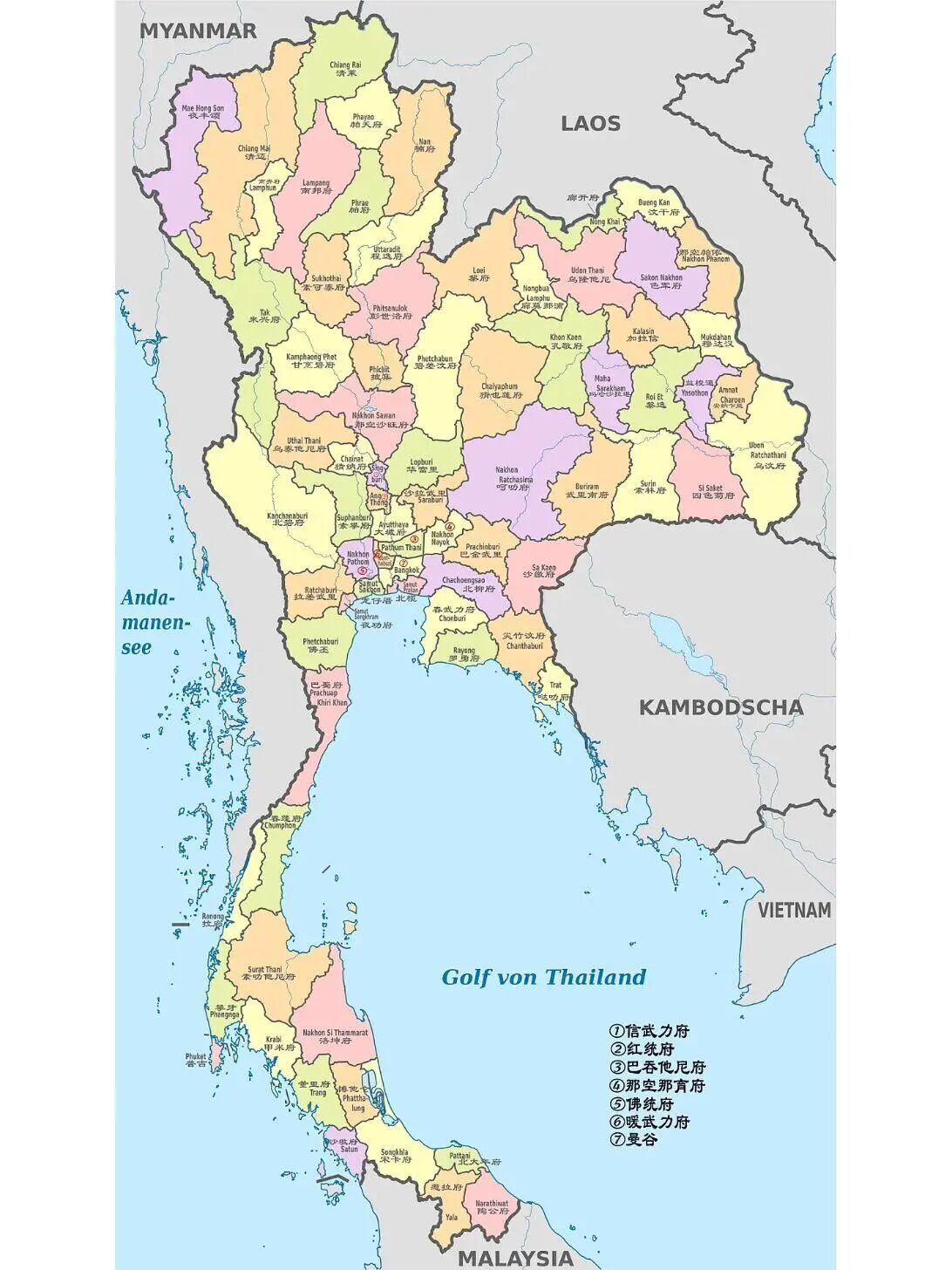
Thailand is located in the south-central part of the Indochina Peninsula, bordering the Gulf of Thailand in the Pacific Ocean to the southeast and the Andaman Sea in the Indian Ocean to the southwest. It borders Myanmar in the west and northwest, Laos in the northeast, Cambodia in the east, and Malaysia in the south.
With a land area of 513,000 square kilometers, it is second only to Indonesia and Myanmar in Southeast Asia. The total population of Thailand is 67.9 million (as of January 2024). There are more than 30 ethnic groups in the country. The Thai are the main ethnic group, and the rest are Lao, Chinese, Malay, etc. Thai is the national language, and the official languages are Thai and English.
Thailand's natural resources mainly include potassium salt, tin, tungsten, antimony, lead, etc., as well as barite, gemstones, oil, natural gas, etc.
Overview of Thailand's economy
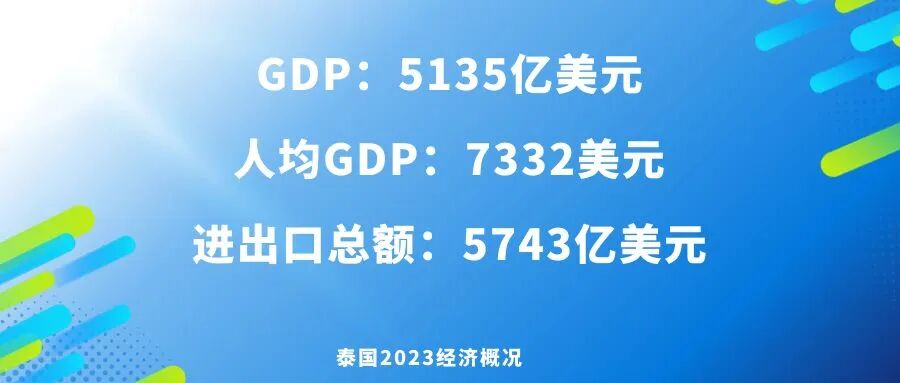
In 2023, Thailand's GDP will exceed US$500 billion, making it the second largest economy in ASEAN. Thai goods enjoy zero-tariff treatment in ASEAN countries and have strong radiation capabilities to neighboring countries.
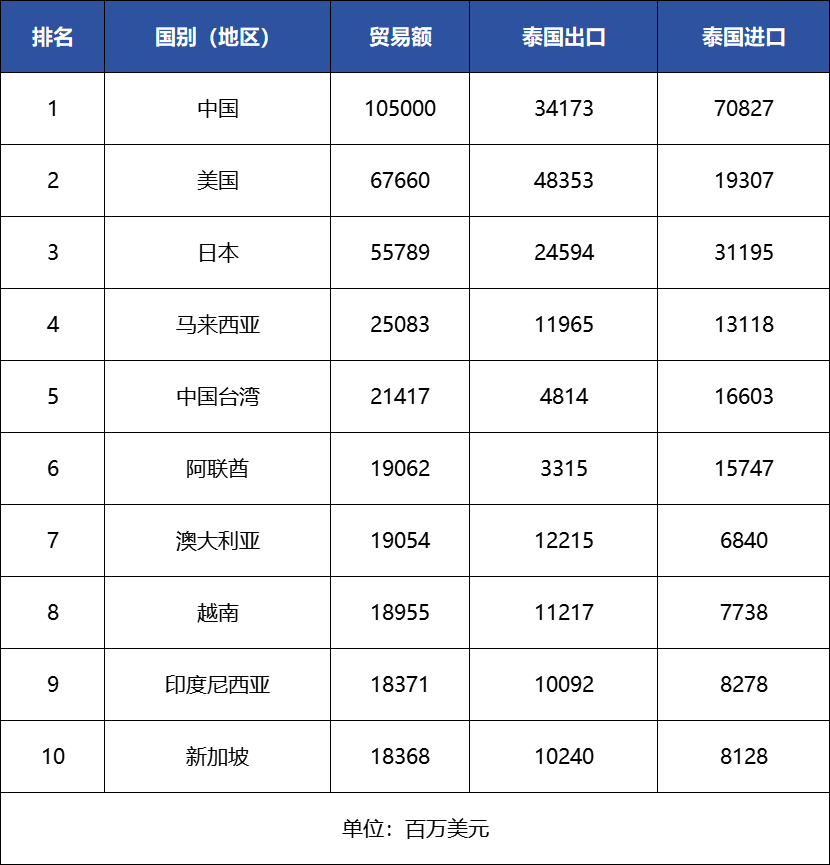
In 2023, Thailand's total foreign trade volume will be US$574.3 billion, of which exports will be US$284.6 billion, imports will be US$289.7 billion, and a trade deficit of US$5.1 billion.
Top 10 Thailand's major trading partners in 2023
Thailand's automobile market
Thailand's automobile industry has made remarkable achievements in development over the years. In 2022, Thailand will rank 10th in global automobile production. In 2023, Thailand's automobile exports will reach 1.1175 million units, setting a new high in five years. Thailand's automobile exports will maintain a growth trend in 2022 and 2023, and decline in 2024. In 2024, Thailand's automobile production will reach 1.47 million units, down 20% year-on-year; automobile sales will reach 460,000 units, down 33% year-on-year; automobile exports will reach 1.01 million units, down 12% year-on-year.
Current situation of Thailand's new energy vehicle industry
Against the background of declining overall sales of Thai cars, the growth of electric vehicle sales has become a bright spot. In the first three quarters of 2024, total passenger car sales in Thailand fell by 23% compared with the same period last year. By model, gasoline-powered vehicles still account for more than 90% of Thailand's car sales, but as the government continues to promote the development of electric vehicles and provide subsidies to car buyers and manufacturers, the proportion of gasoline-powered vehicles sales is expected to continue to decline.
In this context, electric vehicles have become the only bright spot, and most of this growth figure is the contribution of China car companies. According to previous Thai auto media reports, in 2023, the cumulative sales of pure electric vehicles in Thailand exceeded 76,300 units, a surge of 66,600 units compared with 2022, an increase of 684%, and the proportion of pure electric vehicle sales increased to 12%.
Thailand January 2025 China Brand
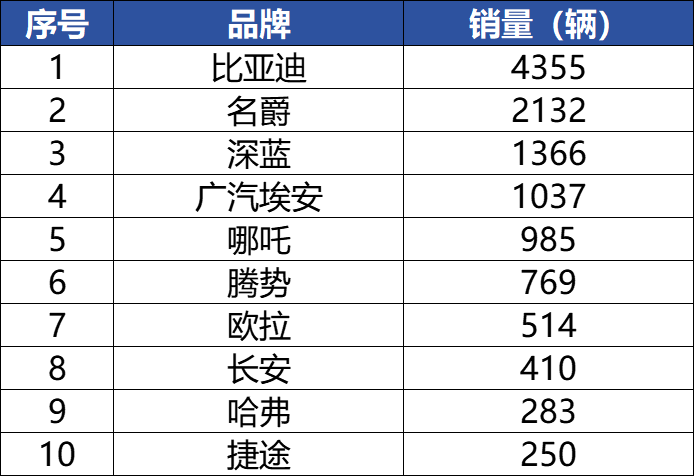
The performance of China brands in the Thai market is beginning to gradually emerge, especially brands such as BYD, MG and GAC Aian, with sales of 4,355 vehicles, 2,132 vehicles and 1,037 vehicles respectively.
1. Construction of infrastructure facilities Thailand has proposed the "30·30" policy, which specifically means that by 2030, 30% of the total number of vehicles produced in Thailand will be zero-emission vehicles, and by 2035, the production of zero-emission vehicles will reach 1.35 million. To this end, before 2025, Thailand will allocate 35 billion baht to purchase land, build factories and charging facilities for tram production.
2. Car purchase subsidies During the period from 2024 to 2027, consumers who purchase new energy vehicles can receive a subsidy of up to 100,000 baht per vehicle. For electric commercial vehicles, the Thai government has also supported relevant companies through tax relief measures. Companies that purchase electric commercial vehicles produced or assembled in Thailand can enjoy tax exemptions corresponding to twice the actual selling price of the vehicle; companies that purchase imported electric commercial vehicles can also enjoy tax exemptions corresponding to 1.5 times the actual selling price of the vehicle.
3. Tax incentives During the period from 2024 to 2025, import tariffs on new energy vehicles selling for no more than 2 million baht will be reduced by 40%.
The consumption tax on imported new energy vehicles selling for no more than 7 million baht will be reduced from 8% to 2%, and road taxes and import tariffs will be exempted differently based on different models of trams.
Opportunities for Thai automobiles to go to sea
1. In terms of brand building, Japanese brands have been deeply involved in the Thai market for many years and have a complete after-sales service network. In contrast, China brands need to make more efforts to strengthen brand building, enhance brand image, accelerate the construction of after-sales service networks, and improve service quality.
2. Impact of cultural differences There are large cultural differences between China and Thailand. China car companies need to have a deep understanding of the needs and preferences of Thai consumers. In terms of product design, it should be adjusted and optimized according to the aesthetics and car habits of Thai consumers.
3. Impact of policy uncertainty Although the Thai government's policies have a lot of support for the development of new energy vehicles, policy changes may have an impact on the investment and operation of China car companies. China car companies need to pay close attention to policy trends, make risk assessments and response plans, and ensure timely responses when policy adjustments are made. At the same time, we must strictly abide by Thai laws and regulations to avoid unnecessary losses caused by legal issues.
Source: Yangtze River Delta new energy vehicle industry offshore base
This article is reproduced from the Yangtze River Delta New Energy Vehicle Industry Offshore Base and is only used for information sharing. If infringement is involved, please contact and delete it. This site does not bear relevant legal responsibilities.

 Online Evaluation
 I am Buyer
 Export Services
 subsites


 023-62852688
  No. 1-1, No. 2899, Longzhou Avenue, Banan District, Chongqing City
 Headquarters


