
 Chinese
 Russian
 Arabic
The traditional automobile industry landscape has been subverted. With the release of statistical bulletins and other official information from various places, the list of the top ten cities in automobile production in 2025 has also been released-Chongqing has returned to the number one city in automobile production in the country, Hefei and Wuhu compete for the top three, and a number of emerging automobile cities are rapidly emerging.
Chongqing ranks first
On May 10, Guangzhou released the 2025 statistical bulletin, showing that in 2025, Guangzhou produced 2.4096 million vehicles, a decrease of 5.1%. This output figure is 378,100 less than Chongqing. At the beginning of this year, Chongqing announced that it would return to "China's No. 1 Automobile City" with 2.788 million vehicles.
In fact, in 2024, Chongqing's automobile production will already surpass Guangzhou. That year, Guangzhou's automobile output was 2.5398 million units; Chongqing's automobile output was 2.5401 million units. However, Shenzhen's automobile production that year was 2.9353 million units. Under the statistics at that time, Chongqing surpassed Guangzhou and failed to become first.
In recent years, the National Bureau of Statistics has promoted the reform of "equal emphasis on law and industry", that is, equal emphasis on statistical reform for legal entities and industrial activity units. Starting from 2025, the National Bureau of Statistics will adjust the statistical method of automobile production from "location of enterprise legal person" to "statistics of production place". Therefore, the output of some BYD branches is no longer included in Shenzhen and Guangzhou.
At present, Shenzhen has not announced its 2025 statistical bulletin and its 2025 automobile production. However, in 2025, the automobile output in Guangdong Province will be 3.0402 million units, leaving 632,400 units after deducting Guangzhou's output. Therefore, Shenzhen's automobile output in 2025 should not exceed this figure, with Chongqing and Guangzhou ranking among the top two in the country.
Chongqing's overtaking Guangzhou is the result of the electric wave of the automobile industry. Chongqing and Guangzhou, both important towns in the traditional automobile industry, have experienced the impact of electrification. However, Chongqing has transformed rapidly. The surge in the production of new energy vehicles represented by Celis has driven the transformation of the entire industry. On the contrary, Guangzhou's transformation has been slower.
The Chongqing City Bureau of Statistics explained that in 2025, the added value of the intelligent networked new energy vehicle industry cluster will increase by 13.4% compared with the previous year, and its contribution rate to the city's designated industries will be 60.9%. Among them, the added value of new energy vehicles increased by 28.9%. Key automobile companies represented by Celis and Chang 'an Series have launched a variety of new energy models, which have high market popularity and good sales, driving the simultaneous growth of supporting enterprises and becoming the main support for the steady growth of the intelligent networked new energy vehicle industry cluster.
In fact, in the first half of the transformation of the new energy vehicle industry, with new energy vehicles as a breakthrough, a number of emerging automobile cities rose rapidly, subverting the original pattern. Changchun, Wuhan, Shanghai, Chongqing, Guangzhou, Beijing, etc. are all traditional automobile cities, but now cities such as Hefei, Wuhu, Xi'an and Zhengzhou have emerged, occupying the position of traditional automobile cities.
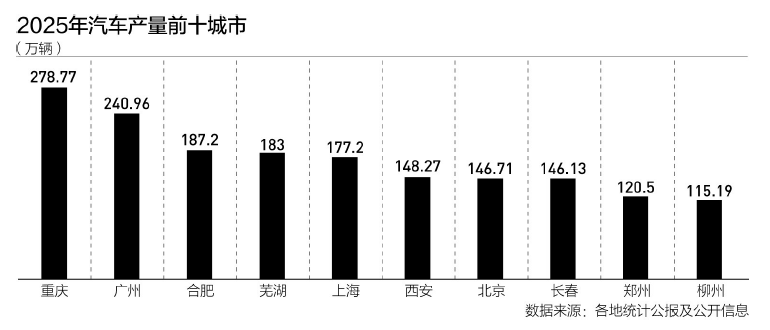
According to statistical bulletins or other official data released by various places, the top ten cities in automobile production last year were Chongqing, Guangzhou, Hefei, Wuhu, Shanghai, Xi'an, Beijing, Changchun, Zhengzhou and Liuzhou, with output of 2.7877 million, 2.4096 million, 1.872 million, 1.83 million, 1.772 million, 1.4827 million, 1.4671 million, 1.4613 million, 1.205 million, and 1.1519 million respectively. In addition, Qingdao (1.022 million vehicles) and others also exceeded one million vehicles. Xinxing Automobile City has already played the leading role.
Although Chongqing and Guangzhou rank in the top two with an absolute advantage of more than 2 million vehicles, they also face competitive pressure from the two brothers in Anhui.
According to the statistical bulletin, in 2025, Hefei will produce 1.872 million vehicles, including 1.371 million new energy vehicles. Wuhu has not released a statistical bulletin yet. However, in March this year, Ningbo, secretary of the Wuhu Municipal Party Committee, said in an interview with the media that the annual output of automobiles was 1.83 million, an increase of 10.7%, accounting for nearly 50% of Anhui's total.
The output of Hefei and Wuhu is roughly the same. Driven by the double-headed, Anhui's automobile output continues to soar. From 2022 to 2024, Anhui's automobile output is 1.7469 million, 2.088 million and 2.6203 million respectively, ranking seventh, fourth and second respectively in the country. In 2025, Anhui's automobile production will top the country's largest automobile production province with 3.6865 million units.
Enter the second half of the competition
On May 15, Xi'an released the 2025 statistical bulletin. The communiqué shows that in 2025, Xi'an's automobile output will be 1.4827 million, down 2.1%; of which, the output of new energy vehicles will be 1.0514 million, down 6.5%. This former "No. 1 city of new energy vehicles" is facing growth bottlenecks.
Data from the Shaanxi Automobile Manufacturers Association show that in 2025, both Xi'an BYD and Xi'an Geely will see a decline in production and sales: Xi'an BYD produced and sold 968,100 vehicles, a year-on-year decrease of 9.85%; Xi'an Geely produced and sold 304,100 vehicles, a year-on-year decrease of 3.54%. Among them, the production and sales of new energy vehicles were 19,600 vehicles, a year-on-year decrease of 57.57%.
Since the beginning of this year, a cold current has hit Xi'an's automobile industry. In the first quarter of this year, the added value of industries above designated size in Xi'an fell by 4.7% year-on-year. Among them, the automobile manufacturing industry fell by 11.2%. In the first quarter of this year, Shaanxi's automobile output was 219,900 units, a decrease of more than 50% compared with 452,500 units in the first quarter of 2025.
In fact, the new energy vehicle industry has also become fiercely competitive, and the industry structure will continue to evolve. Feng Lei, president of the Firestone Creative Industry Research Institute, told First Finance and Economics that the automobile industry has switched from "incremental penetration" to "stock substitution" stage, and the national market has entered "stock strangulation".
This fierce competition will continue to have an impact on fuel vehicles. Taking Chongqing as an example, on May 19, the Chongqing City Bureau of Statistics released data showing that from January to April, the added value of the automobile industry increased by 2.2%, but automobile output fell by 7.5%, of which new energy vehicles increased by 4.0%. This shows that Chongqing's fuel vehicle production capacity continues to be affected.
Not only that, the second half of the transformation of the new energy vehicle industry has also arrived. After electrification, there will be another competition for intelligence. Feng Lei said that from 2025 to 2026, the penetration rate of new energy vehicles in China has exceeded 50%, and the industry has entered the "knockout" stage. Intelligence is a new variable, and all cities will return to the same starting line.
On May 11, the website of the Xi'an City released the "Implementation Plan for Xi'an City to Promote the High-Quality Development of the Intelligent Connected New Energy Vehicle Industry Chain", proposing to strive to build Xi'an into a national first-class intelligent connected new energy vehicle production, research and development and application base by 2030, with the output value of the industrial chain exceeding 310 billion yuan.
Among them, by 2030, the city's output of intelligent networked new energy vehicles will exceed 1.55 million, ranking among the top in the country. The output value of the city's power battery industry reached 40 billion yuan, ranking among the forefront of the industry. Traditional parts and components companies will transform and upgrade, develop new technologies and new products, expand the magnitude of products, and increase the share of complete vehicle supporting equipment. By 2030, the output value of traditional parts and components in the city will exceed 35 billion yuan. Focus on core areas such as smart cockpits, lidar, vehicle gauge chips, motor electronic controls, fuel cell stacks and their key materials, and lay out a number of key projects. By 2030, the output value of new parts and components in the city will exceed 18 billion yuan.
Feng Lei believes that China's automobile industry has now completely switched from "incremental penetration" to "stock substitution." Under the multiple pressures of subsidy receding, price wars intensified and intelligent reshuffle, the entire industry is undergoing a life-and-death transformation from scale expansion to value improvement. Only companies and regions that have completed this transition can go further in this knockout match.
Source: Author| First Finance and Economics Li Xiuzhong
Statement: The copyright belongs to the original author. If you believe that content is infringing, please contact us.

 Online Evaluation
 I am Buyer
 Export Services
 subsites


 023-62852688
  No. 1-1, No. 2899, Longzhou Avenue, Banan District, Chongqing City
 Headquarters


